Crochet guide
How to crochet a dress
A crochet dress is a top with a skirt: either a top made longer, or a bodice with a skirt that begins at the waist. The one below is worked in one piece from the neck down, so there is nothing to sew and you can try it on at every stage. Its counts are given in nine sizes, and the sums for another yarn or another body follow.
On this page 15 parts
- Before you start
- 1. Measure and choose a size
- 2. Make a swatch, then weigh and pull it
- 3. Begin at the neck
- 4. Work the yoke
- 5. Try it on
- 6. Divide it at the underarms
- 7. Work down to the waist
- 8. Gather the skirt
- 9. Work the skirt
- 10. Work the sleeves and the neck
- The sums for another dress
- Change it
- If it goes wrong
- Where to go next

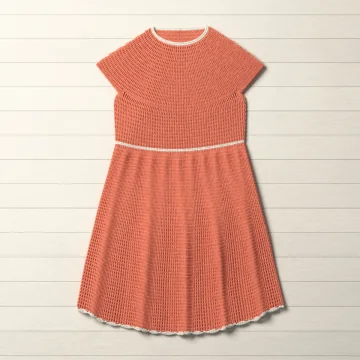
A is the yoke, B a sleeve, C the body, W the waist and D the skirt. A smock like this is loose at the waist and full below it.
Before you start
You need: light yarn (weight 3), a 4.5 mm (7) hook, a yarn needle, scissors, a tape measure and stitch markers.
Know first: the double crochet (UK treble), the single crochet (UK double crochet; United Kingdom patterns use the other names), joined rounds, closed with a slip stitch, and the increase, two stitches in one.
The rounds are those of our summer smock dress, size M; its page has nine sizes to print. In the lines ch is chain, dc double crochet, sc single crochet, sl st slip stitch, st stitch and Rnd round. The chain at the start of a round is not a stitch: the first stitch goes in the stitch at its foot. Square brackets hold what is repeated. The right side always faces you; the work is never turned.
1. Measure and choose a size
Take four measures: the bust at its fullest, the waist, the hips, and the length from the bone at the back of the neck to where the hem should be. Choose by the bust. Take the row nearest to yours. This dress is 2 in (5 cm) larger than the bust.
| Size | Bust; finished | Yoke: rounds, stitches | Waist, then skirt | Yarn, an estimate |
|---|---|---|---|---|
| XS | 29 in (73.5 cm); 31 in (78.5 cm) | 16 rounds, 188; 40 a sleeve | 124, then 186 | 1,475 yd (1,349 m) |
| S | 33 in (84 cm); 35 in (89 cm) | 17 rounds, 208; 42 a sleeve | 140, then 210 | 1,655 yd (1,513 m) |
| M | 37 in (94 cm); 39 in (99 cm) | 18 rounds, 228; 44 a sleeve | 156, then 234 | 1,860 yd (1,701 m) |
| L | 41 in (104 cm); 43 in (109 cm) | 19 rounds, 252; 48 a sleeve | 172, then 258 | 2,035 yd (1,861 m) |
| 1X | 45 in (114.5 cm); 47 in (119.5 cm) | 20 rounds, 284; 56 a sleeve | 188, then 282 | 2,265 yd (2,071 m) |
| 2X | 49 in (124.5 cm); 51 in (129.5 cm) | 21 rounds, 308; 62 a sleeve | 204, then 306 | 2,445 yd (2,236 m) |
| 3X | 53 in (134.5 cm); 55 in (139.5 cm) | 22 rounds, 332; 66 a sleeve | 220, then 330 | 2,650 yd (2,424 m) |
| 4X | 57 in (145 cm); 59 in (150 cm) | 23 rounds, 364; 74 a sleeve | 236, then 354 | 2,880 yd (2,633 m) |
| 5X | 61 in (155 cm); 63 in (160 cm) | 24 rounds, 388; 78 a sleeve | 252, then 378 | 3,080 yd (2,816 m) |
Every size is about 40 to 43½ in (101 to 110.5 cm) long and begins at the same neck, 22 in (56 cm) around. The yarn is an estimate, for the pattern's two colors together. Measuring for crochet clothes shows each measure, and the size chart has typical bodies.
2. Make a swatch, then weigh and pull it
Chain 26, begin in the third chain from the hook and work 13 rows of 24 double crochet. You want 16 stitches and 8½ rows in 4 in (10 cm). Wash it and let it dry. Then pull it lengthwise: a dress is long, and its own weight does the same. If the swatch grows, plan a few rounds fewer in the skirt.
How heavy will it be? Divide the yarn by the length of one ball and multiply by the weight of the ball. At 1,860 yd (1,701 m), with balls of 250 yd (229 m) and 3½ oz (100 g): 1,860 ÷ 250 = 7.4 balls, about 26 oz (740 g).
3. Begin at the neck
Chain 88, loosely, for it has to go over the head. Close it with a slip stitch in the first chain; do not let it twist. Put a marker at the join: it is the middle of the back.
Rnd 1: Ch 2; dc in each ch around; join with sl st in first dc (88 dc).
Rnd 2: Ch 2; [dc in next 5 sts, 2 dc in next st] 10 times, [dc in next 6 sts, 2 dc in next st] 4 times; join with sl st in first dc (102 dc).
Rnd 3: Ch 2; dc in next 4 sts, [2 dc in next st, dc in next 6 sts] 10 times, [2 dc in next st, dc in next 7 sts] 3 times, 2 dc in next st, dc in next 3 sts; join with sl st in first dc (116 dc).
4. Work the yoke
An increase round adds 14 stitches, spread evenly. Round 2, for instance: 88 ÷ 14 is a little over 6, so there is an increase in every 6th stitch ten times and in every 7th four times: 10 × 6 + 4 × 7 = 88. The sum is the same in every later one, a stitch farther apart each time: 102 is 10 × 7 + 4 × 8. The rounds that are not in the table are even. The increase rounds begin at another place each time, so that the increases do not stand in lines: work a few plain stitches before the first one.
| After | Stitches |
|---|---|
| Rounds 2 and 3 | 102, then 116 |
| Rounds 5 and 6 | 130, then 144 |
| Round 8 | 158 |
| Rounds 10 and 11 | 172, then 186 |
| Rounds 13 and 14 | 200, then 214 |
| Round 16 | 228 |
Work to round 18 and count 228. Put a marker after every 20 stitches while you count.
The other sizes. All begin with 88. The difference between one count and the next is how many increases to spread: in XS round 2 adds 12, and 88 ÷ 12 is a little over 7.
| Size | Increase rounds | Stitches after each |
|---|---|---|
| XS | 2, 3, 5, 6, 8, 9, 11, 12, 14 | 100, 110, 122, 132, 144, 154, 166, 176, 188 |
| S | 2, 3, 5, 7, 8, 10, 12, 13, 15 | 102, 114, 128, 142, 154, 168, 182, 194, 208 |
| M | 2, 3, 5, 6, 8, 10, 11, 13, 14, 16 | 102, 116, 130, 144, 158, 172, 186, 200, 214, 228 |
| L | 2, 3, 5, 7, 8, 10, 12, 13, 15, 17 | 104, 120, 138, 154, 170, 186, 202, 220, 236, 252 |
| 1X | 2, 3, 5, 6, 8, 10, 11, 13, 15, 16, 18 | 106, 124, 142, 160, 178, 194, 212, 230, 248, 266, 284 |
| 2X | 2, 3, 5, 6, 8, 9, 11, 13, 14, 16, 17, 19 | 106, 124, 144, 162, 180, 198, 216, 234, 252, 272, 290, 308 |
| 3X | 2, 3, 5, 7, 8, 10, 12, 13, 15, 17, 18, 20 | 108, 128, 148, 170, 190, 210, 230, 250, 272, 292, 312, 332 |
| 4X | 2, 3, 5, 6, 8, 10, 11, 13, 14, 16, 18, 19, 21 | 110, 130, 152, 172, 194, 216, 236, 258, 280, 300, 322, 342, 364 |
| 5X | 2, 3, 5, 7, 8, 10, 12, 13, 15, 17, 18, 20, 22 | 112, 134, 158, 180, 204, 226, 250, 272, 296, 318, 342, 364, 388 |
The rest of the yoke's rounds are even, to the number of rounds in step 1.

This is the yoke from above: N is the neck, A the back, with the dark mark where rounds begin, B the two sleeves and C the front. In size M they have 70, 44, 44 and 70 stitches.
5. Try it on
The yoke should lie flat on the shoulders and reach the underarm, about 8½ in (21.5 cm) below the neck. Too short: work another even round or two. Take it off before step 6.
6. Divide it at the underarms
In round 19 you skip the stitches of each sleeve and chain 8 over the gap, the short row in the picture. Put a marker in the first and the last chain: the next round works one stitch into each of the 8.
- Rnd 19: Ch 2; dc in next 35 sts, ch 8 (underarm), skip next 44 sts (one sleeve), dc in next 70 sts, ch 8 (underarm), skip next 44 sts (one sleeve), dc in next 35 sts; join with sl st in first dc (140 dc, 16 ch).

Count: 35 + 8 + 70 + 8 + 35 = 156, which is 39 in (99 cm) around.
The other sizes. This is the round after your last yoke round. Take both sleeves from the yoke's count: half of what is left is the front, and a quarter is each half of the back. In L that is 252 − 96 = 156: 39, 78 and 39. Chain 8 at each underarm up to 1X, and 10 from 2X on.
7. Work down to the waist
Rnds 20 to 31: Ch 2; dc in each st around; join with sl st in first dc (156 dc).
Rnds 32 to 33: Ch 1; sc in each st around; join with sl st in first sc (156 sc).
Rounds 32 and 33 are single crochet, a firm line at the waist. In the pattern these two, the edge of the hem and the neckband are in the second color; in one color go on. In every size the body has 12 even rounds and then these two. Try it on before the two. If the waist sits too high or too low, work more or fewer of the even rounds.
8. Gather the skirt
One round turns 156 into 234: one stitch, then two in one stitch, all around. Three stitches now stand on every two of the waist, so the skirt falls in folds. In another size repeat the brackets half as many times as you have stitches.
Rnd 34: Ch 2; [dc in next st, 2 dc in next st] 78 times; join with sl st in first dc (234 dc).

9. Work the skirt
Rnds 35 to 87: Ch 2; dc in each st around; join with sl st in first dc (234 dc).
That is 53 even rounds in every size, about 25 in (63.5 cm). Measure your length from the neck and stop where you like: 17 rounds are 8 in (20 cm). Round 88 is an edge of shells, 5 double crochet in one stitch between single crochet, 39 times around. A shell takes 6 stitches, so it goes around as many times as a sixth of your skirt.
- Rnd 88: Ch 1; [sc in next st, skip next 2 sts, 5 dc in next st, skip next 2 sts] 39 times; join with sl st in first sc (39 sc, 195 dc).
10. Work the sleeves and the neck
With the right side facing you, join the yarn in the middle of an underarm. Work one double crochet in the free side of each of the 8 underarm chains (10 from 2X on), the side the body left empty, and one in each of the 44 stitches of the sleeve: 52. Close the round with a slip stitch. Two more rounds of 52 make a cap. The other sleeve is the same. Close any gap at the underarm with the yarn end. Then join the yarn at the back neck and work 88 single crochet into the starting chain, one in each, loosely. Try it over your head. Work two more rounds of 88.
The sums for another dress
- Bodice. Bust plus ease, times your stitches to the inch. Bust 41 in (104 cm) and 2 in of ease, at 4 stitches: 43 × 4 = 172.
- Waist. For a fitted one, waist plus 2 in (5 cm), the same way. A waist of 33 in (84 cm): 35 × 4 = 140. The difference, 172 − 140 = 32, is taken out in the rounds above the waist, for instance 8 decreases in each of four rounds.
- Can you get in? With no opening, the waist has to pass over the shoulders or the hips. Leave it wider and draw it in with a cord or a belt.
- Skirt. It must be wider than the hips. Hips of 43 in (109 cm) plus 3 in (7.5 cm): 46 × 4 = 184. From 140 that is 44 more.
| Skirt | What the rounds do | From 156 stitches |
|---|---|---|
| Straight | Hips only | A few increases, then even |
| A line | 8 to 12 increases in every fifth round or so | After 5 increase rounds of 12: 216 |
| With folds | One round: 1 stitch, then 2 in one, all around | 234 |
| Very full | One round, 2 in every stitch | 312 |
| Tiered | A gathering round every 8 in (20 cm) or so | 234, then 351 |
How to crochet a skirt has the hips and the flare in full.
Change it
- A bodice and a skirt apart. Make a top as long as the waist, sew it, and work the skirt down from its edge in rounds.
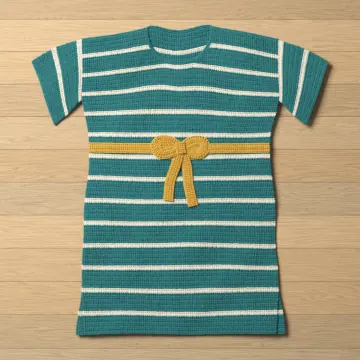
- A longer top. Work a plain sweater on to the knee: the T-shirt dress is one.
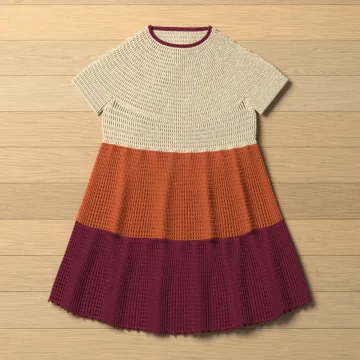
- A ruffle or a tier. Ruffles; the boho tiered dress has two tiers, the dress with a lace skirt a lace one.
- A crochet bodice on a cloth skirt. Edging on fabric shows how stitches are worked into cloth.
- Fit at the bust. Darts add room; altering finished pieces changes a dress that is done.
- Lining or a slip. Crochet can be seen through. Lining has both ways.
- For a child or a baby. Choose by the chest: there are girls' dresses and baby dresses in their own sizes.
If it goes wrong
| What you see | Why | What to do |
|---|---|---|
| The yoke ripples | Too many increases for its depth | Work an even round more between them |
| It is tight over the shoulders | Too few, or a tight gauge | Count, then a larger hook |
| The neck will not go over the head | A tight chain | Work the chain and the neckband with a larger hook |
| The dress grows longer | Its own weight | Fewer rounds, a firmer stitch, a lighter yarn |
| It clings at the hips | The skirt is no wider than they are | More stitches in the gathering round |
| The joins lean to one side | Each round begins a little to one side of the last | Put them at the back, where they hardly show |
Where to go next
Print the summer smock dress, or see all the dresses. Yarn for clothes and stitches for clothes help you choose.