Crochet guide
How to crochet a rug
A crochet rug is a thick flat piece, worked in a circle, round a chain for an oval, or in rows for a rectangle. Choose the material and the shape first. A round rug of T-shirt yarn is written out step by step, in double crochet (treble crochet in United Kingdom terms). After it come an oval and a rectangle with their counts, and how to work any of them in strips of cloth.
On this page 9 parts
Choose the material
Stitch names are United States terms, with the United Kingdom name in brackets.
| Material | Hook to begin with | Stitch |
|---|---|---|
| Super bulky yarn (weight 6), one strand | 10 mm (N/P-15) | Single crochet (UK double crochet) |
| Thinner yarn, several strands as one | 10 mm (N/P-15) | Single or half double crochet (UK half treble) |
| T-shirt yarn | 10 to 15 mm | Double crochet (UK treble) |
| Strips of cloth 1 to 2 in (2.5 to 5 cm) wide | 9 to 10 mm (M/N-13 to N/P-15) | Single, half double or double crochet |
| Rope and cord | Very large | Single crochet, or over the rope |
A smaller hook makes a denser rug and is harder on the hands. If the hook will not go into the stitches, take a larger one. More on each: two strands together, fabric strips, rope, jute and twine, plastic bags.
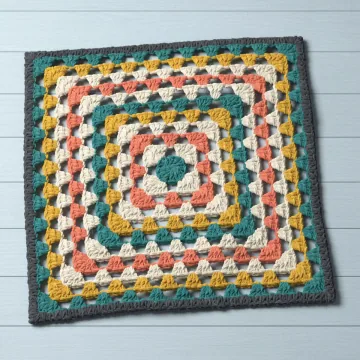
For the shape: a circle or an oval goes in rounds, a rectangle in rows. A square grows from a ring with four corners: our granny square rug is one.
A round rug, about 30 in (76 cm)
Know first: the chain, double crochet (UK treble), single crochet (UK double crochet), the slip stitch and the magic ring. If double crochet is new, work a few rows of it in ordinary yarn first: the rug is nearly all double crochet.
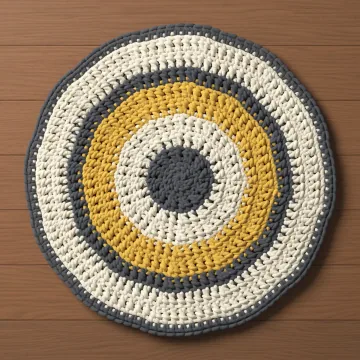
These are the rounds of our round T-shirt yarn rug in one color. Use T-shirt yarn (weight 7) and a 10 mm (N/P-15) hook, or the hook that gives 6.5 double crochet in 4 in (10 cm). As an estimate, buy 190 yd (174 m). You also need a yarn needle, scissors and a tape measure. The pattern has the same rug in three colors.
In the lines ch is chain, dc double crochet, sc single crochet, sl st slip stitch, st stitch, rnd round, MR the magic ring and RS the right side. Work what stands in square brackets as many times as the line says. The number in round brackets at the end is the count of the round. The side that faces you is the right side, and you never turn.
1. Make round 1
Begin with a magic ring. Chain 3: it stands as the first stitch, so count it. Work 11 double crochet into the ring, which makes 12, and pull the ring shut. Close the round with a slip stitch in the top of the chain.
Foundation: Make a magic ring.
Rnd 1 (RS): Ch 3 (counts as dc), 11 dc in MR, sl st in top of ch-3 to join (12 dc).
2. Double it
Chain 3 again. It stands on the first stitch, and one more goes in the same stitch beside it. Two in every stitch make 24.
Rnd 2: Ch 3 (counts as dc), dc in same st, 2 dc in each of next 11 sts, sl st in top of ch-3 to join (24 dc).
3. Keep the rule
From here a round is 12 groups. A group is two stitches in one, then plain stitches: one in round 3, two in round 4, one more every round. Every round adds 12. The chain 3 and the stitch beside it begin the first group, so the line says 11 times for the other 11.
The picture is rounds 1 to 3. A T with one slash is a double crochet, three ovals in a row are the chain 3, and a dot is the slip stitch that closes a round. Red stitches are the pairs that stand in one stitch.

Rnd 3: Ch 3 (counts as dc), dc in same st, dc in next st, [2 dc in next st, dc in next st] 11 times, sl st in top of ch-3 to join (36 dc).
Rnd 4: Ch 3 (counts as dc), dc in same st, dc in next 2 sts, [2 dc in next st, dc in next 2 sts] 11 times, sl st in top of ch-3 to join (48 dc).
4. Lay it on the floor
Do it now, after round 4, and then after every second round. Press it flat with your hands.
- A lies flat. Go on.
- B waves at its edges. It has too many stitches. Pull back to the round where it lay flat and count. If the counts are right, work one round with no increase, then go on.
- C rises like a bowl. It has too few, or tight ones. Pull back until you can press it flat. Then work twice the increases in one round and go on.

Measure it once, after round 4: about 10 3/4 in (27.5 cm) across. If it is larger, begin again with a smaller hook; if it is smaller, with a larger one.
5. Go on to the size
Rnd 5: Ch 3 (counts as dc), dc in same st, dc in next 3 sts, [2 dc in next st, dc in next 3 sts] 11 times, sl st in top of ch-3 to join (60 dc).
Rnd 6: Ch 3 (counts as dc), dc in same st, dc in next 4 sts, [2 dc in next st, dc in next 4 sts] 11 times, sl st in top of ch-3 to join (72 dc).
Rnd 7: Ch 3 (counts as dc), dc in same st, dc in next 5 sts, [2 dc in next st, dc in next 5 sts] 11 times, sl st in top of ch-3 to join (84 dc).
Rnd 8: Ch 3 (counts as dc), dc in same st, dc in next 6 sts, [2 dc in next st, dc in next 6 sts] 11 times, sl st in top of ch-3 to join (96 dc).
Rnd 9: Ch 3 (counts as dc), dc in same st, dc in next 7 sts, [2 dc in next st, dc in next 7 sts] 11 times, sl st in top of ch-3 to join (108 dc).
Rnd 10: Ch 3 (counts as dc), dc in same st, dc in next 8 sts, [2 dc in next st, dc in next 8 sts] 11 times, sl st in top of ch-3 to join (120 dc).
Rnd 11: Ch 3 (counts as dc), dc in same st, dc in next 9 sts, [2 dc in next st, dc in next 9 sts] 11 times, sl st in top of ch-3 to join (132 dc).
6. Edge it
One round of single crochet, with no increase, gives a firm rim. A round of reverse single crochet in its place is heavier, and the weight helps the edge lie down.
Rnd 12: Ch 1, sc in each st around, sl st in first sc to join (132 sc).
The chain 1 is not a stitch, and the first single crochet goes where the round before was joined. Fasten off and weave in the ends on the back.
7. Block it
Lay the rug with its right side, the side that faced you, on the floor and a damp towel over it. Leave it until it lies flat. Blocking has other ways.
How wide after how many rounds
At that gauge a round of double crochet adds about 2 5/8 in (6.7 cm) across, and the edge about 7/8 in (2.2 cm).
| Across | Rounds of double crochet | Stitches in the last | Yarn, an estimate |
|---|---|---|---|
| 14 in (35.5 cm) | 5 | 60 | 50 yd (46 m) |
| 19 1/4 in (49 cm) | 7 | 84 | 90 yd (82 m) |
| 24 1/2 in (62 cm) | 9 | 108 | 135 yd (123 m) |
| 29 3/4 in (75.5 cm) | 11 | 132 | 190 yd (174 m) |
| 35 in (89 cm) | 13 | 156 | 265 yd (242 m) |
For any material, by weight. Weigh the circle after round 4 and measure it. The rug weighs as much as that circle times (finished width / width now), squared. From 10 3/4 in to 30 in (76 cm) that is 2.79 x 2.79, about 7.8 times: a circle of 4 oz (113 g) becomes a rug of about 31 oz (885 g). It is an estimate: have more ready. Scraps and strips are weighed the same way.
In another stitch the rule is the same and the first number changes: a circle of single crochet begins with 6 stitches, one of double crochet with 12. The circle stitch count chart has every round.
An oval rug
An oval goes round a chain. Work both sides of the chain, and put every increase at the two ends.
Starting chain = length less width. A is the length, B the width and C the chain.

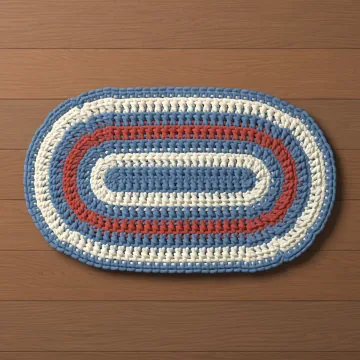
Our oval rag rug is 26 1/2 in (67 cm) by 15 1/2 in (39 cm), in T-shirt yarn or strips of cloth on the 10 mm hook, in double crochet. So C is 11 in (28 cm), and at 6.5 stitches to 4 in that is 11 x 6.5 / 4, about 18 stitches. Chain 4 more than that: 22. In one color, as an estimate, it takes 125 yd (114 m).
Rnd 1 (RS): 2 dc in 4th ch from hook (skipped 3 chs count as dc), dc in next 17 chs, 6 dc in last ch, working along the other side of the foundation ch, dc in next 17 chs, 3 dc in next ch, sl st in top of skipped chs to join (46 dc).
For the other side turn the piece halfway round, like a wheel, and put the hook under the strands of each chain that have nothing in them. The last three stitches go in the chain that holds the first ones.
Rnd 2: Ch 3 (counts as dc), dc in same st, 2 dc in each of next 2 sts, dc in next 17 sts, 2 dc in each of next 6 sts, dc in next 17 sts, 2 dc in each of next 3 sts, sl st in top of ch-3 to join (58 dc).
Rnd 3: Ch 3 (counts as dc), dc in same st, dc in next st, [2 dc in next st, dc in next st] 2 times, dc in next 17 sts, [2 dc in next st, dc in next st] 6 times, dc in next 17 sts, [2 dc in next st, dc in next st] 3 times, sl st in top of ch-3 to join (70 dc).
Rounds 4, 5 and 6 are round 3 with one more plain stitch after each pair every time, also after the first: 82, 94 and 106. The two straight sides stay 17. Edge it with a round of 106 single crochet, and finish as in steps 6 and 7.
For 8 by 5 feet (244 by 152 cm) the chain is 3 feet, 36 in (91 cm): 36 x 6.5 / 4 = 58.5, so about 58 stitches. In double crochet chain 4 more, 62, and the straight sides have one less, 57. In single crochet put its own stitch count in the sum, and chain 2 more. Bag and basket bases teaches the end, and oval shapes has more sums.
A rectangle in rows
The plainest rug is our simple solid rug: 24 in (61 cm) by 36 in (91 cm), one strand of super bulky yarn and a 10 mm hook, 8 stitches and 9.2 rows to 4 in (10 cm). As an estimate it takes 470 yd (430 m).
Foundation: Ch 49.
Row 1 (RS): Sc in 2nd ch from hook and in each ch across (48 sc).
Rows 2 to 83: Ch 1, turn; sc in each st across (48 sc).
At the end of a row chain 1 and turn the piece over. The chain is not a stitch: the first stitch goes in the last one you made. Turning chain shows it. After the last row fasten off and weave in the ends.
| Size | Chain | Stitches | Rows |
|---|---|---|---|
| 20 in (51 cm) by 30 in (76 cm) | 41 | 40 | 69 |
| 24 in (61 cm) by 36 in (91 cm) | 49 | 48 | 83 |
| 30 in (76 cm) by 47 3/4 in (121.5 cm) | 61 | 60 | 110 |
| A square, 24 in (61 cm) | 49 | 48 | 55 |
Measure after row 12, across the middle of the rows and not along the chain: it should be the width in the first column. If it is wider, begin again with a smaller hook; if it is narrower, with a larger one. Count every few rows, so that the sides stay straight.
A rag rug
Any of the three shapes can be worked in cloth.
- Cut strips of one width. Cotton sheets are easy to begin with: they do not stretch, so the stitches stay even. Jersey stretches and gives more.
- Lay the end of the next strip over the last, before you run out, and sew a few stitches through both. The seam goes into the rug with the rest.
- Work loosely, so that the hook gets into the stitches again in the next round.
- Change color by changing strips.

Strips can be knotted instead. The knots show.
Change it
- Stripes. Change the yarn at the join of a round: changing colors.
- A thicker rug. Hold one more strand with the rest and go up a hook size.
- A finger rug. With very thick yarn the hand can stand in for the hook: crochet without a hook.
- What goes under it. A pad or a backing: crochet rugs.
- Left handed. The same words. Your rounds go clockwise, and the first picture is its mirror image.
When it goes wrong
| What you see | Why | What to do |
|---|---|---|
| The edge ripples | Too many stitches for the round | Pull back to where it lay flat and count. If the counts are right, work one round with no increase, then go on |
| The edge lifts, a bowl | Too few stitches, or tight ones | Pull back until you can press it flat. Work twice the increases in one round, then go on. Or begin again with one more hook size |
| A rectangle narrows | The first or the last stitch of a row was missed | Count the stitches your size has, at the end of every row: 40, 48 or 60 |
| It slides | A bare floor | See what goes under it |
Patterns to follow
- Rugs, round rugs and oval rugs
- Rag rugs