Crochet guide
How to crochet a tablecloth or runner
Measure the table first. A cloth is the table plus the drop on both sides; a runner is about a third of the table's width and hangs over its two ends. Then choose how to fill it: rows, many small pieces joined, one large round, or a picture in open mesh. Begin with a runner in rows if it is your first: step 3 writes one out.
On this page 10 parts
| Table | Seats, at 24 in (61 cm) each | Cloth, drop 6 in (15 cm) | Cloth, drop 10 in (25 cm) | Runner |
|---|---|---|---|---|
| Square, 36 in (91 cm) | 4 | 48 by 48 inches (122 by 122 cm) | 56 by 56 inches (142 by 142 cm) | 12 by 48 inches (30 by 122 cm) |
| 36 by 60 inches (91 by 152 cm) | 4 | 48 by 72 inches (122 by 183 cm) | 56 by 80 inches (142 by 203 cm) | 12 by 72 inches (30 by 183 cm) |
| 36 by 72 inches (91 by 183 cm) | 6 | 48 by 84 inches (122 by 213 cm) | 56 by 92 inches (142 by 234 cm) | 12 by 84 inches (30 by 213 cm) |
| 40 by 96 inches (102 by 244 cm) | 8 | 52 by 108 inches (132 by 274 cm) | 60 by 116 inches (152 by 295 cm) | 13 by 108 inches (33 by 274 cm) |
| 40 by 120 inches (102 by 305 cm) | 10 | 52 by 132 inches (132 by 335 cm) | 60 by 140 inches (152 by 356 cm) | 13 by 132 inches (33 by 335 cm) |
| Round, 36 in (91 cm) | 4 | 48 in (122 cm) across | 56 in (142 cm) across | 12 by 48 inches (30 by 122 cm) |
| Round, 48 in (122 cm) | 6 | 60 in (152 cm) across | 68 in (173 cm) across | 16 by 60 inches (41 by 152 cm) |
| Round, 60 in (152 cm) | 7 | 72 in (183 cm) across | 80 in (203 cm) across | 20 by 72 inches (51 by 183 cm) |
The cloths and runners are sums. A long table seats one at each end. Allow 12 in (30 cm) of the length for each of those two, so a side seats as many as 24 goes into the length less 24. A square table seats one on each side; a round one, as many as 24 goes into its rim. Measure yours: tables differ, and people can sit closer.
1. Measure the table and the drop
The drop is how far the cloth hangs. Six to eight inches (15 to 20 cm) is usual for every day, and up to 15 in (38 cm) for a formal table. Measure it with the chairs pushed in.

- Cloth length: the table's length (L in the outline) plus twice the drop (D).
- Cloth width: the table's width (W) plus twice the drop.
- Round cloth: the table across plus twice the drop.
- Runner: a third of the width; the length of the table plus 12 in (30 cm), which is 6 in (15 cm) over at each end. A runner may also lie inside the ends of the table.
The solid line in the outline is the table, and the dashed line is the cloth. That table is 60 by 36 inches (152 by 91 cm) with a drop of 8 in (20 cm). So the cloth is 60 + 16 by 36 + 16, which is 76 by 52 inches (193 by 132 cm).
2. Choose the way
A motif is a small piece worked by itself, such as a square; a cloth is many of them joined. Filet is a mesh of small open and filled squares, and the filled ones make a picture. The numbers in the outlines are those of the table, and orange is where each one begins.

| Way | Begins with | What it asks | Goes larger by |
|---|---|---|---|
| 1. Rows | A chain | Even edges; the plainest for a runner | More rows, or a longer chain |
| 2. Motifs joined | One small piece | Many ends to weave in; small work to carry | More motifs on two sides |
| 3. One large round | A ring | Counting; a round that lies flat | More rounds |
| 4. Filet from a graph | A chain | Reading a graph | More repeats of the graph |
Yarn or thread. Cotton, in medium or light weight for a first one. Thread is finer, and there is much more of it to work: see kinds of thread and the thread sizes.
3. A first runner, written out
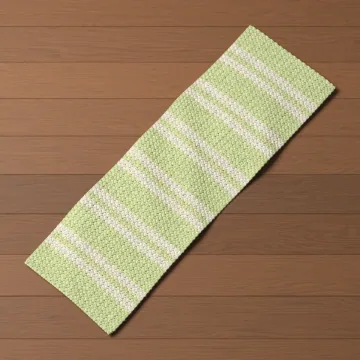
This is our moss stitch table runner, in one color. The pattern's page has it in stripes.
Have: medium cotton yarn (weight 4), a 5.5 mm (I-9) hook, a yarn needle, scissors. Know: the chain, single crochet (double crochet in United Kingdom patterns) and the chain space.
| Runner, about 11¾ in (30 cm) wide | For a table about | Rows | Yarn in all, an estimate |
|---|---|---|---|
| 36 in (91 cm) | 42 in (107 cm) or longer; it lies inside the ends | 157 | 305 yd (279 m) |
| 48 in (122 cm) | 36 in (91 cm) | 210 | 400 yd (366 m) |
| 54 in (137 cm) | 42 in (107 cm) | 236 | 450 yd (411 m) |
| 60 in (152 cm) | 48 in (122 cm) | 263 | 500 yd (457 m) |
| 72 in (183 cm) | 60 in (152 cm) | 315 | 600 yd (549 m) |
| 84 in (213 cm) | 72 in (183 cm) | 368 | 700 yd (640 m) |
| 90 in (229 cm) | 78 in (198 cm) | 394 | 750 yd (686 m) |
| 108 in (274 cm) | 96 in (244 cm) | 473 | 900 yd (823 m) |
| 132 in (335 cm) | 120 in (305 cm) | 578 | 1,100 yd (1,006 m) |
The runner hangs 6 in (15 cm) over each end, but for the first. For another length allow 35 rows to every 8 in (20 cm), and about 100 yd (91 m) to every 12 in (30 cm).
A wider one is a longer chain; the rows stay as many. The brackets in the lines are then worked more often, and the yarn grows in proportion.
| Width, about | Chain | Times, for the 18 | Single crochet in a row | Yarn |
|---|---|---|---|---|
| 11¾ in (30 cm) | 40 | 18 | 19 | as above |
| 13 in (33 cm) | 44 | 20 | 21 | 1.1 times |
| 16 in (41 cm) | 54 | 25 | 26 | 1.4 times |
| 19¾ in (50 cm) | 66 | 31 | 32 | 1.7 times |
In the lines A is your yarn, ch is chain, sc is single crochet, sp is space, sk is skip and RS is the right side. A ch-1 sp is the hole under a chain 1. The turning ch sp is the hole that the chains at the start of a row make at its edge: the three chains passed over in row 1, and the chain 2 in every later row. What stands in square brackets is worked as many times as the number after them says.
Make the chain
Chain 40, loosely. If your chains are tight, make them with a larger hook.
Work row 1
Single crochet in the fourth chain from the hook. The three chains passed over make a space. Then chain 1, skip a chain, single crochet in the next, to the end.
Turn, and find the spaces
Chain 2 and turn. Every single crochet now goes in a hole, under the chain 1 of the row below. The last one goes in the turning space at the far edge, which is the last hole of the row: in row 2 the space of the three chains that were passed over, and after that the space of the chain 2 of the row below.
In the chart ovals are chains and plus signs are single crochet. Row 1 begins at the right, at its number; F is the fourth chain. The three orange ovals are the chains passed over, and the orange plus is the last single crochet of row 2, in their space. Row 2, green, begins at the left with its chain 2.

Foundation: With A, ch 40.
Row 1 (RS): Sc in 4th ch from hook, [ch 1, sk next ch, sc in next ch] 18 times (19 sc, 18 ch-1 sps, 1 turning ch sp).
Rows 2 to 157: Ch 2, turn; [sc in next ch-1 sp, ch 1] 18 times, sc in turning ch sp (19 sc, 18 ch-1 sps, 1 turning ch sp).
These are the lines of the 36 in (91 cm) runner. For a longer one work row 2 again and again to your own number in the table: 368, say, where it says 157.
Count: 19 single crochet, 18 chain-1 spaces and the turning space, in every row. Count the first few rows and then every tenth.
Check the size
After 18 rows the piece is about 11¾ in (30 cm) wide and 4 in (10 cm) tall at 13 stitches and 17½ rows to 4 in (10 cm), a chain space counted as a stitch. If it is wider, take a smaller hook and begin again; if it is narrower, a larger one. A repeat, what stands in the brackets, is two chains of the first chain and about 5/8 in (1.6 cm): chain 2 more or 2 fewer for each.
End it
Stop when it is long enough. Fasten off, weave in the ends, then wet it, pin it straight and let it dry: blocking.
Two ends alike. Moss stitch looks nearly the same up and down, so the two ends match. In a stitch that points one way they do not: give it an edging all round, as the V-stitch lace runner has.
4. How many motifs
Work one motif, block it and measure it. Divide the cloth's length and width by it, and round to whole numbers.
A worked sum. A cloth of 76 by 52 inches (193 by 132 cm) in squares of 4 in (10 cm): 76 ÷ 4 is 19, and 52 ÷ 4 is 13. 19 times 13 is 247 squares. In squares of 6 in (15 cm) it is 13 by 9, which is 117, and the cloth comes to 78 by 54 inches (198 by 137 cm).
Joining in the last round saves the sewing: join as you go. Joining squares has the seams.
5. How much thread
Weigh one finished motif, or a swatch, on a kitchen scale, and multiply. If a 4 in (10 cm) square weighs 8 g, 247 of them weigh 1,976 g, and at 50 g a ball that is 39.5, so 40 balls, and more for joining and an edge. It is an estimate: weigh your own.
A round cloth grows faster than it looks. Twice as wide is four times the area, so about four times the thread. From 36 in (91 cm) to 48 in (122 cm) across is 1.8 times. The yarn calculator does the sum from a swatch.
6. One large round, an oval, a rectangle
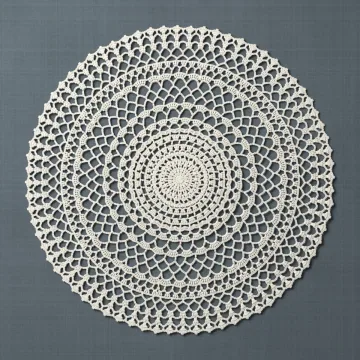
- A round is a doily that goes on. Each round needs more than the last, at the rate the pattern set: the same number of new repeats, or longer loops. Lay it on the table every few rounds. The round lace tablecloth is about 28½ in (72 cm) across in light cotton and about 35 in (89 cm) in medium.
- An oval begins on a chain as long as the cloth's length less its width: for a cloth 72 by 48 inches (183 by 122 cm) that is 24 in (61 cm). Oval shapes has the ends.
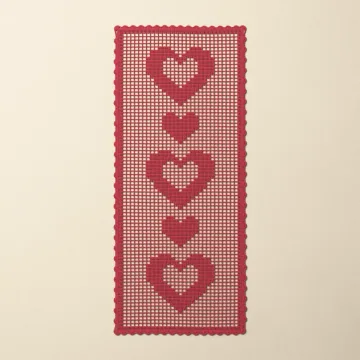
- A rectangle is rows, motifs or filet. The filet heart runner has a line of hearts and says how to make it longer.
- Pineapples are lace shapes, broad at the foot and narrowing to a point. In rows or round they are taught as one pineapple first.
7. Finish, wash, mend
Pin a large cloth out in parts on towels, one part at a time, with the pinned edge of each in line with the one before. Wash it as its yarn label says. For an old cloth see old pieces, and for a broken thread repairing.
If it goes wrong
| What you see | Why | What to do |
|---|---|---|
| The runner narrows | The last stitch in the turning space was missed | Pull back to the last row with 19 |
| The runner spreads | Two stitches in one space, or one in the edge | Pull back and count spaces: 18, and the turning one |
| The chain edge draws in | The chain was tighter than the rows | Begin again with a larger hook for the chain |
| A round cloth cups or waves | Too few or too many in a round | See keep it flat |
| Motifs do not meet | Motifs of two sizes | Block each to one size before joining |
| The cloth is short on one side | The drop was added once | Add it twice, once for each side |
Questions people ask
What size is a runner for a six foot table? Six feet is 72 in (183 cm): 84 in (213 cm) long to hang 6 in (15 cm) at each end, which is 368 rows of the runner above, and a third of the width.
Can a runner go across the table? Yes, one for each pair of seats that face each other. Its length is then the width of the table plus twice the drop.
Can I make a cloth from a doily pattern? Yes, in thicker yarn it comes out larger, and with more rounds larger again.
Where to go next
Follow the moss stitch runner, or look at the tablecloths and table linens.