How to crochet a towel topper
A towel topper is a strap of crochet on the top of a kitchen towel that buttons round an oven door handle. Hem or fold the towel, make 36 holes along it, crochet into them, draw the 36 stitches in to 9, and work up to a buttonhole. There are ways with no cutting and no sewing too.
On this page
| Way | The towel | Needs |
|---|---|---|
| 1. Crochet into half a towel | Cut in two, hemmed, holes punched | An awl or thick needle, a button |
| 2. Crochet onto a whole towel | Folded in half, not cut | Blanket stitch along the fold, a button |
| 3. Sew the topper on | Either of these | Needle and thread, a button |
| 4. A holder the towel slips into | Any, untouched | A loop or a ring, a button |
| 5. A towel of crochet | None | More yarn |
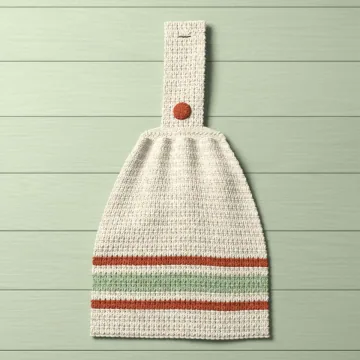
Ways 1 to 3 use the same topper. It is worked out of our hanging kitchen towel, where the towel is crochet as well.
You need: medium cotton (weight 4), about 30 yd (27 m), an estimate; a 5 mm (H-8) hook, and a small one of 1.5 to 2 mm for the first row; a kitchen towel about 16 in (41 cm) wide; a button about 1 in (2.5 cm) across; a ruler and a pencil; an awl or a thick needle for the holes; a sewing needle and thread for the hem and the button; a yarn needle and scissors. For way 2, embroidery floss or crochet thread and a sharp needle for it. The gauge is 14 single crochet (double crochet in United Kingdom patterns) and 16 rows to 4 in (10 cm).
Know first: the slip knot, the chain, single crochet and fastening off. The decrease and the buttonhole are taught below.
In the lines ch is chain, st is stitch, sp is space, sk is skip, sc is single crochet, sc2tog is two single crochet worked together, and RS is the right side. What stands in square brackets is worked as many times as the number after them says.
Get the towel ready
1. Wash it and choose the way
Wash and dry the towel first: cotton can shrink, and the crochet will not shrink with it. Choose a thin towel. A thick one is hard to pierce and to gather.
2. Cut and hem, or fold
Half a towel (way 1). Fold it so that the short ends meet, and cut on the fold. A cut edge frays. Fold it to the wrong side ½ in (1.3 cm), and again ½ in, press, and sew it down close to the lower fold.
A whole towel (way 2). Fold it across the middle, so that the two short ends hang together, and press the fold.
3. Mark 36 places
Mark them on the right side, along the hem or the fold. Measure the edge, take off 1 in (2.5 cm), and divide by 35: that is the distance from mark to mark. Make marks 1 and 36 first, each ½ in (1.3 cm) in from its side. Then mark from both ends toward the middle of the edge: 18 and 19 stand one on either side of it.
| Towel | From mark to mark |
|---|---|
| 14 in (36 cm) | ⅜ in (9.4 mm) |
| 15 in (38 cm) | A little over ⅜ in (10.2 mm) |
| 16 in (41 cm) | A little under 7/16 in (10.9 mm) |
| 18 in (46 cm) | A little under ½ in (12.3 mm) |
| 20 in (51 cm) | A little under 9/16 in (13.8 mm) |
Put them ¼ in (6 mm) below the top fold of the hem, or ½ in (1.3 cm) below the fold of a whole towel.

4. Way 1: make the holes
Push an awl, a thick needle or a skewer through every mark, until the small hook passes.
5. Way 2: sew blanket stitch in place of holes
It suits a hemmed half too, if your hook will not go through. Cut the thread about four times as long as the edge (an estimate), knot its end, and bring the needle up at the first mark. At every mark, the first included, take the thread over the edge to the back and put the needle through from back to front, through both layers of a folded towel. Before the thread is tight pass the needle through its loop, so that the thread lies along the fold.
The thread on the fold between two uprights is a bar. Thirty-six marks make 35 bars. Fasten the thread on the back.

Crochet the topper
This is the piece, its foot on the towel. The foot is 36 stitches wide. A is where you take in (step 8), first to 18 stitches and then to 9. B is the buttonhole (step 10). The ring is the button, which is sewn on at the end (step 11).

6. Row 1, into the towel
Make a slip knot on the small hook. Right side facing, begin at the right: put the hook through the first hole from front to back, pull a loop through and up to the top of the edge, yarn over, and pull through both loops. That is 1 single crochet. Work 1 in each hole: 36. On blanket stitch put the hook under the bars instead, one in each of 35 and one more in the last. A short loop makes the edge buckle. The towel gathers a little between the holes.
7. Row 2, with the larger hook
Change to the 5 mm hook. Chain 1, turn, and work 1 single crochet in each stitch. The chain 1 is not a stitch. Count 36.
8. Take in by half, twice
Every row begins with chain 1 and turn. Row 3: work every two stitches together, 18 times. For each, pull up a loop in one stitch and in the next, then yarn over and pull through all three loops. Row 4 is plain, one in each. Row 5: the same again, 9 times. Nine stitches are left.


9. Work the strap
Rows 6 to 27 are plain, nine stitches: 5½ in (14 cm). After row 20 hold the towel to the handle and lay the strap over it. The hole has to come down to row 6, where the button will be. If it will not, work more plain rows before the hole: the sums below tell how many.
10. Make the buttonhole
Row 28: one in each of three stitches, chain 3, pass over three, one in each of the last three. Row 29: three stitches, three single crochet in the space under the chains, three stitches. Try the button now. It should go through snugly. Work two plain rows and fasten off with a tail of 6 in (15 cm).

The same in pattern lines. They begin on a chain, for a topper that is sewn on (way 3). On a towel leave out the foundation and row 1 as it stands: your row 1 is step 6.
Foundation: Ch 37.
Row 1 (RS): Sc in 2nd ch from hook and in each ch across (36 sc).
Row 2: Ch 1, turn; sc in each st across (36 sc).
Row 3: Ch 1, turn; [sc2tog] 18 times (18 sc).
Row 4: Ch 1, turn; sc in each st across (18 sc).
Row 5: Ch 1, turn; [sc2tog] 9 times (9 sc).
Rows 6 to 27: Ch 1, turn; sc in each st across (9 sc).
Row 28: Ch 1, turn; sc in next 3 sts, ch 3, sk next 3 sts, sc in next 3 sts (6 sc, 1 ch-3 sp).
Row 29: Ch 1, turn; sc in next 3 sts, 3 sc in next ch-3 sp, sc in next 3 sts (9 sc).
Rows 30 to 31: Ch 1, turn; sc in each st across (9 sc).
11. Sew the button
With the side that faced you in row 1 up, sew it with needle and thread in the middle of the strap over rows 6 and 7, just above the last decrease. Weave in the ends.
12. Hang it
Right side toward you, take the strap up behind the handle, over it and down in front, and button it.
Sew it on instead (way 3)
Work the lines above from the chain, buttonhole and all. Gather or pleat the top of the towel to the width of the topper's foot, its 36 stitch edge: 10¼ in (26 cm). Tack the pleats with a few stitches. Pin the foot over the edge on the right side, and sew through the crochet and the towel with sewing thread, once along the front and once along the back. Sewing and attaching has the stitches.
Without a button, without sewing
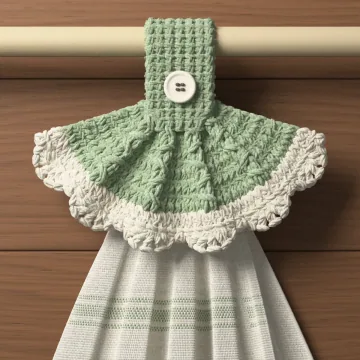
- A holder (way 4). The buttoned towel holder has a loop behind a fan: pull the towel through it, and lift it out for the wash.
- A ring. A strap with a covered ring at its foot: ring towel holder. Draw any towel halfway through. Around a ring shows how to cover it.
- A slip-through corner. Crochet a small triangle or heart and sew it to one corner of a whole towel along two sides only. Pass the corner behind the handle, bring the opposite corner round the front, and pull the towel through between crochet and cloth.
- A tie. Leave out the buttonhole. At the end of the last row chain 40 and fasten off. Join the yarn at the other end of that row and do the same. Tie a bow over the handle.
- A knob. End the strap in a loop of chain that passes over it: button loops.
- A snap or touch tape in place of the button: closures.
The sums
The strap. Lay a tape round the handle, loosely, as the strap will lie. Inches times 4 is the number of rows between the last decrease and the buttonhole. 7 in (18 cm) is 28 rows, so the buttonhole comes in row 34 instead of 28.
Another number of stitches. Use 28, 36 or 44: each can be halved twice, and leaves a strap of 7, 9 or 11. The hole is always the middle three, with two, three or four stitches on either side. Divide the towel's edge, less 1 in (2.5 cm), by one less than the number.
A crochet towel (way 5). The hanging kitchen towel is 10¼ in (26 cm) wide. A loose one to dry dishes with is larger: the cotton hand towel is 16 by 25 inches (41 by 64 cm).
If it goes wrong
| What you see | Why | What to do |
|---|---|---|
| The edge of the towel curls or buckles | Row 1 is tight | Pull the loops longer, or put a chain between stitches and skip it in row 2 |
| A thread of the towel breaks out | The holes are too near the edge | Go below the hem's fold, through three layers |
| A cut edge frays under the crochet | It was not hemmed | Take it off, hem it twice, begin again |
| Holes show beside the stitches | They were punched wide | A thicker yarn in row 1 |
| It slips off | The button is small for the hole | A larger button; or sew one stitch at an end of the hole |
| The strap stretches | Loose stitches | A smaller hook for the strap; sew the button higher |
| The topper is crooked | The first or last hole was missed | Count 36 stitches in row 1 |
Questions people ask
Do I need to cut the towel? No. Fold it across the middle and crochet along the fold. It hangs double.
Which yarn? One that is washed as the towel is, which for most is cotton. The whole goes in the wash together.
How long does the topper stand above the towel? About 7¾ in (20 cm) flat. Buttoned, about half of that.
Can I use my usual hook for row 1? Only through punched holes or blanket stitch.
Where to go next
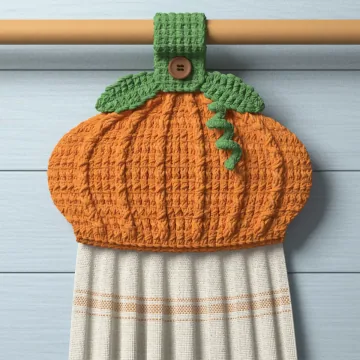
Towels of every kind: towel toppers. The pumpkin towel topper hems and punches half a towel as here. Crochet edging on fabric goes round a whole cloth.