Crochet guide
How to crochet a dishcloth
A dishcloth is a square of cotton about 8 in (20 cm) wide. Chain 27, work 30 rows of 26 single crochet (double crochet in United Kingdom patterns), and stop when it is square. The edge and the loop at a corner are there if you want them. Every step is below, with the count to check.
On this page 7 parts
| What you need | For one cloth |
|---|---|
| Yarn | Medium cotton (weight 4), about 65 yd (59 m), an estimate; 10 yd (9 m) more for the edge and the loop |
| Hook | 5.5 mm (I-9) |
| Also | A yarn needle, scissors, a tape measure, stitch markers or safety pins |
| Gauge | 13 single crochet (double crochet in United Kingdom patterns) and 15 rows to 4 in (10 cm) |
| To know first | The slip knot, the chain, single crochet and fastening off. For the edge and the loop, the slip stitch too |
Why cotton. It takes up water at once. Acrylic takes up much less, so it pushes the water about. A yarn that is mostly cotton works too. Yarn for dishcloths compares the fibers.
The gauge does not have to be exact: a cloth that comes out half an inch (1.3 cm) larger washes as well. It only changes how many rows make it square.
The rows are those of our simple solid dishcloth. In the lines ch is chain, sc is single crochet, st is stitch and RS is the right side, the side that faces you in row 1.
The cloth, step by step
1. Chain 27
Make a slip knot with a tail of about 6 in (15 cm), put it on the hook, and chain 27, loosely. Twenty-six chains are for the stitches. One is for the turn.
2. Work row 1
Pass over the first chain from the hook. Work 1 single crochet in the second and in every chain after it. Do not count the loop on the hook. Count 26.

3. Chain 1 and turn
Chain 1, then turn the work like a page. The chain lifts the yarn to the height of the new row. It is not a stitch and you never work into it.
4. Put the first stitch in the first stitch
It goes in the stitch the chain stands on, at the very edge: the last one you made before you turned. It is easily passed over.

5. Put the last stitch in the last stitch
Work 1 single crochet in each stitch. Near the end look for one more top at the edge: it lies flatter than the rest and is easy to miss. Work into it, and count 26.

6. Repeat
Every row is the same as row 2. Put a marker in the edge after every tenth row, so that you need not count from the start.
Foundation: Ch 27.
Row 1 (RS): Sc in 2nd ch from hook and in each ch across (26 sc).
Rows 2 to 30: Ch 1, turn; sc in each st across (26 sc).
7. Stop when it is square
Do not trust the number 30: your rows may be taller or shorter than ours. Take the hook out and put a marker through the loop, so that nothing can run. Fold the upper left corner down, so that the left side edge lies along the starting chain. If the two edges end together, the cloth is square (1). If the chain sticks out, work more rows (2). If the side edge sticks out, pull rows back (3).

Put the hook back in the loop. Now choose:
- A plain cloth: fasten off. Cut the yarn 6 in (15 cm) from the hook and pull the end through the loop. Go to step 11.
- A loop and no edge: do not cut. Go to step 10.
- An edge: stop after an even-numbered row (in a size with 23 rows, after 22 or 24), do not cut, and go to step 8.
8. Begin the edge
Chain 1 and turn: the right side faces you, and you are at the upper right corner, the dot in the plan under the table. Work three single crochet in the first stitch, one in each of the next 24, and three in the last.
9. Work round the other three sides
Turn the cloth a quarter at each corner, the right side always facing you. The stitches are wider than the rows are tall, so a side takes four stitches for every five rows: put the hook into the end of a row, through the side of its edge stitch. A corner always takes three. In a cloth of 26 stitches and 30 rows:
| Along | Where the stitches go | Stitches |
|---|---|---|
| The top | Three in the first stitch, one in each of 24, three in the last | 30 |
| The left side | In the ends of 4 rows, pass over 1, six times | 24 |
| The starting chain | Three in chain 27, one in each of the next 24 chains, three in chain 2 | 30 |
| The right side | In the ends of 4 rows, pass over 1, six times | 24 |
| The whole round | Slip stitch in the first single crochet to join | 108 |
The starting chain is at the top when you reach it, the cloth upside down. Begin under the last stitch of row 1, in chain 27 of the first chart, and put the hook under the strands that row 1 left free. Stop at chain 2. Chain 1 was passed over in step 2 and is left out again.

Another size. Along the top and the chain the 24 becomes your stitches less 2. On a side work as many groups of five rows as there are, then one stitch in each row left over: 28 rows are five groups and 3 rows, so 23 stitches. Do both sides alike.

After the first side lay it flat. If it waves, pass over more row ends. If it draws in, pass over fewer: many makers use every row end. Adding a border shows both faults.
10. Make the loop
Chain 10 from the corner where your yarn is, slip stitch in that same corner, and fasten off. With an edge the corner is the place of the join. The picture shows a cloth with none. For a thicker loop work single crochet over the chain before you fasten off: hanging loops.

11. Weave in the ends for the wash
Thread each tail in the yarn needle and run it on the wrong side under several stitches one way, then back the other way along the next row, then once more. An end that goes one way only works loose in the wash. Do not rely on a knot. Weaving in ends has every move.

Sizes
| Cloth | About | Chain | Stitches | Rows | Yarn, an estimate |
|---|---|---|---|---|---|
| Baby washcloth | 6 in (15 cm) | 21 | 20 | 23 | 40 yd (37 m) |
| Small dishcloth | 7½ in (19 cm) | 25 | 24 | 28 | 60 yd (55 m) |
| Dishcloth | 8 in (20 cm) | 27 | 26 | 30 | 65 yd (59 m) |
| Large dishcloth | 8½ in (22 cm) | 29 | 28 | 32 | 75 yd (69 m) |
| Washcloth | 9 in (23 cm) | 30 | 29 | 34 | 85 yd (78 m) |
| Large washcloth | 10 in (25 cm) | 34 | 33 | 38 | 105 yd (96 m) |
A dishcloth and a washcloth are the same thing for different rooms, in the same cotton.
For another size or yarn: stitches in 4 in (10 cm), divided by 4, times the width you want in inches. Add 1 chain. With 17 stitches to 4 in and a cloth of 8 in: 17 ÷ 4 × 8 = 34 stitches, so chain 35. The starting chain calculator does it for any stitch.
A rectangle: keep the 26 stitches and work on. At this gauge 45 rows are 12 in (30 cm).
The same cloth in another stitch
Each of these is about 8 in (20 cm) wide at 13 stitches to 4 in (10 cm).
| Stitch | Chain | Chains for another width | Rows |
|---|---|---|---|
| Single crochet | 27 | Any number | 30 |
| Half double crochet (UK half treble) | 28, the first stitch in the 3rd | Any number | 22 |
| Double crochet (UK treble) | 28, the first stitch in the 4th | Any number | 14 |
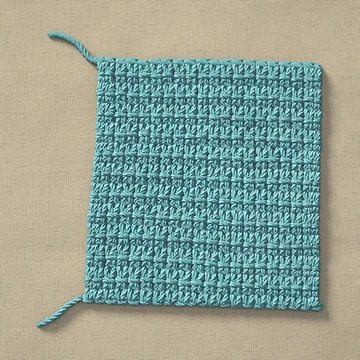
| Lemon peel stitch | 27 | An odd number | 22 |
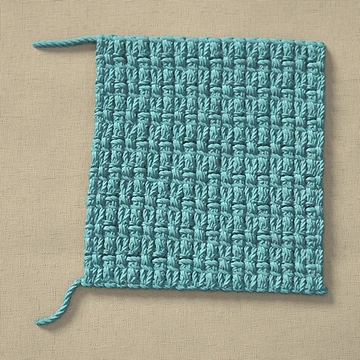
| Grit stitch | 27 | An odd number | 30 |
Every row has 26. The last two patterns work as their pages say. The two taller stitches turn in their own way:
- Half double crochet: chain 2 and turn. The chain 2 is not a stitch. Put the first stitch in the first stitch, as in step 4.
- Double crochet: the 3 chains you pass over in row 1 are its first stitch. After that chain 3 and turn: the chain 3 is the first stitch of the new row, so step 4 does not hold. The next stitch goes in the second stitch of the row below, and the last one in the top chain of the 3 at the far end.
A close stitch keeps its shape. Tall, open stitches stretch in use. A bumpy stitch scrubs harder: stitches for dishcloths helps you choose.
Change it
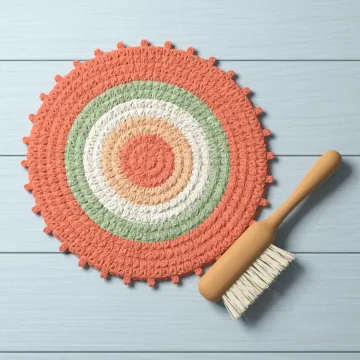
- Round. Begin with a ring and 8 half double crochet, and add 8 in every round: 8, 16, 24, 32, 40, 48, 56, 64, 72. With its edge that is about 7 in (18 cm), the smaller size of the round dishcloth. In single crochet begin with 6 and add 6: a coaster is the same thing made smaller.
- Stripes. Change on the last pull of a row: changing colors.
- Looks knitted. Knit look stitches has several.
- For scrubbing. Hold a rough yarn along, or make a scrubby.
- Thin cotton or crochet thread. Do the sum above: more chains, more rows, a smaller hook.
- Left-handed. The words are the same. Read the pictures as mirror images: your row 1 runs from left to right.
If it goes wrong
| What you see | Why | What to do |
|---|---|---|
| It gets narrower | The first or last stitch of a row was missed | Pull back to a row of 26 |
| It gets wider | A stitch went into the chain 1, or two in one stitch | Pull back to a row of 26 |
| The bottom is narrower than the top | The chain is tight | Chain with a larger hook next time; on this one the edge helps |
| It is stiff | The hook is small for the yarn | Try 6 mm (J-10) |
| It is limp and gapes | Loose stitches | Try 5 mm (H-8) |
| The edge waves or ruffles | Too many stitches along a side | Pass over more row ends |
| The edge cups | Too few, or tight | Pass over fewer |
| A corner curls | It has fewer than three stitches | Pull back to it and work three |
Questions people ask
How many chains for a dishcloth? 27 for 8 in (20 cm) in medium cotton on a 5.5 mm hook. Other sizes are in the table.
What happens in the first wash? Cotton softens, and it can shrink a little. A cloth that stretched in use draws back when it is washed. Follow the yarn label. Washing and care has more.
How much yarn for a set of four? Four times 65 yd (59 m) is 260 yd (238 m), an estimate, without edges.
Do I need to block it? Only for looks. Pin it to its size while it is damp and let it dry flat: blocking.
Where to go next
Print the simple solid dishcloth, or choose from the dishcloths and washcloths. A potholder is the next thing: the same rows, twice as many, folded in two.