Buttoned towel holder crochet pattern
Intermediate · 2 colors · 535 stitches in 2 pieces
PDF · US Letter · 3 pages · Change paper
Go to the instructions Row counter
- Size
- Fan about 7½ in (19 cm) wide and 3½ in (9 cm) deep with its shells, its pleats drawn in; tab about 1¾ in (4.5 cm) wide and 5¼ in (13 cm) long before it is folded; for a rail up to 1¼ in (3 cm) thick
- Skill
- IntermediatePost stitches, increases and an edge of shells
- Yarn
- Medium (4), about 43 yd (39 m), an estimate
- Hook
- 4 mm (US G-6)
Paper for the PDF
For your own crochet, gifts and handmade pieces you sell. Do not resell or share this PDF or copies of it. Selling, classes and kits: the rules
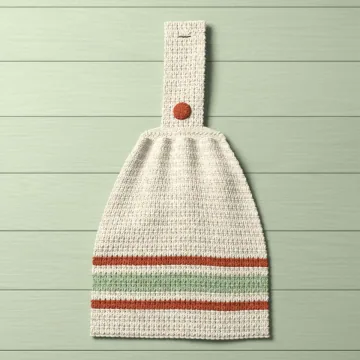
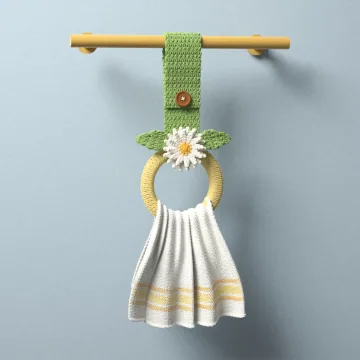
A pleated fan with a band and an edge of shells hangs like a skirt over the gathered top of a kitchen towel. The towel is pulled through a loop behind the fan, so that it lifts out for the wash, and a tab buttons over the rail of an oven door or a cabinet. Sage and cream.
Gauge
16 stitches and 18 rows to 4 in (10 cm) in single crochet.
Check it on the tab of the holder, laid flat, when row 20 is done: the 7 stitches of a row are about 1¾ in (4.5 cm) wide and the 20 rows are about 4½ in (11 cm) tall. If they measure more, start again with a smaller hook; if they measure less, with a larger one.
How to measure it
Before you start
How it is worked: Post stitches · Changing colors · Joining and seaming pieces
Read the 7 notes
- The ch 1 at the start of a row does not count as a stitch.
- The ch 2 at the start of a row does not count as a stitch.
- The holder is worked from the buttonhole end of the tab down to the shells.
- Pleats: the 4 BPdc of row 26 are worked round 4 dc of row 25. From row 27 to row 30, each FPdc or BPdc is worked round the post stitch that stands in its place in the row below. They make four raised pleats on the right side.
- To change yarn, work the last yarn over of the last stitch of the row before with the new yarn. Cut the old yarn at the end of its stripe, leaving a tail of about 6 in (15 cm), and leave a tail of the same length on the new yarn.
- Leave a tail of about 6 in (15 cm) when you begin and when you fasten off, unless another length is given. The ends that are not sewn with are woven in.
- Use cotton yarn: it stands up to washing.
Instructions
- “[ ]” is a repeat.
- The count at the end is what the row leaves.
- Tick a row when it is done. Your place is kept in this browser.
How to read these rows
Square brackets “[ ]” hold a repeat: work what is inside as many times as it says. In UK terms sc is double crochet, dc is treble, FPdc is front post treble, or raised treble front, BPdc is back post treble, or raised treble back and sk is miss.
Holder
Yarns in order of use: A, sage; B, cream.
- FoundationWith A, ch 6.
- Row 1RSSc in 2nd ch from hook and in each ch acrossleaves (5 sc)
- Row 2Ch 1, turn; 2 sc in first st, sc in next 3 sts, 2 sc in last stleaves (7 sc)
- Row 3Ch 1, turn; sc in each st acrossleaves (7 sc)
- Row 4Ch 1, turn; sc in next 2 sts, ch 3, sk next 3 sts, sc in next 2 stsleaves (4 sc, 1 ch-3 sp)
- Row 5Ch 1, turn; sc in next 2 sts, 3 sc in next ch-3 sp, sc in next 2 stsleaves (7 sc)
- Rows 6 to 24Ch 1, turn; sc in each st acrossleaves (7 sc)Next: row 6 of 24
- Row 25Ch 2, turn; dc in first st, 2 dc in each of next 2 sts, dc in next st, 2 dc in each of next 2 sts, dc in last stleaves (11 dc)
- Row 26Ch 2, turn; dc in first st, repeat: 2 dc in next st, BPdc around next st 4 times, 2 dc in next st, dc in last stleaves (12 dc, 4 BPdc)
- Row 27Ch 2, turn; dc in first st, repeat: 2 dc in next st, dc in next st, FPdc around next st 4 times, 2 dc in next st, dc in next st, dc in last stleaves (17 dc, 4 FPdc)
- Row 28Ch 2, turn; dc in first st, repeat: 2 dc in next st, dc in next 2 sts, BPdc around next st 4 times, 2 dc in next st, dc in next 2 sts, dc in last stleaves (22 dc, 4 BPdc)
- Row 29Ch 2, turn; dc in first st, repeat: 2 dc in next st, dc in next 3 sts, FPdc around next st 4 times, 2 dc in next st, dc in next 3 sts, dc in last stleaves (27 dc, 4 FPdc)
- Row 30Ch 2, turn; dc in first st, repeat: 2 dc in next st, dc in next 4 sts, BPdc around next st 4 times, 2 dc in next st, dc in next 4 sts, dc in last stleaves (32 dc, 4 BPdc)
- Row 31With B, ch 1, turn; 2 sc in first st, sc in next 35 stsleaves (37 sc)
- Row 32Ch 1, turn; sc in each st acrossleaves (37 sc)
- Row 33Ch 1, turn; sc in first st, repeat: sk next 2 sts, 5 dc in next st, sk next 2 sts, sc in next st 6 timesleaves (7 sc, 30 dc)
- EndFasten off.
Towel loop
Yarn A, sage.
- FoundationWith A, ch 6.
- Row 1RSSc in 2nd ch from hook and in each ch acrossleaves (5 sc)
- Rows 2 to 24Ch 1, turn; sc in each st acrossleaves (5 sc)Next: row 2 of 24
- EndFasten off, leaving a tail of about 20 in (51 cm) to sew with.
Assembly
- Weave in all the ends of the holder. Weave in the beginning end of the towel loop, and keep its tail.
- Towel loop: fold the loop in half, its right side out (row 1 is a right side row), so that its foundation chain and its last row lie one on the other. Lay the holder with its wrong side up and the shells toward you. Lay these two edges on row 24, the last row of the tab, over the 5 middle stitches of its 7, the fold of the loop toward the shells. Pin them. With the tail of the loop, sew through both edges and the back of row 24, 5 stitches, then go back over the 5 stitches once. The loop hangs behind the fan, about 2¾ in (7 cm) long, and it is open at its two sides.
- Button: with sewing thread, sew it to the right side of row 25, the first row of double crochet, over the sixth of its 11 stitches.
- To hang it, pass the buttonhole end of the tab up behind the rail, over it and down in front, and button it.
- Gather a towel in your hand across its middle. Lift the fan and pull one end of the towel through the loop from the side, until half of the towel hangs on each side of the loop. Bring the two halves together behind the fan and let the fan down over them. To take the towel out, pull it back through the loop.
Finishing
- Weave in what is left of the sewing lengths with the yarn needle.
In all: 2 pieces; 535 stitches (415 in the holder, 120 in the towel loop).