Crochet for older people, to make and to be given
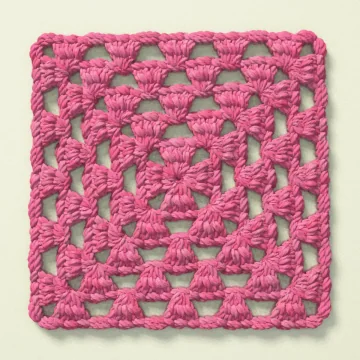
For older eyes or hands, change the yarn first. Take a smooth, thick one in a color that stands out from your lap, a hook of 6 mm (J-10) or more, and one stitch, row after row: the mat below is a first piece worked that way. If you are making a gift for somebody in a nursing home, the second half of this page has what homes ask for.
On this page
Find what is hard, and change that first
| What is hard | What to change | More about it |
|---|---|---|
| Seeing the stitches | Smooth, thick yarn. A cloth of the opposite shade on the lap. A lamp aimed at the work | By touch and with low vision |
| Holding the hook | A thick handle, and the hands resting on a pillow | Handles and grips |
| Hands that are sore or shake | Short sittings, above all at first. Both forearms on something firm | Sore or shaky hands |
| Only one hand can work | The hook fixed in a clamp on a table | With one hand |
| Keeping the place | One stitch, short rows, a marker at each end | Stitch markers |
| Remembering the steps | One step at a time, beside somebody who knows it | Below |
Change one thing, work a few rows, and see. Crochet is a pastime, not a treatment. What suits an illness, a sore hand or failing sight is a question for the person's doctor or the person who cares for them.
Yarn, hook and light
Yarn. Smooth, plain and medium or bulky. Thin yarn, small hooks and fuzzy yarn make the stitches harder to find.
Color. Teachers of beginners mostly say light yarn. One handbook for care workers says that dark yarn is easier to see. Contrast serves both: pale yarn over a dark cloth, or dark yarn over a white one. Try both in the chair where the work will be done.
Hook. 6 mm (J-10) or 6.5 mm (K-10 1/2) is a size that blind crocheters name to begin with. A very big hook and its yarn tire some hands, so go up one size at a time.
Light. A lamp with a bending neck, turned to the work and away from the eyes. A magnifier on a stand leaves both hands free.
Paper. Copy the pattern large with a thick pen, one row to a line, or print it large. The row counter has large buttons.
A first piece: a mat in one stitch
Never held a hook? How to crochet shows the chain first. The mat takes bulky yarn, a 6.5 mm hook (K-10 1/2), two stitch markers and about 30 yards (27 m). It comes out about 5 1/2 in (14 cm) square, the size for a mug. Yarn and size are estimates.
- Chain 16, loosely. The loop on the hook is not one of them.
- Row 1. Work 1 half double crochet (United Kingdom: half treble) in the third chain from the hook and in every chain after it: 14 stitches. Put a marker in the first stitch and in the last.
- Row 2. Chain 2, which is not a stitch, and turn the work. Work 1 half double crochet in each stitch: the first in the marked stitch beside the chain, the last in the other marked stitch. Count 14. As you use a marked stitch, move its marker up to the new one.
- Rows 3 to 12. The same as row 2. The mat then has 168 stitches. Stop sooner or later if that makes it square.
- Finish. Cut the yarn 6 in (15 cm) from the hook, pull the end through the loop, and weave in both ends.
Go on instead of finishing, and the mat becomes a scarf. How to crochet a scarf has pictures of the same rows, and of joining the next ball.
For eyes and hands that manage medium yarn, two more small pieces. The yarn is an estimate.
| Piece | How it is worked | Stitches | Yarn and hook |
|---|---|---|---|
| Classic granny square | Five rounds of double crochet (United Kingdom: treble) in threes. The hook goes into gaps, not into the tops of stitches | 180, chains not counted | Medium, 30 yards (27 m), 5.5 mm (I-9) |
| First dishcloth | 30 rows of 26 single crochet (United Kingdom: double crochet) | 780 | Medium cotton, 65 yards (59 m), 5.5 mm (I-9) |
A blanket made of granny squares is never heavy until the squares are joined, and someone else can join them.
With someone who has dementia
What charities and health bodies agree on about activities, put into crochet.
- Begin with what they used to make. If they crocheted or knitted before, offer that, in one stitch and a yarn that is easy to see. If they never did, let it be something to do together.
- Get it started for them. Make the chain and the first rows yourself, and hand it over with the hook in place.
- Ask for help. "Could you help me with this row?" invites more than "Would you like to crochet?"
- Show one step, then wait. Use your own hands to show it. If a step is lost, do that part and give the work back.
- Do not correct it. A missed stitch does no harm. The time spent matters more than the piece.
- Change over when it stops being pleasant. Wind yarn into a ball, or sort balls by color. Some people would sooner sit and watch. Try again another day.
The person who cares for them knows whether a hook, scissors, a needle or small parts should be near. Ask first.
What to make for somebody older
Nursing homes, hospices and veterans' hospitals ask for a few things over and over. Ask the home what it can use before you begin: crochet for charity has the questions and how to pack it.
| Gift | What homes ask | What to watch | A pattern of ours |
|---|---|---|---|
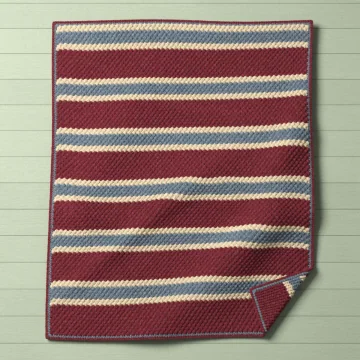
| Lap blanket | Often 35 or 36 by 45 inches (89 or 91 by 114 cm). For a wheelchair, smaller, about like a baby blanket: 30 by 30 inches (76 by 76 cm) on one home's list | A closed stitch. No fringe, and no edge near the wheels | Wheelchair lap blanket, in two sizes |
| Shawl | Often any size | That it stays on: see below. For a wheelchair, leave the fringe off | Ridged comfort shawl |
| Bag for a walker | On several lists | How thick the bar is. Ours goes round one of up to 1 1/4 in (3 cm) | Walker bag |
| Slippers | On some lists | The sole: see below | Slippers from a rectangle |
| Fidget blanket or sleeve | Asked for by homes and hospitals that care for people with dementia | Everything sewn on firmly | Fidget lap blanket |
For any of them: soft yarn that goes in a washing machine and a dryer. Bright, clear colors. No lace for hands that catch in holes. Raised stitches are something to feel. A lap blanket can have a small pocket on one side.
Near a wheelchair, nursing handbooks warn of blankets and of clothes in the wheels. So ask for two measures before you begin, with the person seated: across the lap between the armrests, and from the waist to the shins.
A shawl that stays on
A plain shawl can slide off when the arms move. There are four ways round it.
- Put it over the head. A poncho stays where a shawl slips. The easy chunky poncho is two rectangles of one stitch, sewn together, with a fringe that you can leave off.
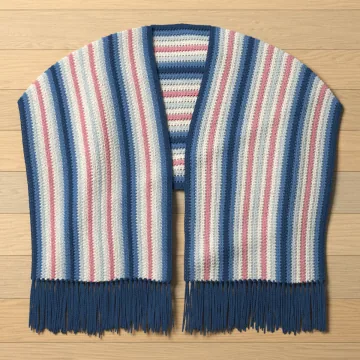
- Shape it and tie it. The classic cape covers the shoulders and upper arms, opens at the front and has ties.
- Button it. The chunky button scarf has three big buttons. Few fastenings ask less of stiff fingers: closures compares buttons, snaps and ties.
- Pass one end through the other. The one skein chunky scarf has a slit near one end for that.
Ask whether the person can pull something over the head. If not, choose the cape or the buttons.
Slippers and bed socks: the sole comes first
A bare crocheted sole can slip on a smooth floor. Health bodies in the United States and in the United Kingdom say the same to older people: do not walk about the house in socks, and wear slippers that fit, stay on and grip.
- To walk in: only with a sole that grips, in a size that fits and stays on. Slippers on soles shows how crochet goes onto a sole.
- For bed or an armchair: bed socks, with a note that they come off before the feet touch the floor. Socks has patterns.
A fidget sleeve, step by step
A fidget sleeve, also called a twiddle muff, is a soft double tube with things fixed inside and outside, for hands that like to be busy. This one is worked in medium yarn with a 5 mm hook (H-8), about 250 yards (229 m) in all. It comes out about 12 in (30 cm) long and 12 1/4 in (31 cm) around. All three are estimates.
- Chain 40 and close it in a ring with a slip stitch, without twisting it.
- Try it on. Put both your hands into the ring, one from each side. If it is tight, start again with more chains, and buy a little more yarn. Your own number then stands for 40 in every step below.
- Round 1. Chain 2, which does not count as a stitch. Make 1 half double crochet (United Kingdom: half treble) in the chain you joined into and in every chain round, and close with a slip stitch in the first stitch: 40 stitches. Do not turn: the side toward you is the right side, and it stays on the outside of the tube.
- All later rounds. The same: chain 2, then 1 half double crochet in the stitch you joined into and in every stitch round, 40 in all. To change color, finish the last stitch of a round in the old yarn. Put the hook in the first stitch, lay the new yarn over it, leaving a tail of 6 in (15 cm), and pull that through the stitch and the loop on the hook. That slip stitch closes the round and brings in the new color. Cut the old yarn to a tail as long and leave both tails inside the tube. Every change takes a little more yarn.
- Stop at 24 in (61 cm), which is about 66 rounds, and 2,640 stitches if you began with 40. Cut the yarn, leave 40 in (1 m) for sewing, and pull it through the last loop. One half will be the outside, the other the lining.
- Fix the things on now, all on the right side. Put one hand inside the tube, so that you do not sew it shut. Put most on one half and a few on the other. Leave the middle, where it will fold, and the two ends bare.
- Push the lining half down inside the other half until the two ends meet. Its right side now faces the hands.
- Sew the two ends together, stitch to stitch all the way round, with the long yarn end and a whip stitch. The hands go in at both ends, and the other yarn ends are shut in between the layers.
Fix on: crocheted loops, braids and ruffles, with both ends sewn under. A small pocket. Large buttons, sewn through many times. A zipper, sewn down on both sides. Ribbon, both ends sewn under.
Leave off: anything sharp or brittle, anything that breaks easily or hangs by one thread, loose ends, and whatever cannot go through a hot wash again and again.
Pull hard at each thing. If it moves, sew it again. Whether a person should have small parts in reach is for those who care for them to say: ask before you begin.
Questions people ask
What can seniors crochet that is easy? The mat on this page, which can grow into a scarf. Then a granny square or a dishcloth.
What is a quick crochet gift for a nursing home? Ask first what it can use. Our chunky button scarf has 826 stitches, and our wheelchair lap blanket has 12,660. For blankets, squares by many hands share the work.
Can a person with dementia still crochet? Some go on with a craft they know, with help. Let the person's own pleasure in it decide.
Can an older person learn to crochet? Yes. How to teach someone to crochet has a first lesson, and crochet groups often take beginners.
Where to go next
- Lap blankets, prayer shawls, ponchos and walker bags
- How to wash crochet and what to put on a label