For another width, add or take away 6 chains at a time: each 6 chains adds one more repeat of the bracketed group, and 6 more stitches to a row that has no brackets. Measure your own gauge first.
To work an FPdc: yo, insert the hook from front to back to front around the post (the upright part) of the st, yo, pull up a loop, [yo, pull through 2 loops] 2 times. The front is the side that faces you as you work.
To work a BPdc: the same, but insert the hook from back to front to back around the post of the st.
To work an FPtr: yo 2 times, insert the hook from front to back to front around the post (the upright part) of the st, yo, pull up a loop, [yo, pull through 2 loops] 3 times.
BPdc around next 4 sts is one BPdc around each of them.
Whip stitch: bring the needle through both edges from front to back, over the top and through from front to back again, all in the same direction.
Leave a tail of about 6 in (15 cm) when you begin, and weave it in at the end with the others. Join a new ball at the end of a row, with the same tails: each join adds two ends.
Buy whole balls from one dye lot.
Left-handed. Work everything as it is written, the other way: rows from left to right, rounds clockwise. Left-handed crochet
Abbreviations
Written in US terms. Where the UK name differs it is given beside the US one.
To find how many balls: divide by the length on your yarn's label and round up. Buy them from one dye lot.
The estimate is from the stitches and chains of this size at this gauge, with 30 percent added.
To measure your own: work the swatch and measure it, mark the yarn where the swatch begins and ends, pull the swatch out and measure the yarn it took; divide by the area of the swatch and multiply by the area of the piece.
FPdc round the stitch below, from the front, BPdc round the stitch below, from the back, FPtr round the stitch below, from the front, yo yarn over the hook, RS right side, the one that shows.
The ch 2 at the start of a row does not count as a stitch: the first stitch of the row goes into the first st of the row below.
The number of rows is our estimate: yours may differ, and the length does not change the stitch count.
Special stitches
cable cable of 4
Skip the next 2 sts, FPtr around each of the 2 sts after them, then, working in front of those, FPtr around each of the 2 skipped sts in order. It leaves 4 FPtr for the next row.
Row 1RSHdc in 3rd ch from hook and in each ch acrossleaves (26 hdc)
Row 2Ch 2,turn;hdc in next 2 sts,[repeat: BPdc around next 4 sts,hdc in next 2 sts]4 timesleaves (10 hdc, 16 BPdc)
Row 3Ch 2,turn;hdc in next 2 sts,[repeat: cable over next 4 sts,hdc in next 2 sts]4 timesleaves (10 hdc, 4 cables)
Row 4Ch 2,turn;hdc in next 2 sts,[repeat: BPdc around next 4 sts,hdc in next 2 sts]4 timesleaves (10 hdc, 16 BPdc)
Row 5Ch 2,turn;hdc in next 2 sts,[repeat: FPdc around next 4 sts,hdc in next 2 sts]4 timesleaves (10 hdc, 16 FPdc)
Row 6Ch 2,turn;hdc in next 2 sts,[repeat: BPdc around next 4 sts,hdc in next 2 sts]4 timesleaves (10 hdc, 16 BPdc)
Stop and measure now, after row 6.Width, across the middle of the rows and not along the chain edge: about 8¾ in (22 cm). If it is wider, start again with a smaller hook; if it is narrower, with a larger one. If only the chain edge is tight, make the chain with a larger hook.
Rows 7 to 123Go on repeating rows 2 to 5 in order, over and over. Row 7 is worked as row 3. The last row, row 123, is worked as row 3.Repeat until the piece measures about 58 in (147 cm), ending with a row worked as row 3: at our gauge that is row 123. Go by the tape measure, not the count.Next: row 7 of rows 7 to 123, worked as row 3
Lay the strip flat, wrong side up, with no twist in it, and bring the two short ends over to meet, so that the right side is outside and the 26 places of the foundation edge meet the 26 places of the last row. With a 30 in (76 cm) length of the yarn, whip stitch through both edges, one stitch to each place, from corner to corner.
Lay the piece flat, pull it gently to its size, dampen it and let it dry.
About
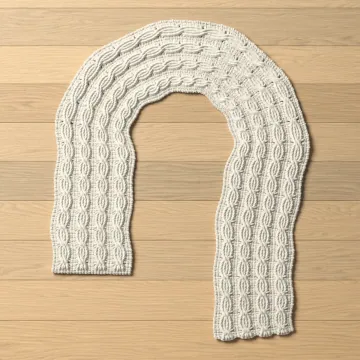
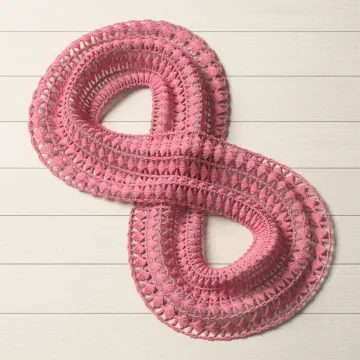
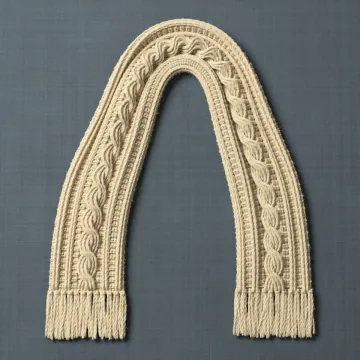
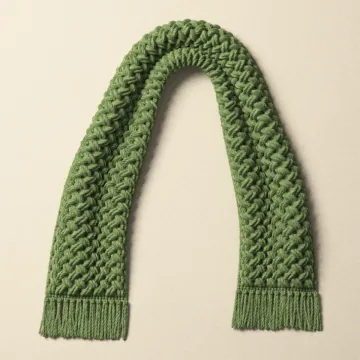
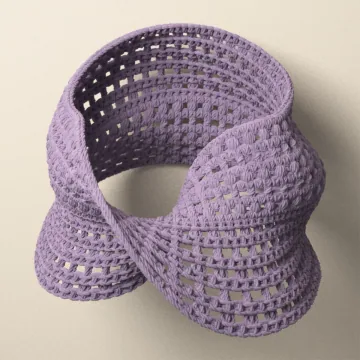
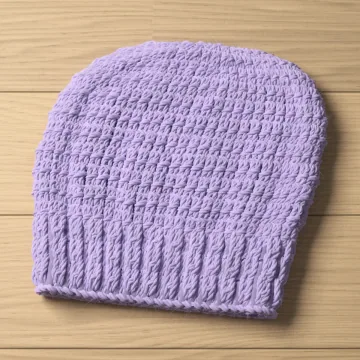
Narrow ribs of four post stitches that cross every fourth row, with two half double crochets between them. It is worked flat as a long strip and the two short ends are sewn together.