Carnation crochet pattern
Crochet, 2½ in across, 4 colors, easy
PDF. Prints on US Letter and A4.
What you need
Each amount is an estimate.
- Yarn A carnation pinkabout 15 yd (14 m)rows 1 to 3 of the large frills and rows 1 to 3 of the small frills
- Yarn B deep roseabout 15 yd (14 m)the sewn details
- Yarn C cream whiteabout 10 yd (9 m)row 4 of the large frills and row 4 of the small frills
- Yarn D sage greenabout 15 yd (14 m)the cups, the long stem, the short stem and the leaves
- Yarn in all
- About 55 yd (50 m) or 15 g
- Weight
- Fine weight, 2 on the label
- Hook
- 3.25 mm (US D-3), or the size that gives you the gauge
- Also
- A yarn needle, scissors, pins for blocking and a spray bottle
- Gauge
- 21 stitches and 22 rows to 4 in (10 cm) in single crochet (UK double crochet). How to check it
Instructions
How to read these rows
US terms · Show UK terms
- ch chain, sl st slip stitch, sc single crochet (UK double crochet), hdc half double crochet (UK half treble), dc double crochet (UK treble).
- 2 dc in next st: both in one stitch. dc in each of next 6 sts: one in each.
- [ ] 6 times: work what is inside 6 times in all.
- (7 dc): the stitches you have when the row is done. How to read a pattern.
- Joining squares. Changing colors.
- A chain that counts as a stitch is marked so in its line and is included in the count.
- A chain 1 at the start of a row does not count as a stitch.
- Frills: each is a fan worked back and forth in rows from a magic ring; do not join the ends of a row. Pull the ring closed when row 1 is done. The turning chain of a row counts as its first st and stands on the first st of the row below; the last sts of a row go in the top of the turning chain of the row before. A frill has more stitches than lie flat, so that it ruffles. Both its sides may be the right side.
Go to: Large frill · Small frill · Cup · Long stem · Short stem · Leaf
Large frill make 4
- Make 2 in each of A and B. The lines say A; for the frills in B, read B in its place. The edge is always C.
- StartWith A, make a magic ring.
- Row 1Ch 3 (counts as dc), 6 dc in ring. Pull the tail to close the ring.leaves (7 dc)
- Row 2Turn, ch 3 (counts as dc), 2 dc in each of next 6 stsleaves (13 dc)
- Row 3Turn, ch 3 (counts as dc), repeat: dc in next st, 2 dc in next st 6 timesleaves (19 dc)
Fasten off A.
- Row 4Turn, join C with sl st in first st, repeat: ch 2, sl st in next st 18 timesleaves (18 sl sts)
- EndFasten off, leaving a 10 in (25 cm) tail for sewing.
Small frill make 2
- Make 1 in each of A and B. The lines say A; for the frill in B, read B in its place. The edge is always C.
- StartWith A, make a magic ring.
- Row 1Ch 3 (counts as dc), 6 dc in ring. Pull the tail to close the ring.leaves (7 dc)
- Row 2Turn, ch 3 (counts as dc), 2 dc in each of next 6 stsleaves (13 dc)
- Row 3Turn, ch 2 (counts as hdc), repeat: hdc in next st, 2 hdc in next st 6 timesleaves (19 hdc)
Fasten off A.
- Row 4Turn, join C with sl st in first st, repeat: ch 2, sl st in next st 18 timesleaves (18 sl sts)
- EndFasten off, leaving a 10 in (25 cm) tail for sewing.
Cup make 2
Yarn D, sage green.
- StartWith D, ch 3.
- Row 1Sc in 2nd ch from hook, sc in next chleaves (2 sc)
- Row 2Ch 1, turn, 2 sc in first st, sc in next stleaves (3 sc)
- Row 3Ch 1, turn, 2 sc in first st, sc in next st, 2 sc in next stleaves (5 sc)
- Row 4Ch 1, turn, sc in first st, sc in next 4 stsleaves (5 sc)
- Row 5Ch 1, turn, sl st in first st, repeat: ch 3, sl st in 2nd ch from hook, sc in next ch, sl st in next st 4 timesleaves (4 sc)
- EndFasten off, leaving a 14 in (36 cm) tail for sewing.
Long stem
Yarn D, sage green.
Short stem
Yarn D, sage green.
Leaf make 4
Yarn D, sage green.
Finishing
- Block: lay the frills down with their curved edges up, with the magic ring at the bottom, spread the two straight ends of the rows like a wide V, the outer end of each ¼ in (0.6 cm) higher than the magic ring, and let the edge ripple; pin the cups ⅞ in (2.2 cm) wide below the points, and the points straight up. Pin the leaves right side up in a soft curve: two with the tops of the stitches on the outside of the curve, for the rose flower, and two with the foundation chain on the outside of it, for the pink flower. Spray the pieces with water and let them dry.
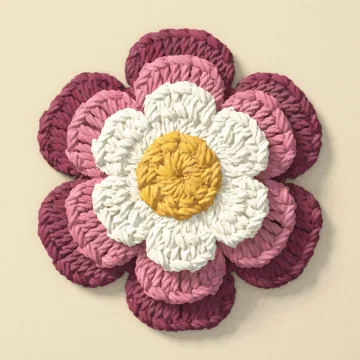
- Make two heads, one from the three frills with A and one from the three with B. Lay a large frill down with its curved edge up. Lay the second large frill on it, its magic ring ⅜ in (1 cm) straight below that of the first, and the small frill on both, its magic ring ⅝ in (1.6 cm) straight below that of the first. Run the tail of each frill along the back of its straight side to its ring. Sew the frills together with their tails from ring to ring, and catch each of the two in front to the one behind it in four places, spaced evenly, ⅝ in (1.6 cm) out from its ring, so that the white edges stay free.
- Cup: lay it on the head, right side up, the four points up, its middle below the middle of the frills and the tips of the points ½ in (1.3 cm) above the ring of the small frill, so that it hides the ring of the small frill. Sew it on with its tail along the feet of the points and down both sides as far as the frills reach.
- Lay out the pair. Every place is measured from the middle of the lower edge of the cup of the same flower. The pink flower leans to the left: the top of its frills in the middle is ½ in (1.3 cm) to the left and 2½ in (6.4 cm) above that edge. The rose flower leans to the right: the top of its frills is ¾ in (1.9 cm) to the right and 2½ in (6.4 cm) above. The lower edge of the rose cup lies 2⅜ in (6 cm) to the right and ½ in (1.3 cm) below that of the pink cup.
- Stems: the long one belongs to the pink flower, the short one to the rose flower. Lay the stems right side up. Lay the end with the tail under the cup, ¼ in (0.6 cm) above its lower edge, and bring the stem down in a soft curve until its other end is, for the long stem, 1⅝ in (4.1 cm) to the right and 3½ in (8.9 cm) below, and for the short stem, 1⅝ in (4.1 cm) to the left and 3 in (7.6 cm) below. Each stem is one or two stitches longer than its way: let what is left over lie under the cup. The long stem lies over the short one where they cross. Sew each stem to the back of its cup with its tail.
- Leaves, two to each stem, right side up, each with the outside of its curve up, so that its tip is lower than its middle, on the outer side of the stem. Pink flower: one leaf has its broad end on the stem, ⅜ in (1 cm) to the right and 1⅜ in (3.5 cm) below, its tip 1⅝ in (4.1 cm) to the left and 1¼ in (3.2 cm) below; the other has its broad end on the stem, ⅞ in (2.2 cm) to the right and 2¼ in (5.7 cm) below, its tip 1 in (2.5 cm) to the left and 2⅞ in (7.3 cm) below. Rose flower: one leaf has its broad end on the stem, ⅜ in (1 cm) to the left and 1¼ in (3.2 cm) below, its tip 1⅝ in (4.1 cm) to the right and 1⅜ in (3.5 cm) below; the other has its broad end on the stem, ⅞ in (2.2 cm) to the left and 2 in (5.1 cm) below, its tip 1 in (2.5 cm) to the right and 2⅞ in (7.3 cm) below. Sew the broad ends to the stems with their tails, and with what is left of the tails of the two lower leaves sew the stems to each other where they cross.
- Weave in all the ends that are left with the yarn needle.
About
Two carnations seen from the side, one pink and one deep rose, their stems crossed. Each head is three ruffled frills, one over another, with finely toothed cream white edges, in a sage green cup with four small points; the stems have long narrow curved leaves.