Cross stitch blanket crochet pattern
Crochet, 33 × 37¾ in, 2 colors, easy
Size: Baby Change size
Which size? Baby blanket size chart
PDF. Prints on US Letter and A4.
What you need
- Yarn A warm whiteabout 1,150 yd (1,052 m), an estimatemain color
- Yarn B redabout 300 yd (274 m), an estimatecontrast
- Yarn in all
- About 1,450 yd (1,326 m) or 730 g, an estimate
- Weight
- Medium weight, 4 on the label (UK aran)
- Hook
- 5.5 mm (US I-9), or the size that gives you the gauge
- Also
- Yarn needle, scissors and tape measure
- Gauge
- 13 stitches and 15 rows to 4 in (10 cm) in single crochet (UK double crochet). How to check it
Instructions Baby
How to read these rows
US terms · Show UK terms
- ch chain, sl st slip stitch, sc single crochet (UK double crochet).
- sk skip, RS right side, the one that shows.
- 3 sc in next st: all in one stitch. sc in next 2 sts: one in each.
- [ ] 22 times: work what is inside 22 times in all.
- (102 sc): the stitches you have when the row is done. How to read a pattern.
- Working in the round.
- The ch 1 at the start of a row does not count as a stitch: the first stitch of the row goes into the first st of the row below.
- The chain at the start of a round does not count as a stitch. After rnd 1, the first stitch of a round goes into the stitch that the slip stitch joined: that stitch is the first of the next stitches.
Baby blanket
Yarn A, warm white.
- StartWith A, ch 103.
- Row 1RSSc in 2nd ch from hook and in each ch acrossleaves (102 sc)
- Rows 2 to 11Ch 1, turn; sc in each st acrossleaves (102 sc)Next: row 2 of rows 2 to 11
- Stop and measure now, after row 11.Width, across the middle of the rows and not along the chain edge: about 31½ in (80 cm). If it is wider, start again with a smaller hook; if it is narrower, with a larger one. If only the chain edge is tight, make the chain with a larger hook.
- Rows 12 to 136Ch 1, turn; sc in each st acrossleaves (102 sc)Next: row 12 of rows 12 to 136
- EndFasten off, leaving a 6 in (15 cm) tail.
Border
Yarns in order of use: B, red; A, warm white.
- StartRight side facing and row 136 at the top, join B with sl st in the stitch that ends row 136, at the top right corner.
- Rnd 1RSCh 1, 3 sc in first st, sc in next 100 sts, 3 sc in last st, repeat: sc in end of each of next 5 rows, sk next row end 22 times, sc in end of each of next 4 rows, 3 sc in first ch of foundation edge, sc in next 100 chs, 3 sc in last ch of foundation edge, repeat: sc in end of each of next 5 rows, sk next row end 22 times, sc in end of each of next 4 rows, sl st in first sc to joinleaves (440 sc)
- Rnd 2RSWith A, ch 1, sc in next st, 3 sc in next st, sc in next 102 sts, 3 sc in next st, sc in next 116 sts, 3 sc in next st, sc in next 102 sts, 3 sc in next st, sc in next 115 sts, sl st in first sc to joinleaves (448 sc)
- Rnd 3RSWith B, ch 1, sc in next 2 sts, 3 sc in next st, sc in next 104 sts, 3 sc in next st, sc in next 118 sts, 3 sc in next st, sc in next 104 sts, 3 sc in next st, sc in next 116 sts, sl st in first sc to joinleaves (456 sc)
- EndFasten off, leaving a 6 in (15 cm) tail.
Assembly
- Cross stitch, when the border is done: thread the yarn needle with two strands of yarn B together, no longer than your arm, and have the right side facing with row 136 at the top. The border takes no crosses. One cross covers a square of 2 sts by 2 rows, whichever side of the sc shows. Bring the needle up at the lower left corner of the square and down at its upper right corner; then up at the lower right corner and down at the upper left corner. The corners are the gaps between one sc and the next. Cross every square the same way, so that the same half lies on top, and pull only until the yarn lies flat. Crosses beside each other share their corners.
- To begin a length of yarn, leave a tail of 4 in (10 cm) at the back, hold it along the back and work the first crosses over it. To end it, run the needle under the backs of the last crosses for 2 in (5 cm) and cut the yarn. Begin and end every heart and every small heart by itself. Work the cross rows of a heart to and fro, from the point up, each beginning at the side where the one before it ended. Whenever you go up to a new cross row, first lock the yarn: at the back, run the needle under the upright strand that the last cross has there (on the right side of that cross as seen from the front), and only then bring it up for the first cross of the new row. (Without this the yarn could slip out again where the new cross begins in the very hole in which the last one ended.) Where a cross row leaves 2 sts between two crosses, go straight across the back. Along a line of crosses go on from cross to cross straight across the back, behind the cross just worked and the 2 sts that are left. In cross row 9 of a heart work the crosses of one side first, run the needle under the backs of cross row 8 to the other side, and work the crosses there. No strand at the back passes more than 4 sts.
- Count the rows from the foundation, row 1 lying next to the border, and the stitches from the left, the first st lying next to the border. A line of crosses takes 2 rows: leave the first 6 sts, 1 cross over the next 2 sts, [leave 2 sts, 1 cross over the next 2 sts] 22 times, leave the last 6 sts: 23 crosses, 102 sts in all. The 4 hearts of a band stand side by side: leave the first 6 sts, [18 sts for a heart, leave 6 sts] 3 times, 18 sts for a heart, leave the last 6 sts: 4 hearts, 102 sts in all.
- Lower band: rows 7 and 8, a line of crosses. Rows 13 to 30, the hearts. Rows 35 and 36, a line of crosses.
- Between the bands, small hearts in 3 lines of 14 rows each, with 6 rows between the lines. Rows 42 to 55 and 82 to 95, each group of 14 rows: leave the first 8 sts, [14 sts for a small heart, leave 10 sts] 3 times, 14 sts for a small heart, leave the last 8 sts: 4 small hearts, 102 sts in all. Rows 62 to 75: leave the first 20 sts, [14 sts for a small heart, leave 10 sts] 2 times, 14 sts for a small heart, leave the last 20 sts: 3 small hearts, 102 sts in all.
- Upper band: rows 101 and 102, a line of crosses. Rows 107 to 124, the hearts, with their points down as in the lower band. Rows 129 and 130, a line of crosses.
- Each heart is 9 crosses wide and 9 cross rows tall, 18 sts by 18 rows. From its point up, over its 18 sts from left to right: cross row 1: leave 8 sts, 1 cross, leave 8 sts; cross row 2: leave 6 sts, 3 crosses, leave 6 sts; cross row 3: leave 4 sts, 5 crosses, leave 4 sts; cross row 4: leave 2 sts, 7 crosses, leave 2 sts; cross rows 5 to 7, each: 9 crosses; cross row 8: 4 crosses, leave 2 sts, 4 crosses; cross row 9: leave 2 sts, 2 crosses, leave 6 sts, 2 crosses, leave 2 sts. One heart has 55 crosses.
- Each small heart is 7 crosses wide and 7 cross rows tall, 14 sts by 14 rows. From its point up, over its 14 sts from left to right: cross row 1: leave 6 sts, 1 cross, leave 6 sts; cross row 2: leave 4 sts, 3 crosses, leave 4 sts; cross row 3: leave 2 sts, 5 crosses, leave 2 sts; cross rows 4 to 6, each: 7 crosses; cross row 7: leave 2 sts, 2 crosses, leave 2 sts, 2 crosses, leave 2 sts. One small heart has 34 crosses, the whole blanket has 906.
Finishing
- Weave in the ends.
- Lay the piece flat, pull it gently to its size, dampen it and let it dry.
About
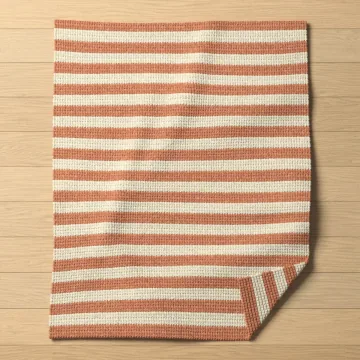
Plain single crochet (UK double crochet), where two stitches by two rows are the square for one cross. Two bands of hearts, one near each end, are cross stitched over the finished rows in red, with a line of crosses above and below each band and small hearts between the bands. A border is worked all the way around.