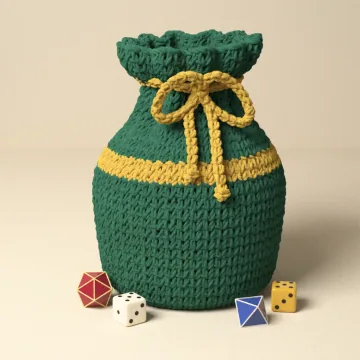
Dragon egg dice bag crochet pattern
Intermediate · 4 colors · 2 sizes
Size: One set Change size
PDF · US Letter · 4 pages · Change paper
Go to the instructions Round counter
- Size
- About 2¾ in (7 cm) across and 4½ in (11.5 cm) tall, for one set of seven dice
- Skill
- IntermediateIt has one special stitch, the scale, worked round the posts of the stitches below.
- Yarn
- Light (3), about 105 yd (96 m), an estimate
- Hook
- 3.5 mm (US E-4)
Size 2 choices · One set is pictured
Paper for the PDF
For your own crochet, gifts and handmade pieces you sell. Do not resell or share this PDF or copies of it. Selling, classes and kits: the rules
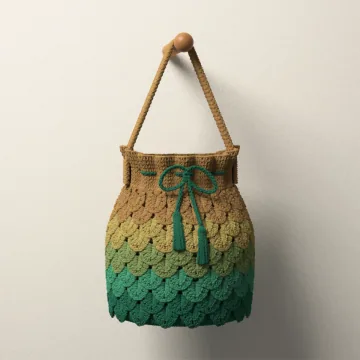
A dice bag in the shape of a dragon egg, covered all round in small overlapping scales that shade from deep amethyst at the base to silver at the top. The base is a round bowl of single crochet (UK double crochet). Above it rows of pairs of double crochet (UK treble) carry the scales, also called crocodile stitch, and grow narrower toward the top, which a cord draws closed.
Sizes
| Size | Finished size, about | Yarn, an estimate |
|---|---|---|
| One set | 2¾ in (7 cm) across, 4½ in (11.5 cm) tall | about 105 yd (96 m) |
| Several sets | 4¼ in (11 cm) across, 6 in (15 cm) tall | about 190 yd (174 m) |
Gauge
22 stitches and 24 rounds to 4 in (10 cm) in single crochet.
A scale row is a round of pairs and a round of scales together. Two scale rows are about 1 in (2.5 cm) tall, measured on the wrong side; the scales themselves are longer and hang over the row below. Scale rows that differ a little do no harm.
How to measure it
Check your gauge on the piece. Begin the pattern and measure the piece itself as you go.
The gauge is checked on the piece itself: after round 6 the base should measure about 2 in (5 cm) across, laid flat and not stretched.
If the piece measures more than that, begin again with a smaller hook; if it measures less, with a larger hook.
Before you start
How it is worked: Magic ring · Working in the round · Changing colors
Read the 6 notes
- Begin with a magic ring: wind the yarn once round two fingers, put the hook through the ring and draw up a loop. Work round 1 into the ring, then pull the tail to draw the ring closed.
- Each round is joined with a slip stitch and all of them are worked with the right side facing; never turn. The chain at the start of a round does not count as a stitch: work the first stitch of the round into the first place of the round below, the one the round below was joined in. A round of pairs is joined in the top of the first dc of its first pair, and a round of scales in the top of its first sc, or of the first dc of its first scale.
- Into a pair or a scale: where the pattern says to work a stitch into a pair, put the hook between the two dc of that pair, at their tops. A scale hangs in front of its pair, so a stitch worked into a scale goes into the same place: between the two dc of the pair behind it.
- How the scales lie: each is worked on every second pair, with one sc in the pair between, which holds it down. In the next scale row the scales come on the other pairs, so that each lies over the gap between two of the row below.
- To change color where a joined round begins, draw the new yarn through as the last yarn over of the slip stitch that ends the round before. Cut the old yarn at each change, leaving a tail of 6 in (15 cm).
- Colors, round by round. Rounds 1 to 15: A. Rounds 16 to 19: B. Rounds 20 to 21: C. Rounds 22 to 27: D.
Instructions
Size: One set Change sizeUS termsUK terms
- “[ ]” is a repeat.
- The count at the end is what the round leaves.
- Tick a round when it is done. Your place is kept in this browser.
How to read these rounds
Square brackets “[ ]” hold a repeat: work what is inside as many times as it says. In UK terms sl st is slip stitch, sc is double crochet, dc is treble and sk is miss.
Yarns in order of use: A, deep amethyst; B, amethyst; C, lilac gray; D, silver.
- FoundationMake a magic ring.
- Rnd 1RSCh 1, 6 sc in MR, sl st in first sc to joinleaves (6 sc)
- Rnd 2Ch 1, 2 sc in each st around, sl st in first sc to joinleaves (12 sc)
- Rnd 3Ch 1, repeat: 2 sc in next st, sc in next st 6 times, sl st in first sc to joinleaves (18 sc)
- Rnd 4Ch 1, repeat: sc in next 2 sts, 2 sc in next st 6 times, sl st in first sc to joinleaves (24 sc)
- Rnd 5Ch 1, sc in next st, 2 sc in next st, repeat: sc in next 3 sts, 2 sc in next st 5 times, sc in next 2 sts, sl st in first sc to joinleaves (30 sc)
- Rnd 6Ch 1, repeat: sc in next 4 sts, 2 sc in next st 6 times, sl st in first sc to joinleaves (36 sc)
- Stop and measure now, after round 6.The base should measure about 2 in (5 cm) across.
- Rnd 7Ch 1, sc in each st around, sl st in first sc to joinleaves (36 sc)
- Rnd 8Ch 1, repeat: sc in next 5 sts, 2 sc in next st 6 times, sl st in first sc to joinleaves (42 sc)
- Rnd 9Ch 1, sc in each st around, sl st in first sc to joinleaves (42 sc)
- Rnd 10Ch 1, repeat: sc in next 6 sts, 2 sc in next st 6 times, sl st in first sc to joinleaves (48 sc)
- Rnd 11Ch 1, sc in each st around, sl st in first sc to joinleaves (48 sc)
Scale row 1
- Rnd 12Ch 2, repeat: pair in next st, ch 1, sk next 2 sts 16 times, sl st in first pair to joinleaves (16 pairs, 16 ch-1 sps)
- Rnd 13Ch 1, repeat: sc in next st, sk next ch-1 sp, scale in next st, sk next ch-1 sp 8 times, sl st in first sc to joinleaves (8 sc, 8 scales)
Scale row 2
- Rnd 14Ch 2, repeat: pair in next st, ch 1 16 times, sl st in first pair to joinleaves (16 pairs, 16 ch-1 sps)
- Rnd 15Ch 1, repeat: scale in next st, sk next ch-1 sp, sc in next st, sk next ch-1 sp 8 times, sl st in first scale to joinleaves (8 scales, 8 sc)
Scale row 3
- Rnd 16With B, ch 2, repeat: pair in next st, pair in next st, ch 1 8 times, sl st in first pair to joinleaves (16 pairs, 8 ch-1 sps)
- Rnd 17Ch 1, repeat: sc in next st, scale in next st, sk next ch-1 sp 8 times, sl st in first sc to joinleaves (8 sc, 8 scales)
Scale row 4
- Rnd 18Ch 2, repeat: pair in next st, pair in next st, ch 1 8 times, sl st in first pair to joinleaves (16 pairs, 8 ch-1 sps)
- Rnd 19Ch 1, repeat: scale in next st, sc in next st, sk next ch-1 sp 8 times, sl st in first scale to joinleaves (8 scales, 8 sc)
Scale row 5
- Rnd 20With C, ch 2, pair in each st around, sl st in first pair to joinleaves (16 pairs)
- Rnd 21Ch 1, repeat: sc in next st, scale in next st 8 times, sl st in first sc to joinleaves (8 sc, 8 scales)
Scale row 6
- Rnd 22With D, ch 2, pair in each st around, sl st in first pair to joinleaves (16 pairs)
- Rnd 23Ch 1, repeat: scale in next st, sc in next st 8 times, sl st in first scale to joinleaves (8 scales, 8 sc)
Top
- Rnd 24Ch 1, 2 sc in each st around, sl st in first sc to joinleaves (32 sc)
- Rnd 25Ch 1, repeat: sc in next 3 sts, ch 1, sk next st 8 times, sl st in first sc to joinleaves (24 sc, 8 ch-1 sps)
- Rnd 26Ch 1, repeat: sc in next 3 sts, sc in next ch-1 sp 8 times, sl st in first sc to joinleaves (32 sc)
- Rnd 27Ch 1, sc in each st around, sl st in first sc to joinleaves (32 sc)
- EndFasten off, leaving a tail of 6 in (15 cm).
Assembly
- Weave in all the tails on the wrong side. Turn the bag right side out and smooth every scale down so that its tip points to the base.
- For the cord, with A, ch 110, about 16 in (40.5 cm) long, and fasten off with a tail of 6 in (15 cm) at each end. Round 25 has 8 chain-1 spaces, an even number. Begin at any of them, from the outside: go in at that space and out at the next, and so on round, so that the cord comes out at the last space, beside the one where it went in. Make both ends equally long. Knot each end and trim its tail to about ½ in (1.5 cm).
- Draw the cord up until the top closes, and tie it in a bow. The last rounds stand up above the cord as a small frill.
Finishing
- If a scale curls up, pin its tip down on the row below, damp it and let it dry.
In all: 27 rounds.