Girls' heart border shawl crochet pattern
Intermediate · 3 colors · 2,199 stitches · 3 sizes
Size: Toddler, 2 to 3 years Change size
PDF · US Letter · 5 pages · Change paper
Go to the instructions Row counter
- Size
- About 33¼ × 16½ in (84 × 42 cm)
- Skill
- IntermediateWorking in two colors, increases, picots
- Yarn
- Light (3), about 285 yd (261 m), an estimate
- Hook
- 5 mm (US H-8)
Size 3 choices · Toddler, 2 to 3 years is pictured
Which size? Shawl and cowl size chart
Paper for the PDF
For your own crochet, gifts and handmade pieces you sell. Do not resell or share this PDF or copies of it. Selling, classes and kits: the rules
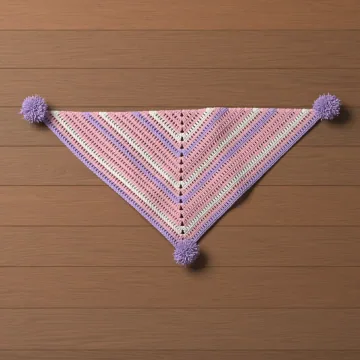
A heart shawl for girls in DK yarn: a small top down triangle with a band of cherry hearts on cream, a picot edge and a chest button. Three sizes. The hearts are worked in as the rows go by, in double crochet (UK: treble) in two colors, and they stand upright when the shawl is worn.
Sizes
| Size | Finished size, about | Yarn, an estimate |
|---|---|---|
| Toddler, 2 to 3 years | 33¼ × 16½ in (84 × 42 cm) | about 285 yd (261 m) |
| Child, 4 to 6 years | 39¼ × 19½ in (100 × 50 cm) | about 385 yd (352 m) |
| Child, 7 to 10 years | 45¼ × 22½ in (115 × 57 cm) | about 500 yd (457 m) |
Gauge
15 stitches and 7½ rows to 4 in (10 cm) in double crochet.
How to measure it
Check your gauge on the piece. Begin the pattern and measure the piece itself as you go.
After row 6 the top edge, laid flat and measured straight across from tip to tip, is about 9.1 in (23.1 cm). If yours is smaller, use a larger hook; if it is larger, use a smaller one.
In a thinner or a thicker yarn: how many stitches you need, and how large it comes out.
To make it larger or smaller
Each size in the list is printed in full when it is chosen, with its own hearts, counts and yarn amounts. For a shawl a little larger than one of them work its rows as printed as far as the second cherry row, then two, four or six rows more than the one that is printed in yarn A, so that the edging is still a right side row: each of these rows has 4 dc more than the row before it in each of its two long runs, and adds about 1.5 in (3.8 cm) to the top edge. In the edging the square brackets are then worked one time more on each half for every row added. The hearts stay as they are, and yarns A and B take more than the amounts in the list: buy another ball of each.
Before you start
How it is worked: Changing colors · Joining and seaming pieces
Read the 12 notes
- The ch 3 at the start of a row counts as a dc; the last stitch of the next row is worked into the top of it. The chain stands on the first stitch of the row: "same st" right after it is that stitch, and "next st" is the one after it.
- A ch 1 at the start of a row does not count as a stitch.
- A stitch worked into a chain space goes into the open space under the chain, not into a chain stitch.
- Stitches in round brackets with a place after them, or several of one stitch with one place after them, are all worked into that one place. The brackets at the end of a row hold its count.
- What is in square brackets is worked as many times as the number after them says, in all.
- Row 1 is a right side row. Turn once between rows: the word "turn" near the start of each row is that turn.
- To change color, in the middle of a row as well as at its end, work the last stitch of the old color until two loops are left on the hook and draw the new color through them. From one row to the next cut the old color, leaving a tail of about 6 in (15.2 cm), and fasten in a fresh piece.
- In the rows of the hearts nothing is cut: carry the color that is not in use. Fasten in yarn C with the first stitch after the turning chain of the first of these rows, lay it along the tops of the row below and work over it, so that it runs hidden inside the stitches from one end of the row to the other; wherever the colors change places, the other strand is carried in the same way. At the ch 2 of the center the carried strand lies behind the chain. At the end of a row turn with both strands, and keep the carried one just loose enough that the row is not drawn in. After the last of these rows cut yarn C.
- About 33.2 in (84.3 cm) across the top edge and 16.6 in (42.2 cm) deep.
- The edging, about 0.5 in (1.3 cm) deep, is left out of these figures.
- 22 rows and an edging row. Yarn A: rows 1 to 9 and 22. Yarn C (cherry): rows 10 and 21 and the hearts. Yarn B (cream): rows 11 to 20, the ground of the hearts, and the edging, row 23.
- One heart stands at the center, half of it on each side of the ch-2 sps, and one more stands on each half; as the shawl is worn they all stand upright. They are worked in two colors in rows 12 to 19, where "with C" and "with B" say which color the next stitches are in.
Instructions
Size: Toddler, 2 to 3 years Change sizeUS termsUK terms
First read the 12 notes just above.
- “[ ]” is a repeat.
- “( )” goes into one place.
- The count at the end is what the row leaves.
- Tick a row when it is done. Your place is kept in this browser.
- Left-handed? Work everything as it is written, the other way: rows from left to right, rounds clockwise. Left-handed crochet
How to read these rows
Square brackets “[ ]” hold a repeat: work what is inside as many times as it says. Round brackets “( )” inside a line hold stitches that all go into one place. In UK terms sl st is slip stitch, sc is double crochet and dc is treble.
Yarns in order of use: A, strawberry pink; C, cherry red; B, cream.
- FoundationCh 4, sl st in first ch to form a ring.
- Row 1RSCh 3 (counts as dc), 2 dc in ring, ch 2, 3 dc in ringleaves (6 dc, 1 ch-2 sp)
- Row 2WSCh 3 (counts as dc), turn; 2 dc in same st, dc in next 2 sts, (2 dc, ch 2, 2 dc) in next ch-2 sp, dc in next 2 sts, 3 dc in top of turning chleaves (14 dc, 1 ch-2 sp)
- Row 3RSCh 3 (counts as dc), turn; 2 dc in same st, dc in next 6 sts, (2 dc, ch 2, 2 dc) in next ch-2 sp, dc in next 6 sts, 3 dc in top of turning chleaves (22 dc, 1 ch-2 sp)
- Row 4WSCh 3 (counts as dc), turn; 2 dc in same st, dc in next 10 sts, (2 dc, ch 2, 2 dc) in next ch-2 sp, dc in next 10 sts, 3 dc in top of turning chleaves (30 dc, 1 ch-2 sp)
- Row 5RSCh 3 (counts as dc), turn; 2 dc in same st, dc in next 14 sts, (2 dc, ch 2, 2 dc) in next ch-2 sp, dc in next 14 sts, 3 dc in top of turning chleaves (38 dc, 1 ch-2 sp)
- Row 6WSCh 3 (counts as dc), turn; 2 dc in same st, dc in next 18 sts, (2 dc, ch 2, 2 dc) in next ch-2 sp, dc in next 18 sts, 3 dc in top of turning chleaves (46 dc, 1 ch-2 sp)
- Row 7RSCh 3 (counts as dc), turn; 2 dc in same st, dc in next 22 sts, (2 dc, ch 2, 2 dc) in next ch-2 sp, dc in next 22 sts, 3 dc in top of turning chleaves (54 dc, 1 ch-2 sp)
- Row 8WSCh 3 (counts as dc), turn; 2 dc in same st, dc in next 26 sts, (2 dc, ch 2, 2 dc) in next ch-2 sp, dc in next 26 sts, 3 dc in top of turning chleaves (62 dc, 1 ch-2 sp)
- Row 9RSCh 3 (counts as dc), turn; 2 dc in same st, dc in next 30 sts, (2 dc, ch 2, 2 dc) in next ch-2 sp, dc in next 30 sts, 3 dc in top of turning chleaves (70 dc, 1 ch-2 sp)
- Row 10WSYarn C. Ch 3 (counts as dc), turn; 2 dc in same st, dc in next 34 sts, (2 dc, ch 2, 2 dc) in next ch-2 sp, dc in next 34 sts, 3 dc in top of turning chleaves (78 dc, 1 ch-2 sp)
- Row 11RSYarn B. Ch 3 (counts as dc), turn; 2 dc in same st, dc in next 38 sts, (2 dc, ch 2, 2 dc) in next ch-2 sp, dc in next 38 sts, 3 dc in top of turning chleaves (86 dc, 1 ch-2 sp)
- Row 12WSCh 3 (counts as dc), turn; 2 dc in same st, dc in next 27 sts, with C, dc in next 7 sts, with B, dc in next 8 sts, (2 dc, ch 2, 2 dc) in next ch-2 sp, dc in next 8 sts, with C, dc in next 7 sts, with B, dc in next 27 sts, 3 dc in top of turning chleaves (94 dc, 1 ch-2 sp)
- Row 13RSCh 3 (counts as dc), turn; 2 dc in same st, dc in next 27 sts, with C, dc in next 11 sts, with B, dc in next 8 sts, (2 dc, ch 2, 2 dc) in next ch-2 sp, dc in next 8 sts, with C, dc in next 11 sts, with B, dc in next 27 sts, 3 dc in top of turning chleaves (102 dc, 1 ch-2 sp)
- Row 14WSCh 3 (counts as dc), turn; 2 dc in same st, dc in next 29 sts, with C, dc in next 11 sts, with B, dc in next 10 sts, (2 dc, ch 2, 2 dc) in next ch-2 sp, dc in next 10 sts, with C, dc in next 11 sts, with B, dc in next 29 sts, 3 dc in top of turning chleaves (110 dc, 1 ch-2 sp)
- Row 15RSCh 3 (counts as dc), turn; 2 dc in same st, dc in next 27 sts, with C, dc in next 15 sts, with B, dc in next 7 sts, with C, dc in next 5 sts, (2 dc, ch 2, 2 dc) in next ch-2 sp, dc in next 5 sts, with B, dc in next 7 sts, with C, dc in next 15 sts, with B, dc in next 27 sts, 3 dc in top of turning chleaves (118 dc, 1 ch-2 sp)
- Row 16WSCh 3 (counts as dc), turn; 2 dc in same st, dc in next 27 sts, with C, dc in next 17 sts, with B, dc in next 5 sts, with C, dc in next 9 sts, (2 dc, ch 2, 2 dc) in next ch-2 sp, dc in next 9 sts, with B, dc in next 5 sts, with C, dc in next 17 sts, with B, dc in next 27 sts, 3 dc in top of turning chleaves (126 dc, 1 ch-2 sp)
- Row 17RSCh 3 (counts as dc), turn; 2 dc in same st, dc in next 29 sts, with C, dc in next 17 sts, with B, dc in next 5 sts, with C, dc in next 11 sts, (2 dc, ch 2, 2 dc) in next ch-2 sp, dc in next 11 sts, with B, dc in next 5 sts, with C, dc in next 17 sts, with B, dc in next 29 sts, 3 dc in top of turning chleaves (134 dc, 1 ch-2 sp)
- Row 18WSCh 3 (counts as dc), turn; 2 dc in same st, dc in next 31 sts, with C, dc in next 17 sts, with B, dc in next 5 sts, with C, dc in next 13 sts, (2 dc, ch 2, 2 dc) in next ch-2 sp, dc in next 13 sts, with B, dc in next 5 sts, with C, dc in next 17 sts, with B, dc in next 31 sts, 3 dc in top of turning chleaves (142 dc, 1 ch-2 sp)
- Row 19RSCh 3 (counts as dc), turn; 2 dc in same st, dc in next 35 sts, with C, dc in next 15 sts, with B, dc in next 7 sts, with C, dc in next 13 sts, (2 dc, ch 2, 2 dc) in next ch-2 sp, dc in next 13 sts, with B, dc in next 7 sts, with C, dc in next 15 sts, with B, dc in next 35 sts, 3 dc in top of turning chleaves (150 dc, 1 ch-2 sp)
- Row 20WSCh 3 (counts as dc), turn; 2 dc in same st, dc in next 74 sts, (2 dc, ch 2, 2 dc) in next ch-2 sp, dc in next 74 sts, 3 dc in top of turning chleaves (158 dc, 1 ch-2 sp)
- Row 21RSYarn C. Ch 3 (counts as dc), turn; 2 dc in same st, dc in next 78 sts, (2 dc, ch 2, 2 dc) in next ch-2 sp, dc in next 78 sts, 3 dc in top of turning chleaves (166 dc, 1 ch-2 sp)
- Row 22WSYarn A. Ch 3 (counts as dc), turn; 2 dc in same st, dc in next 82 sts, (2 dc, ch 2, 2 dc) in next ch-2 sp, dc in next 82 sts, 3 dc in top of turning chleaves (174 dc, 1 ch-2 sp)
- Row 23RSYarn B. Ch 1, turn; sc in first st, repeat: sk next st, (2 dc, picot, 2 dc) in next st, sk next st, sc in next st 21 times, sk next 2 sts, (4 dc, picot, 3 dc) in next ch-2 sp, sk next 2 sts, sc in next st, repeat: sk next st, (2 dc, picot, 2 dc) in next st, sk next st, sc in next st 20 times, sk next st, (2 dc, picot, 2 dc) in next st, sk next st, sc in top of turning chleaves (44 sc, 175 dc, 43 picots)
- EndFasten off.
Putting it together
Button loop: lay the shawl with the right side up and the top edge away from you. Count the rows along the top edge from the middle outward: the end stitch of row 10 stands about 7.5 in (19.1 cm) from the middle on each side. Join yarn A with a slip stitch round the end stitch of row 10 on the left, ch 9, slip stitch round the same end stitch beside the first slip stitch, and fasten off. Sew the button, about 0.9 in (2.3 cm) across, to the right side of the end stitch of row 10 on the right, with yarn A and the yarn needle, and fasten it off firmly on the wrong side. The shawl is buttoned at the chest and its two tips hang free.
Finishing
- Weave in the ends.
In all: 23 rows; 2,199 stitches.