Iris stitch wrap crochet pattern
Easy, standard to long and wide, 3 colors
PDF, for US Letter and A4. Standard. Another size
What you need
- Yarn
- Medium weight, 4 on the label (UK aran), an estimate: about 980 yd (896 m) in all or 490 g. Using a different yarn?
- A violet330 yd (302 m), 170 g
- B lavender300 yd (274 m), 150 grows 21 to 40 and 81 to 100
- C ivory350 yd (320 m), 180 gstripe
- Hook
- 5.5 mm (US I-9), or the size that gives you the gauge
- Gauge
- 13 stitches and 7½ rows to 4 in (10 cm) in iris stitch. Test square
- Also
- A yarn needle, scissors and a tape measure
New to this? How to crochet
Choose a size
| Size | Finished size | Yarn (ydm) |
|---|---|---|
| Standard, chosen | 20 × 66¼ in (51 × 168 cm) | 980896 |
| Long | 20 × 72 in (51 × 183 cm) | 1,070978 |
| Long and wide | 23¾ × 72 in (60 × 183 cm) | 1,2501,143 |
Press a size: the rows and the PDF follow. Take the size nearest your own measure. Shawl and cowl size chart
Before you start
Gauge
Work a test square first (11 rows)
A test piece to measure and pull out. It is not the start of the pattern.
Lay it flat and measure in its middle.
- StartCh 23.
- 1Sh in 5th ch from hook (skipped chs count as dc), repeat: sk next 3 chs, sh in next ch 4 times, sk next ch, dc in next ch2 dc, 5 sh
- 2–11Ch 3 (counts as dc), turn; repeat: sh in next ch-1 sp 5 times, sk next 2 sts, dc in top of turning ch2 dc, 5 sh
Key
- ch
- chain
- dc
- double crochet UK tr
- tr
- treble crochet UK dtr
- sk
- skip
- st
- stitch
ch-1 sp: the hole under the chain. The hook goes in the hole, never into a chain.
The ch 3 is the first dc: skip the first stitch; the last dc goes in the top of the 3 chains.
[ ] 15 times: 15 times in all. ( ) in one place: all of it there. 2 dc, 16 sh: the row now has that many; a check, not a step.
US terms. Show UK terms
Left-handed? Hook in the left hand; work the rows from left to right. No count changes.
Rows
Standard. Change
Press a row’s number when it is done. Key
Special stitches
- The 124 rows below make this size. For another length, work fewer or more rows in the same order, with the stripes in the same order, and stop at the end of a stripe.
- Check your width as you go: when row 6 is done, measure the width, across the middle of the rows and not along the chain edge. It is about 20 in (51 cm). If it is wider, start again with a smaller hook; if it is narrower, with a larger one. If only the chain edge is tight, make the chain with a larger hook.
- StartWith A, make a slip knot and ch 67.
- 1Sh in 5th ch from hook (skipped chs count as dc), repeat: sk next 3 chs, sh in next ch 15 times, sk next ch, dc in next ch2 dc, 16 sh
- 2–20Ch 3 (counts as dc), turn; repeat: sh in next ch-1 sp 16 times, sk next 2 sts, dc in top of turning ch2 dc, 16 sh
Stripe in B, lavender
- 21With B, ch 3 (counts as dc), turn; repeat: sh in next ch-1 sp 16 times, sk next 2 sts, dc in top of turning ch2 dc, 16 sh
- 22–40Ch 3 (counts as dc), turn; repeat: sh in next ch-1 sp 16 times, sk next 2 sts, dc in top of turning ch2 dc, 16 sh
Stripe in C, ivory
- 41With C, ch 3 (counts as dc), turn; repeat: sh in next ch-1 sp 16 times, sk next 2 sts, dc in top of turning ch2 dc, 16 sh
- 42–60Ch 3 (counts as dc), turn; repeat: sh in next ch-1 sp 16 times, sk next 2 sts, dc in top of turning ch2 dc, 16 sh
Stripe in A, violet
- 61With A, ch 3 (counts as dc), turn; repeat: sh in next ch-1 sp 16 times, sk next 2 sts, dc in top of turning ch2 dc, 16 sh
- 62–80Ch 3 (counts as dc), turn; repeat: sh in next ch-1 sp 16 times, sk next 2 sts, dc in top of turning ch2 dc, 16 sh
Stripe in B, lavender
- 81With B, ch 3 (counts as dc), turn; repeat: sh in next ch-1 sp 16 times, sk next 2 sts, dc in top of turning ch2 dc, 16 sh
- 82–100Ch 3 (counts as dc), turn; repeat: sh in next ch-1 sp 16 times, sk next 2 sts, dc in top of turning ch2 dc, 16 sh
Stripe in C, ivory
- 101With C, ch 3 (counts as dc), turn; repeat: sh in next ch-1 sp 16 times, sk next 2 sts, dc in top of turning ch2 dc, 16 sh
- 102–124Ch 3 (counts as dc), turn; repeat: sh in next ch-1 sp 16 times, sk next 2 sts, dc in top of turning ch2 dc, 16 sh
- Fasten off, leaving a tail of about 6 in (15 cm).
Assembly
- Fringe: cut 66 lengths of A, each about 12 in (30 cm) long. For each knot fold three lengths in half together, pull the fold through the foundation edge with the hook, pull the ends through the fold and draw it tight. Make 22 knots along the foundation edge, one at each corner and the others evenly spread, a little under 1 in (2.5 cm) apart. Trim the ends level, about 5 in (13 cm) long.
- Fringe: cut 66 lengths of C, each about 12 in (30 cm) long. For each knot fold three lengths in half together, pull the fold through the last row with the hook, pull the ends through the fold and draw it tight. Make 22 knots along the last row, one at each corner and the others evenly spread, a little under 1 in (2.5 cm) apart. Trim the ends level, about 5 in (13 cm) long.
Finishing
- Weave in the ends with the yarn needle, changing direction once or twice.
Goes with this
About this pattern
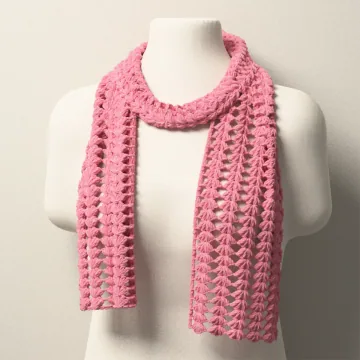
Small shells of two double crochets, a chain and two more, stacked chain space over chain space in straight columns. Here in stripes of violet, lavender and ivory; work it in one color if you like. A knotted fringe closes both ends.
Gauge
13 stitches and 7½ rows to 4 in (10 cm) in iris stitch.
To check yours in the middle of the test piece: three repeats of the bracketed group side by side (12 foundation chains' worth) are about 3¾ in (9.5 cm) wide, and 8 rows are about 4¼ in (11 cm) tall.
Use any hook that gives you this. If you count more stitches than this in 4 in (10 cm), change to a larger hook; if you count fewer, to a smaller one.
Notes
- The ch 3 at the start of a row counts as a dc. The last stitch of the next row is worked into the top of it. In row 1 the 3 chains nearest the hook stand for that first dc and the last chain you made is its top; the fourth skipped chain is only passed over. The last dc of row 2 goes into that top.
- Row 1 is the right side.
- A stitch worked into a chain space passes over any stitches that lie before the space; they are left unworked.
- Stitches in parentheses are all worked into the one place named after them.
- Leave a tail of about 6 in (15 cm) when you begin, and weave it in at the end with the others.
- To change yarn, work the last yarn over of the last stitch of the row before with the new yarn. Cut the old yarn at the end of its stripe, leaving a tail of about 6 in (15 cm), and leave a tail of the same length on the new yarn.
- For another width, add or take away 4 chains at a time: each 4 chains adds one more repeat of each bracketed group. Measure your own gauge first.
- The finished sizes are given without the fringe.
- Buy whole balls from one dye lot.
Yarn
To find how many balls: divide by the length on your yarn's label and round up. Buy them from one dye lot.
The estimate is from the stitches of this size at this gauge, with 15 percent added.
For an estimate from a swatch of your own: the yarn calculator.
Abbreviations
Written in US terms. Where the UK name differs it is given beside the US one.
- dc
- double crochet (UK: tr, treble)
- RS
- right side
- sk
- skip (UK: miss)
- sp
- space
- st
- stitch
- tr
- treble crochet (UK: dtr, double treble)
Details
- Size
- About 20 × 66¼ in (51 × 168 cm)
- In all
- 124 rows
- Skill
- EasyGroups in one place, skipped stitches, chain spaces
You may sell what you make from it by hand, in small quantities. The PDF itself is not to be sold or shared. Selling, classes and kits: the rules