Daisy trim for jeans hems crochet pattern
Easy · 3 colors · 3 sizes
Size: Adult, straight leg Change size
PDF · US Letter · 4 pages · Change paper
Go to the instructions Round counter
- Size
- About 15½ in (39.5 cm) round and about 2½ in (6.5 cm) deep
- Skill
- EasySmall rounds, petals, joining as you go, eyelets
- Yarn
- Light (3), about 125 yd (114 m), an estimate
- Hook
- 4 mm (US G-6)
Size 3 choices · Adult, straight leg is pictured
Paper for the PDF
For your own crochet, gifts and handmade pieces you sell. Do not resell or share this PDF or copies of it. Selling, classes and kits: the rules
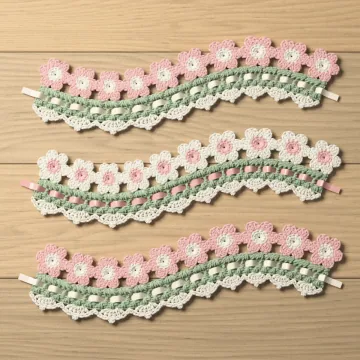
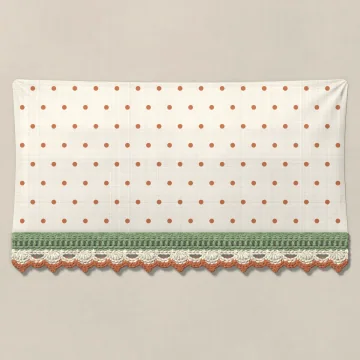
A lace band with a seventies look in DK cotton. Each daisy is two small rounds, and the heading is four.
Sizes
| Size | Finished size, about | Yarn, an estimate |
|---|---|---|
| Adult, straight leg | 15½ in (39.5 cm) round, 2½ in (6.5 cm) deep | about 125 yd (114 m) |
| Child | 12½ in (31.5 cm) round, 2½ in (6.5 cm) deep | about 100 yd (91 m) |
| Adult, flared leg | 21¾ in (55.5 cm) round, 2½ in (6.5 cm) deep | about 170 yd (155 m) |
Gauge
18 stitches and 9½ rounds to 4 in (10 cm) in double crochet.
How to measure it
Check your gauge on the piece. Begin the pattern and measure the piece itself as you go.
After round 2 of the heading the strip is about 15.6 in (39.6 cm) round. If yours is shorter, use a larger hook; if it is longer, use a smaller one.
In a thinner or a thicker yarn: how many stitches you need, and how large it comes out.
To make it larger or smaller
One daisy is about 1.56 in (3.95 cm) of hem, and 9 daisies are 14 in (35.6 cm). For another hem, divide its length round by 1.56 in (3.95 cm) and take the nearest whole number of daisies, m: one first daisy, m - 2 next daisies and one last daisy. The ring is then no more than about 0.9 in (2.3 cm) longer or shorter than the hem: ease in what is too long as you sew; if it is too short, dampen the finished ring, pin it out to the length of the hem and let it dry. In the heading the brackets of rounds 1 and 2 are worked m - 1 times. With an even m, round 2 has 7 × m sc, and the brackets of rounds 3 and 4 are worked 7 × m ÷ 2 - 1 times. With an odd m, work 3 sc instead of 2 in the last ch-2 sp of round 2: it then has 7 × m + 1 sc, and the brackets of rounds 3 and 4 are worked (7 × m + 1) ÷ 2 - 1 times. For a back pocket sew on a row of daisies alone, without the heading. Divide the width of the pocket by 1.56 in (3.95 cm): the whole number in the answer is the number of daisies in all, the first daisy among them. Work one first daisy, and next daisies for all the others. Lay the row on the outside of the pocket, right side up, its middle on the middle of the pocket, with the tips of the upper petals just below the hem stitching of the pocket. Pin it. With the sewing needle and the thread that matches yarn A sew through the pocket cloth only: one small stitch over the tip of each free petal, between its 2 dc, and one over each place where two daisies are joined. Fasten the thread on the inside of the pocket.
Before you start
How it is worked: Working in the round · Joining squares · Changing colors
Read the 14 notes
- Rounds go against the clock (with the clock if you are left handed). Lay a daisy with its right side up and its first petal at the right: petals 2, 3 and 4 are its upper half, petal 5 is at the left, and petals 6, 7 and 8 are its lower half (for a left-handed maker left and right change places).
- Each next daisy lies to the left of the one before it: it is joined by its first petal, a jpetal, to the fifth petal of the daisy before it. The last daisy is joined by its first petal in the same way, and by its fifth petal to the first petal of the first daisy, so that the daisies form a ring. Before that last join see that the strip is not twisted: every right side faces out.
- Petals are worked into the 8 sc of round 1, one petal in each. The slip stitch with which yarn A is joined is the first slip stitch of the first petal. The slip stitch that joins round 2 at its end goes into the first slip stitch of the first petal.
- Heading: choose one edge of the ring as the upper edge. Each st of it is the gap between the 2 dc of a petal; take the three free petals of each daisy in turn, beginning on any daisy with the one of the three at its right-hand end (its left-hand end if you are left handed), and go round to the left (to the right). In round 1 the dc stand on the outer two petals of a daisy and the sc on the middle one.
- When a round begins with "Join", fasten off the yarn you have at the end of the round before (cut it, leaving a tail of about 6 in (15.2 cm), and draw the tail through the last loop). Then join the yarn named with a slip stitch in the place named.
- The ch 3 at the start of a round counts as a dc.
- A ch 1 at the start of a round does not count as a stitch.
- A stitch worked into a chain space goes into the open space under the chain, not into a chain stitch.
- Where several stitches have one place after them, as in "2 sc in next ch-2 sp", they are all worked into that one place.
- What is in square brackets is worked as many times as the number after them says, in all.
- Every round is worked with the right side facing; do not turn.
- For two hems about 15.6 in (39.6 cm) round each. Every leg has a ring of 10 daisies; with its heading the trim is about 2.5 in (6.4 cm) deep.
- Each daisy is 2 rounds and each heading is 4 rounds.
- Work for each leg: one first daisy, then 8 next daisies, then one last daisy, then the heading along the upper edge of the ring. The daisies are written out first.
Instructions
Size: Adult, straight leg Change sizeUS termsUK terms
First read the 14 notes just above.
Go to: First daisy · Next daisies · Last daisy · Heading
- “[ ]” is a repeat.
- The count at the end is what the round leaves.
- Tick a round when it is done. Your place is kept in this browser.
- Left-handed? Work everything as it is written, the other way: rows from left to right, rounds clockwise. Left-handed crochet
How to read these rounds
Square brackets “[ ]” hold a repeat: work what is inside as many times as it says. In UK terms sl st is slip stitch, sc is double crochet and dc is treble.
Heading, round 3 in full words: Chain 3 (counts as double crochet), chain 1, skip next stitch, [double crochet in next stitch, chain 1, skip next stitch] 34 times, slip stitch in top of chain-3 to join.
First daisy make 2
Yarns in order of use: B, yellow cotton; A, white cotton.
- FoundationCh 4, sl st in first ch to form a ring.
- Rnd 1Ch 1, 8 sc in ring, sl st in first sc to joinleaves (8 sc)
- Rnd 2Join A with sl st in first st, petal in first st, petal in next 7 sts, sl st in first petal to joinleaves (8 petals)
- EndFasten off.
Next daisies make 16
Yarns in order of use: B, yellow cotton; A, white cotton.
- FoundationCh 4, sl st in first ch to form a ring.
- Rnd 1Ch 1, 8 sc in ring, sl st in first sc to joinleaves (8 sc)
- Rnd 2Join A with sl st in first st, jpetal in first st, petal in next 7 sts, sl st in first jpetal to joinleaves (1 jpetal, 7 petals)
- EndFasten off.
Last daisy make 2
Yarns in order of use: B, yellow cotton; A, white cotton.
- FoundationCh 4, sl st in first ch to form a ring.
- Rnd 1Ch 1, 8 sc in ring, sl st in first sc to joinleaves (8 sc)
- Rnd 2Join A with sl st in first st, jpetal in first st, petal in next 3 sts, jpetal in next st, petal in next 3 sts, sl st in first jpetal to joinleaves (2 jpetals, 6 petals)
- EndFasten off.
Heading make 2
Yarns in order of use: C, sky blue cotton; A, white cotton.
- FoundationThe upper edge of the daisy ring: 30 sts round, with the right side facing you, each st the gap between the 2 dc of a petal, three petals to a daisy.
- Rnd 1Join C with sl st in first st, ch 3 (counts as dc), ch 2, sc in next st, ch 2, dc in next st, repeat: dc in next st, ch 2, sc in next st, ch 2, dc in next st 9 times, sl st in top of ch-3 to joinleaves (20 dc, 20 ch-2 sps, 10 sc)
- Rnd 2Ch 1, sc in first st, 2 sc in next ch-2 sp, sc in next st, 2 sc in next ch-2 sp, sc in next st, repeat: sc in next st, 2 sc in next ch-2 sp, sc in next st, 2 sc in next ch-2 sp, sc in next st 9 times, sl st in first sc to joinleaves (70 sc)
- Rnd 3Ch 3 (counts as dc), ch 1, sk next st, repeat: dc in next st, ch 1, sk next st 34 times, sl st in top of ch-3 to joinleaves (35 dc, 35 ch-1 sps)
- Rnd 4Join A with sl st in first st, ch 1, sc in first st, sc in next ch-1 sp, repeat: sc in next st, sc in next ch-1 sp 34 times, sl st in first sc to joinleaves (70 sc)
- EndFasten off.
Finishing
- Weave in the ends on the wrong side.
- Sew it on: turn the jeans right side out and lay the heading over the hem with its right side up, so that round 1 lies just below the edge of the hem and rounds 2, 3 and 4 lie on the denim. Begin with the join of the rounds at the inner seam. Pin the heading all round, easing it to fit. With the sewing needle and the thread that matches yarn A sew the top edge down with small stitches, one under every second sc of round 4. With the thread that matches yarn C sew round 2 down along the edge of the hem in the same way, one small stitch under every second sc of round 2.
In all: 22 pieces.