Lace kippah crochet pattern
Intermediate · 2 colors · 1,136 stitches · 2 sizes, Small to large
Size: Large, head 23 in (58 cm) Change size
PDF · US Letter · 5 pages · Change paper
Go to the instructions Round counter
- Size
- About 22½ in (57 cm) round and about 4½ in (11 cm) deep, measured along the cloth from the center of the top to the tips of the shells, and about 7¼ in (18 cm) across above the shellsTo fit a head of 23 in (58 cm)
- Skill
- IntermediateDouble crochet and chain spaces in joined rounds, a shell edge
- Yarn
- Super fine (1), about 80 yd (73 m), an estimate
- Hook
- 2.25 mm (US B-1)
Size 2 choices · Large, head 23 in (58 cm) is pictured
Paper for the PDF
For your own crochet, gifts and handmade pieces you sell. Do not resell or share this PDF or copies of it. Selling, classes and kits: the rules
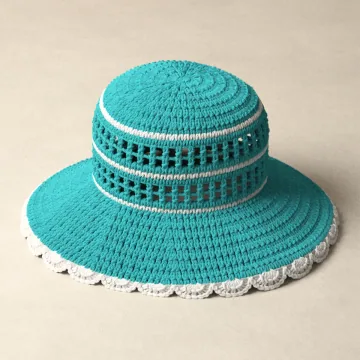
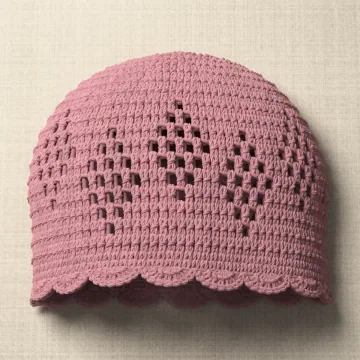
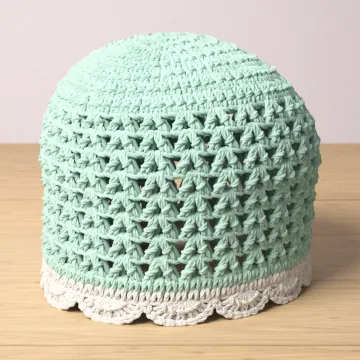
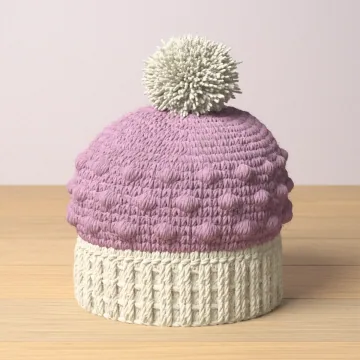
A lace kippah (yarmulke) for a woman: rings of double crochet (UK treble) and chains in lilac Super fine (1) cotton, with a plum edge of small shells. It is written in 2 sizes, about 6 in (15 cm) and 7¼ in (18 cm) across above the shells. Every round is written with its stitch count.
Sizes
- Size
- Large
- Head
- 23 in (58 cm)
- Finished size, about
- 22½ in (57 cm) round, 4½ in (11 cm) deep
- Yarn, an estimate
- about 80 yd (73 m)
Scroll the table sideways to see every column.
Gauge
30 stitches and 16 rounds to 4 in (10 cm) in double crochet.
The gauge is measured on the kippah itself, at the two places the rounds name: across the crown, which checks the height of the rounds, and round the outside of the kippah with a soft tape, along the round just worked, which checks the stitches and so the size round. If the kippah measures more round than its round says, begin again with a smaller hook; if less, with a larger one. If it is right round and the crown measures more than it says, your rounds are taller than the gauge and the kippah will come out deeper than stated; if the crown measures less, it will come out shallower. The depths given are worked out from the rounds: to 4 in (10 cm) go 32 rounds of single crochet or 16 rounds of double crochet.
How to measure it
Check your gauge on the piece. Begin the pattern and measure the piece itself as you go.
After round 18, put a soft tape round the outside of the kippah along that round, without pulling it in: the kippah should measure about 22½ in (57 cm) round.
The pattern also stops you to measure after round 3.
Before you start
How it is worked: Magic ring · Working in the round · Changing colors
Read the 12 notes
- A kippah rests on the top or the back of the head and does not go round it, so choose the size by how far it is across: lay a ruler over the head where the kippah will sit. The head measurement beside each size is only a guide to which head it is meant for.
- The pattern is written in United States terms; the United Kingdom term stands beside each stitch in the list of abbreviations.
- The kippah begins with a magic ring: wrap the yarn once round two fingers, leaving a tail of 6 in (15 cm), and with the hook draw a loop of the working yarn up through the ring. Keep that loop on the hook and make the chain that round 1 begins with; where round 1 names no chain, make 1 chain to hold the loop, and do not count it. Work the stitches of round 1 into the ring, over the tail too, then pull the tail until the ring is closed.
- The right side of the kippah faces you in every round; the rounds are never turned.
- A joined round begins with a chain that does not count as a stitch and ends with a slip stitch in its first stitch. Unless the line says otherwise, the first stitch of the next round goes into the same place as that slip stitch. In the edging round that begins with a chain and then a slip stitch, that first slip stitch goes into the joined stitch itself.
- To change yarn at the start of a round, finish the joining slip stitch of the round before with the new yarn. Where a yarn rests for 4 rounds or fewer before it is used again, carry it up the inside; where it rests for more, or is not used again, cut it, leaving a tail of 6 in (15 cm).
- Where a round begins with slip stitches and then a chain, the slip stitches lead to the chain space: the first of them goes into the stitch or the space just after the stitch that was joined, and the chain is made from there.
- The number at the end of each line is the number of stitches it has when it is finished; chains and slip stitches that are not named there are not counted.
- To wear the kippah, hold it to the hair with one or two clips at the edge.
- Where the first double crochet of a round goes: in rounds 4 and 11 into the joined stitch; in rounds 5 to 10 and 12 to 16 into a space. Each of these rounds begins with a slip stitch into the chain space that follows the joined stitch: make the chain 3, which is not counted, there, and the first double crochet into the same space. Every space of the round before is used once, in the order in which the spaces come, from under its chains and not through a chain.
- The chain that ends the repeats of a round lies just before the joining slip stitch: it is a space like the others, and the last stitches of the next round go into it.
- How the kippah widens: a double crochet is 1 stitch wide, a ch-1 sp also 1, a ch-2 sp 2 and a ch-3 sp 3. Counted so, rounds 1 to 16 are 12, 24, 36, 48, 60, 72, 84, 96, 96, 108, 120, 132, 144, 144, 156 and 168 stitches wide, and the edge has 168. No round grows by more than 12, which is what a round of double crochet can take and lie flat at this gauge; from round 9 on some take fewer or none, so that the kippah curves down little by little and stands as a shallow dome. If the net ruffles a little while you work, the shaping at the end draws it smooth.
Instructions
Size: Large, head 23 in (58 cm) Change sizeUS termsUK terms
- “[ ]” is a repeat.
- “( )” goes into one place.
- The count at the end is what the round leaves.
- Tick a round when it is done. Your place is kept in this browser.
How to read these rounds
Square brackets “[ ]” hold a repeat: work what is inside as many times as it says. Round brackets “( )” inside a line hold stitches that all go into one place. In UK terms sl st is slip stitch, sc is double crochet and dc is treble.
Yarns in order of use: A, lilac; B, plum.
- FoundationMake a magic ring.
Crown
- Rnd 1RSCh 3, 12 dc in MR, sl st in first dc to joinleaves (12 dc)
- Rnd 2Ch 3, 2 dc in each st around, sl st in first dc to joinleaves (24 dc)
- Rnd 3Ch 3, repeat: 2 dc in next st, dc in next st 12 times, sl st in first dc to joinleaves (36 dc)
- Stop and measure now, after round 3.The crown, laid flat, should measure about 1½ in (4 cm) across.
Inner net
- Rnd 4Ch 3, repeat: dc in next st, ch 1, dc in next st, ch 1, sk next st 12 times, sl st in first dc to joinleaves (24 dc, 24 ch-1 sps)
- Rnd 5Sl st in next ch-1 sp, ch 3, dc in same sp, ch 1, dc in next ch-1 sp, ch 2, repeat: dc in next ch-1 sp, ch 1, dc in next ch-1 sp, ch 2 11 times, sl st in first dc to joinleaves (24 dc, 12 ch-1 sps, 12 ch-2 sps)
- Rnd 6Sl st in next ch-1 sp, ch 3, dc in same sp, ch 1, (dc, ch 1, dc) in next ch-2 sp, ch 1, repeat: dc in next ch-1 sp, ch 1, (dc, ch 1, dc) in next ch-2 sp, ch 1 11 times, sl st in first dc to joinleaves (36 dc, 36 ch-1 sps)
- Rnd 7Sl st in next ch-1 sp, ch 3, dc in same sp, ch 1, dc in next ch-1 sp, ch 1, dc in next ch-1 sp, ch 2, repeat: dc in next ch-1 sp, ch 1, dc in next ch-1 sp, ch 1, dc in next ch-1 sp, ch 2 11 times, sl st in first dc to joinleaves (36 dc, 24 ch-1 sps, 12 ch-2 sps)
- Rnd 8Sl st in next ch-1 sp, ch 3, dc in same sp, ch 1, dc in next ch-1 sp, ch 2, dc in next ch-2 sp, ch 2, repeat: dc in next ch-1 sp, ch 1, dc in next ch-1 sp, ch 2, dc in next ch-2 sp, ch 2 11 times, sl st in first dc to joinleaves (36 dc, 12 ch-1 sps, 24 ch-2 sps)
- Rnd 9Sl st in next ch-1 sp, ch 3, dc in same sp, ch 1, dc in next ch-2 sp, ch 2, dc in next ch-2 sp, ch 2, repeat: dc in next ch-1 sp, ch 1, dc in next ch-2 sp, ch 2, dc in next ch-2 sp, ch 2 11 times, sl st in first dc to joinleaves (36 dc, 12 ch-1 sps, 24 ch-2 sps)
Ring
- Rnd 10Sl st in next ch-1 sp, ch 3, 3 dc in same sp, 3 dc in next ch-2 sp, 3 dc in next ch-2 sp, repeat: 3 dc in next ch-1 sp, 3 dc in next ch-2 sp, 3 dc in next ch-2 sp 11 times, sl st in first dc to joinleaves (108 dc)
Outer net
- Rnd 11Ch 3, repeat: dc in next st, ch 1, sk next st, dc in next st, ch 2, sk next st, dc in next st, ch 1, sk next st, dc in next st, ch 2, sk next 2 sts 12 times, sl st in first dc to joinleaves (48 dc, 24 ch-1 sps, 24 ch-2 sps)
- Rnd 12Sl st in next ch-1 sp, ch 3, dc in same sp, ch 1, dc in next ch-2 sp, ch 2, dc in next ch-1 sp, ch 2, dc in next ch-2 sp, ch 2, repeat: dc in next ch-1 sp, ch 1, dc in next ch-2 sp, ch 2, dc in next ch-1 sp, ch 2, dc in next ch-2 sp, ch 2 11 times, sl st in first dc to joinleaves (48 dc, 12 ch-1 sps, 36 ch-2 sps)
- Rnd 13Sl st in next ch-1 sp, ch 3, dc in same sp, ch 2, dc in next ch-2 sp, ch 2, dc in next ch-2 sp, ch 2, dc in next ch-2 sp, ch 2, repeat: dc in next ch-1 sp, ch 2, dc in next ch-2 sp, ch 2, dc in next ch-2 sp, ch 2, dc in next ch-2 sp, ch 2 11 times, sl st in first dc to joinleaves (48 dc, 48 ch-2 sps)
- Rnd 14Sl st in next ch-2 sp, ch 3, dc in same sp, ch 2, repeat: dc in next ch-2 sp, ch 2 47 times, sl st in first dc to joinleaves (48 dc, 48 ch-2 sps)
- Rnd 15Sl st in next ch-2 sp, ch 3, dc in same sp, ch 2, dc in next ch-2 sp, ch 2, dc in next ch-2 sp, ch 2, dc in next ch-2 sp, ch 3, repeat: dc in next ch-2 sp, ch 2, dc in next ch-2 sp, ch 2, dc in next ch-2 sp, ch 2, dc in next ch-2 sp, ch 3 11 times, sl st in first dc to joinleaves (48 dc, 36 ch-2 sps, 12 ch-3 sps)
- Rnd 16Sl st in next ch-2 sp, ch 3, dc in same sp, ch 2, dc in next ch-2 sp, ch 3, dc in next ch-2 sp, ch 2, dc in next ch-3 sp, ch 3, repeat: dc in next ch-2 sp, ch 2, dc in next ch-2 sp, ch 3, dc in next ch-2 sp, ch 2, dc in next ch-3 sp, ch 3 11 times, sl st in first dc to joinleaves (48 dc, 24 ch-2 sps, 24 ch-3 sps)
Edge
- Rnd 17With B, ch 1, repeat: sc in next st, 2 sc in next ch-2 sp, sc in next st, 3 sc in next ch-3 sp 24 times, sl st in first sc to joinleaves (168 sc)
- Rnd 18Ch 1, sc in each st around, sl st in first sc to joinleaves (168 sc)
- Stop and measure now, after round 18.Put a soft tape round the outside of the kippah along that round, without pulling it in: the kippah should measure about 22½ in (57 cm) round.
Shells
- Rnd 19Ch 1, repeat: sl st in next st, sk next 2 sts, 5 dc in next st, sk next 2 sts 28 times, sl st in first sl st to joinleaves (140 dc)
- EndFasten off, leaving a tail of 6 in (15 cm).
Assembly
- Pull the ring at the start of the kippah closed once more and weave its tail through the stitches of round 1 on the inside.
- For the shaping, which comes last, crush paper into a firm, smooth ball about 8½ in (22 cm) across and put it in a plastic bag. The kippah covers only the top of the ball: in its shape the dome is about 2 in (5 cm) high without the shells.
Finishing
- Weave in every end on the inside of the kippah.
- Shaping, when all the ends are woven in: wet the kippah, press the water out in a towel and lay it, right side out, over the ball, the closed ring at the very top. Smooth it down all round, so that the spaces open and the two rounds of single crochet lie level and close against the ball. Smooth each shell flat on the ball below them, and let the kippah dry there.
In all: 19 rounds; 1,136 stitches.