Pinwheel hexagon bedspread crochet pattern
Easy · 3 colors · 8,856 stitches in 18 pieces · 3 sizes
Size: Crib or lap Change size
PDF · US Letter · 4 pages · Change paper
Go to the instructions Round counter
- Size
- About 31 in (79 cm) wide and 36 in (91 cm) long
- Skill
- EasyWorked in rounds, with the stitches named
- Yarn
- Light (3), about 795 yd (727 m), an estimate
- Hook
- 4 mm (US G-6)
Size 3 choices · Crib or lap is pictured
Paper for the PDF
For your own crochet, gifts and handmade pieces you sell. Do not resell or share this PDF or copies of it. Selling, classes and kits: the rules
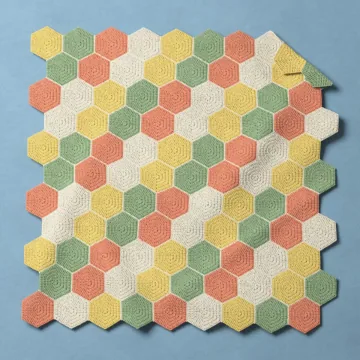
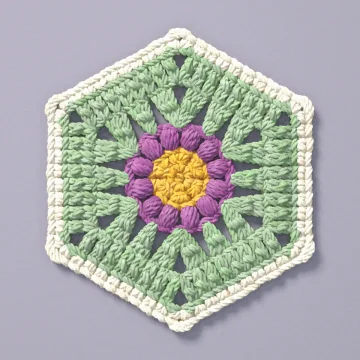
A vintage pinwheel bedspread of cotton hexagons in navy, white and dusty blue, each with six turning arms, framed in white. Finished size: about 31 in (79 cm) wide and 36 in (91 cm) long, at the gauge below.
Sizes
| Size | Finished size, about | Yarn, an estimate |
|---|---|---|
| Crib or lap | 31 in (79 cm) wide, 36 in (91 cm) long | about 795 yd (727 m) |
| Twin | 70 in (178 cm) wide, 90 in (229 cm) long | about 4,700 yd (4,298 m) |
| Queen | 86 in (218 cm) wide, 104 in (264 cm) long | about 6,670 yd (6,099 m) |
Gauge
17 stitches to 4 in (10 cm) in double crochet.
After rnd 4 the hexagon measures about 3¾ in (9.5 cm) from flat side to flat side. If yours is larger, use a smaller hook; if it is smaller, use a larger hook. A finished hexagon measures about 7¾ in (19.5 cm) from flat side to flat side.
How to measure it
Before you start
How it is worked: Magic ring · Working in the round · Joining squares · Changing colors
 Make the loop
 Put a loop on the hook
 Round 1
 Close the ring
Read the 10 notes
- Magic ring: wrap the yarn round two fingers, work the first round into the loop, then pull the tail to close it. Ch 4 joined into a ring with a sl st does as well.
- Every round is worked with the right side facing; do not turn.
- A beginning chain counts as the stitch in brackets after it. A ch 1 at the start of a round does not count as a stitch.
- When the next stitch or space of a kind is named, pass over anything else that comes before it. Work into a space round the chain, not into it.
- The sl sts at the start of a round carry the yarn to where the round begins; they are not counted.
- Join a new color with a sl st in the place named. Fasten off a color only where the round says so; where it does not, the same color goes on into the next round.
- The words are for a navy hexagon. For a dusty blue one use C wherever the words say A. For a white one use B wherever the words say A; after rnd 8 fasten off and join the same B again for rnd 9.
- Each arm leaves out its first dc and takes in the ch sp in front of the next arm, so the arms turn. The sl st at the start of rnds 2 to 8 passes over the first dc of the first arm, just as "sk next dc" does for the others.
- The last ch of a round lies between the last dc and the beginning ch 3; the join closes it into a ch sp like the others.
- Whip stitch: hold the two edges together, put the needle through both from back to front, bring the yarn over the edges and go in again from the back, one stitch along.
Instructions
Size: Crib or lap Change sizeUS termsUK terms
- “[ ]” is a repeat.
- “( )” goes into one place.
- The count at the end is what the round leaves.
- Tick a round when it is done. Your place is kept in this browser.
How to read these rounds
Square brackets “[ ]” hold a repeat: work what is inside as many times as it says. Round brackets “( )” inside a line hold stitches that all go into one place. In UK terms sl st is slip stitch, sc is double crochet and dc is treble.
Hexagon make 18
Yarns in order of use: A, navy; B, white.
- FoundationWith A, make a magic ring.
- Rnd 1Ch 3 (counts as dc), dc in ring, ch 1, repeat: 2 dc in ring, ch 1 5 times, join with sl st in top of beg ch-3leaves (12 dc, 6 ch-1 sps)
- Rnd 2Sl st in next dc, ch 3 (counts as dc), 2 dc in next ch-1 sp, ch 2, repeat: sk next dc, dc in next dc, 2 dc in next ch-1 sp, ch 2 5 times, join with sl st in top of beg ch-3leaves (18 dc, 6 ch-2 sps)
- Rnd 3Sl st in next dc, ch 3 (counts as dc), dc in next dc, 3 dc in next ch-2 sp, ch 2, repeat: sk next dc, dc in each of next 2 dc, 3 dc in next ch-2 sp, ch 2 5 times, join with sl st in top of beg ch-3leaves (30 dc, 6 ch-2 sps)
- Rnd 4Sl st in next dc, ch 3 (counts as dc), dc in each of next 3 dc, 3 dc in next ch-2 sp, ch 2, repeat: sk next dc, dc in each of next 4 dc, 3 dc in next ch-2 sp, ch 2 5 times, join with sl st in top of beg ch-3leaves (42 dc, 6 ch-2 sps)
- Rnd 5Sl st in next dc, ch 3 (counts as dc), dc in each of next 5 dc, 3 dc in next ch-2 sp, ch 2, repeat: sk next dc, dc in each of next 6 dc, 3 dc in next ch-2 sp, ch 2 5 times, join with sl st in top of beg ch-3leaves (54 dc, 6 ch-2 sps)
- Rnd 6Sl st in next dc, ch 3 (counts as dc), dc in each of next 7 dc, 3 dc in next ch-2 sp, ch 2, repeat: sk next dc, dc in each of next 8 dc, 3 dc in next ch-2 sp, ch 2 5 times, join with sl st in top of beg ch-3leaves (66 dc, 6 ch-2 sps)
- Rnd 7Sl st in next dc, ch 3 (counts as dc), dc in each of next 9 dc, 3 dc in next ch-2 sp, ch 2, repeat: sk next dc, dc in each of next 10 dc, 3 dc in next ch-2 sp, ch 2 5 times, join with sl st in top of beg ch-3leaves (78 dc, 6 ch-2 sps)
- Rnd 8Sl st in next dc, ch 3 (counts as dc), dc in each of next 11 dc, 3 dc in next ch-2 sp, ch 2, repeat: sk next dc, dc in each of next 12 dc, 3 dc in next ch-2 sp, ch 2 5 times, join with sl st in top of beg ch-3. Fasten off Aleaves (90 dc, 6 ch-2 sps)
- Rnd 9Join B with sl st in any ch-2 sp, ch 1, (sc, ch 2, sc) in same sp, sc in each of next 15 dc, repeat: (sc, ch 2, sc) in next ch-2 sp, sc in each of next 15 dc 5 times, join with sl st in first scleaves (102 sc, 6 ch-2 sps)
- EndFasten off.
Assembly
- Hexagons: work, for crib or lap 18 (8 navy, 5 white and 5 dusty blue); for twin 111 (39 navy, 39 white and 33 dusty blue); for queen 158 (53 navy, 52 white and 53 dusty blue). Weave in the ends and block each to about 7¾ in (19.5 cm) from flat side to flat side.
- Lay the hexagons right side up in rows, a point at the top and a flat side at each side: long rows and short rows by turns, the short ones set in by half a hexagon, beginning and ending with a long row. Crib or lap: five rows, three of 4 and two of 3. Twin: thirteen rows, seven of 9 and six of 8. Queen: 15 rows, eight of 11 and seven of 10. Every long row runs navy, dusty blue, white, over and over from the left, beginning with navy; every short row runs the same way but begins with white. No two hexagons of one color touch.
- For each edge where two hexagons meet cut about 24 in (60 cm) of B. Put the two hexagons with the right sides together and whip stitch the edge (needle always through from the back to the front, over the edge) through both loops of both: once in the two ch-2 sps at one end, once in each of the 17 pairs of sc, once in the two ch-2 sps at the other end. (19 stitches) Fasten off and draw the ends inside the edge. Join the hexagons of each row first, then row to row.
- Picot edge: the picot is ch 3, sl st in the 3rd ch from hook. With the right side facing, join A with a sl st in a ch-2 sp of an outer corner whose next corner to the left is an outer corner too, ch 1, (sc, picot, sc) in same sp. Along every free side of a hexagon: [sc in each of next 3 sc, picot] 5 times, sc in each of next 2 sc. At an outer corner (a ch-2 sp with no seam): (sc, picot, sc) in the ch-2 sp. At an inner corner, where two hexagons meet: sc2tog over their two ch-2 sps. Go on round the whole bedspread, join with sl st in first sc. Fasten off. (crib or lap: 34 free sides, 20 outer and 14 inner corners; 618 sc, 14 sc2tog, 190 picots; twin: 86 free sides, 46 outer and 40 inner corners; 1,554 sc, 40 sc2tog, 476 picots; queen: 102 free sides, 54 outer and 48 inner corners; 1,842 sc, 48 sc2tog, 564 picots)
Finishing
- Weave in the ends of the edge with the yarn needle.
- Pin out the edge with every picot drawn evenly, damp it, and let it dry.
In all: 18 pieces; 8,856 stitches.