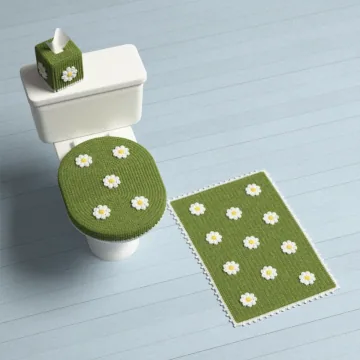
Ribbed bathroom set crochet pattern
Crochet, 26½ × 18 in, 2 colors, easy
PDF. Prints on US Letter and A4.
What you need
- Yarn A terracottaabout 600 yd (549 m), an estimatemain color
- Yarn B creamabout 80 yd (73 m), an estimatestripe
- Yarn in all
- About 680 yd (622 m) or 520 g, an estimate
- Weight
- Bulky weight, 5 on the label (UK chunky), cotton
- Hook
- 6.5 mm (US K-10½), or the size that gives you the gauge
- Also
- A yarn needle, scissors, a tape measure, a stitch marker and about 8 pins and a non-slip rug mesh, cut about 1 in (2.5 cm) smaller all round than the mat
- Gauge
- 11 stitches and 9½ rows to 4 in (10 cm) in half double crochet worked in the back loops. How to check it
Instructions Long lid
How to read these rows
US terms · Show UK terms
- ch chain, sl st slip stitch, sc single crochet (UK double crochet), hdc half double crochet (UK half treble).
- BLO: only the loop away from you. sk skip, yo yarn over the hook, RS right side, the one that shows.
- 3 sc in next st: all in one stitch. sc in next 62 sts: one in each. ch-1 sp: the gap under the one chain; the hook goes in the gap.
- [ ] 7 times: work what is inside 7 times in all.
- (64 hdc): the stitches you have when the row is done. How to read a pattern.
- Changing colors. Working in the round.
- The ch 1 at the start of a row or a round does not count as a stitch.
Go to: Mat · Border of the mat · Lid cover · Walls · Lower edge · Upper edge · Top · Assembly
Mat
Yarn A, terracotta.
- Row 1 and every odd-numbered row is a right side row.
- StartWith A, ch 65.
- Row 1RSHdc in 2nd ch from hook and in each ch acrossleaves (64 hdc)
- Rows 2 to 35Ch 1, turn; hdc in BLO of each st acrossleaves (64 hdc)Next: row 2 of rows 2 to 35
- EndFasten off.
Border of the mat
Yarns in order of use: A, terracotta; B, cream.
- The border goes along the last row, down the ends of the rows, along the foundation chain and up the ends of the rows, and all its rounds are worked with the right side facing. 3 sc in one place turn a corner; from round 2 on they go into the middle one of the 3 sc of the round before, the corner stitch, so that slanting lines run out to the four corners. From round 2 on every stitch is worked into the back loop only.
- StartWork around the edge of the piece, right side facing: the 64 sts of the last row, the ends of the 35 rows, the 64 chs of the foundation, the ends of the 35 rows.
- Rnd 1Join A with sl st in first st, ch 1, 3 sc in first st, sc in next 62 sts, 3 sc in next st, repeat: sc in end of each of next 4 rows, 2 sc in end of next row 7 times, 3 sc in next ch, sc in next 62 chs, 3 sc in next ch, repeat: sc in end of each of next 4 rows, 2 sc in end of next row 7 times; join with sl st in first scleaves (220 sc)
- Rnd 2With B, ch 1, sc in BLO of same st as join, 3 sc in BLO of next st, sc in BLO of next 64 sts, 3 sc in BLO of next st, sc in BLO of next 44 sts, 3 sc in BLO of next st, sc in BLO of next 64 sts, 3 sc in BLO of next st, sc in BLO of next 43 sts; join with sl st in first scleaves (228 sc)
- Rnd 3With A, ch 1, sc in BLO of same st as join, sc in BLO of next st, 3 sc in BLO of next st, sc in BLO of next 66 sts, 3 sc in BLO of next st, sc in BLO of next 46 sts, 3 sc in BLO of next st, sc in BLO of next 66 sts, 3 sc in BLO of next st, sc in BLO of next 44 sts; join with sl st in first scleaves (236 sc)
- Rnd 4With B, ch 1, sc in BLO of same st as join, sc in BLO of next 2 sts, 3 sc in BLO of next st, sc in BLO of next 68 sts, 3 sc in BLO of next st, sc in BLO of next 48 sts, 3 sc in BLO of next st, sc in BLO of next 68 sts, 3 sc in BLO of next st, sc in BLO of next 45 sts; join with sl st in first scleaves (244 sc)
- Rnd 5With A, ch 1, sc in BLO of same st as join, sc in BLO of next 3 sts, 3 sc in BLO of next st, sc in BLO of next 70 sts, 3 sc in BLO of next st, sc in BLO of next 50 sts, 3 sc in BLO of next st, sc in BLO of next 70 sts, 3 sc in BLO of next st, sc in BLO of next 46 sts; join with sl st in first scleaves (252 sc)
- EndFasten off.
Lid cover
Yarns in order of use: A, terracotta; B, cream.
- Round 1 goes all the way round the foundation chain. The chain nearest the hook is skipped and does not count as a stitch. Work along the chain to its far end, do not turn, and go on along the other side of the same chain, under the strands that are still free: "2 hdc in same ch" go into the far end chain, which already holds the 2 hdc of "2 hdc in last ch". The "2 hdc in last ch" at the end of the round go into the chain the round began in, beside its first 2 hdc.
- The words in square brackets that are worked 2, 4 and 2 times make the two curved ends; "12 sts" is a straight side. From round 2 on every stitch goes into the back loop only, and the front loops stay free as a ridge: the side with the ridges is the right side. A round that begins with an increase has both its stitches in the stitch of the join. Put the stitch marker into the first stitch of every round and move it up. Rounds 12 and 14 are cream.
- All the rounds are worked without turning. Round 17 is the last one of the top. Rounds 18 to 22 are the side, without increases; from round 19 on the stitches go under both loops again. The ch-1 spaces of round 21 are for the cord.
- StartWith A, ch 15.
- Rnd 12 hdc in 2nd ch from hook, hdc in next 12 chs, 2 hdc in last ch, working along the other side of the chain, 2 hdc in same ch, hdc in next 12 chs, 2 hdc in last ch; join with sl st in first hdcleaves (32 hdc)
- Rnd 2Ch 1, repeat: 2 hdc in BLO of next st 2 times, hdc in BLO of next 12 sts, repeat: 2 hdc in BLO of next st 4 times, hdc in BLO of next 12 sts, repeat: 2 hdc in BLO of next st 2 times; join with sl st in first hdcleaves (40 hdc)
- Rnd 3Ch 1, repeat: 2 hdc in BLO of next st, hdc in BLO of next st 2 times, hdc in BLO of next 12 sts, repeat: 2 hdc in BLO of next st, hdc in BLO of next st 4 times, hdc in BLO of next 12 sts, repeat: 2 hdc in BLO of next st, hdc in BLO of next st 2 times; join with sl st in first hdcleaves (48 hdc)
- Rnd 4Ch 1, repeat: 2 hdc in BLO of next st, hdc in BLO of next 2 sts 2 times, hdc in BLO of next 12 sts, repeat: 2 hdc in BLO of next st, hdc in BLO of next 2 sts 4 times, hdc in BLO of next 12 sts, repeat: 2 hdc in BLO of next st, hdc in BLO of next 2 sts 2 times; join with sl st in first hdcleaves (56 hdc)
- Rnd 5Ch 1, repeat: hdc in BLO of next st, 2 hdc in BLO of next st, hdc in BLO of next 2 sts 2 times, hdc in BLO of next 12 sts, repeat: hdc in BLO of next st, 2 hdc in BLO of next st, hdc in BLO of next 2 sts 4 times, hdc in BLO of next 12 sts, repeat: hdc in BLO of next st, 2 hdc in BLO of next st, hdc in BLO of next 2 sts 2 times; join with sl st in first hdcleaves (64 hdc)
- Rnd 6Ch 1, repeat: 2 hdc in BLO of next st, hdc in BLO of next 4 sts 2 times, hdc in BLO of next 12 sts, repeat: 2 hdc in BLO of next st, hdc in BLO of next 4 sts 4 times, hdc in BLO of next 12 sts, repeat: 2 hdc in BLO of next st, hdc in BLO of next 4 sts 2 times; join with sl st in first hdcleaves (72 hdc)
- Rnd 7Ch 1, repeat: hdc in BLO of next 2 sts, 2 hdc in BLO of next st, hdc in BLO of next 3 sts 2 times, hdc in BLO of next 12 sts, repeat: hdc in BLO of next 2 sts, 2 hdc in BLO of next st, hdc in BLO of next 3 sts 4 times, hdc in BLO of next 12 sts, repeat: hdc in BLO of next 2 sts, 2 hdc in BLO of next st, hdc in BLO of next 3 sts 2 times; join with sl st in first hdcleaves (80 hdc)
- Rnd 8Ch 1, repeat: 2 hdc in BLO of next st, hdc in BLO of next 6 sts 2 times, hdc in BLO of next 12 sts, repeat: 2 hdc in BLO of next st, hdc in BLO of next 6 sts 4 times, hdc in BLO of next 12 sts, repeat: 2 hdc in BLO of next st, hdc in BLO of next 6 sts 2 times; join with sl st in first hdcleaves (88 hdc)
- Rnd 9Ch 1, repeat: hdc in BLO of next 3 sts, 2 hdc in BLO of next st, hdc in BLO of next 4 sts 2 times, hdc in BLO of next 12 sts, repeat: hdc in BLO of next 3 sts, 2 hdc in BLO of next st, hdc in BLO of next 4 sts 4 times, hdc in BLO of next 12 sts, repeat: hdc in BLO of next 3 sts, 2 hdc in BLO of next st, hdc in BLO of next 4 sts 2 times; join with sl st in first hdcleaves (96 hdc)
- Rnd 10Ch 1, repeat: 2 hdc in BLO of next st, hdc in BLO of next 8 sts 2 times, hdc in BLO of next 12 sts, repeat: 2 hdc in BLO of next st, hdc in BLO of next 8 sts 4 times, hdc in BLO of next 12 sts, repeat: 2 hdc in BLO of next st, hdc in BLO of next 8 sts 2 times; join with sl st in first hdcleaves (104 hdc)
- Rnd 11Ch 1, repeat: hdc in BLO of next 4 sts, 2 hdc in BLO of next st, hdc in BLO of next 5 sts 2 times, hdc in BLO of next 12 sts, repeat: hdc in BLO of next 4 sts, 2 hdc in BLO of next st, hdc in BLO of next 5 sts 4 times, hdc in BLO of next 12 sts, repeat: hdc in BLO of next 4 sts, 2 hdc in BLO of next st, hdc in BLO of next 5 sts 2 times; join with sl st in first hdcleaves (112 hdc)
- Rnd 12With B, ch 1, repeat: 2 hdc in BLO of next st, hdc in BLO of next 10 sts 2 times, hdc in BLO of next 12 sts, repeat: 2 hdc in BLO of next st, hdc in BLO of next 10 sts 4 times, hdc in BLO of next 12 sts, repeat: 2 hdc in BLO of next st, hdc in BLO of next 10 sts 2 times; join with sl st in first hdcleaves (120 hdc)
- Rnd 13With A, ch 1, repeat: hdc in BLO of next 5 sts, 2 hdc in BLO of next st, hdc in BLO of next 6 sts 2 times, hdc in BLO of next 12 sts, repeat: hdc in BLO of next 5 sts, 2 hdc in BLO of next st, hdc in BLO of next 6 sts 4 times, hdc in BLO of next 12 sts, repeat: hdc in BLO of next 5 sts, 2 hdc in BLO of next st, hdc in BLO of next 6 sts 2 times; join with sl st in first hdcleaves (128 hdc)
- Rnd 14With B, ch 1, repeat: 2 hdc in BLO of next st, hdc in BLO of next 12 sts 2 times, hdc in BLO of next 12 sts, repeat: 2 hdc in BLO of next st, hdc in BLO of next 12 sts 4 times, hdc in BLO of next 12 sts, repeat: 2 hdc in BLO of next st, hdc in BLO of next 12 sts 2 times; join with sl st in first hdcleaves (136 hdc)
- Rnd 15With A, ch 1, repeat: hdc in BLO of next 6 sts, 2 hdc in BLO of next st, hdc in BLO of next 7 sts 2 times, hdc in BLO of next 12 sts, repeat: hdc in BLO of next 6 sts, 2 hdc in BLO of next st, hdc in BLO of next 7 sts 4 times, hdc in BLO of next 12 sts, repeat: hdc in BLO of next 6 sts, 2 hdc in BLO of next st, hdc in BLO of next 7 sts 2 times; join with sl st in first hdcleaves (144 hdc)
- Rnd 16Ch 1, repeat: 2 hdc in BLO of next st, hdc in BLO of next 14 sts 2 times, hdc in BLO of next 12 sts, repeat: 2 hdc in BLO of next st, hdc in BLO of next 14 sts 4 times, hdc in BLO of next 12 sts, repeat: 2 hdc in BLO of next st, hdc in BLO of next 14 sts 2 times; join with sl st in first hdcleaves (152 hdc)
- Rnd 17Ch 1, repeat: hdc in BLO of next 7 sts, 2 hdc in BLO of next st, hdc in BLO of next 8 sts 2 times, hdc in BLO of next 12 sts, repeat: hdc in BLO of next 7 sts, 2 hdc in BLO of next st, hdc in BLO of next 8 sts 4 times, hdc in BLO of next 12 sts, repeat: hdc in BLO of next 7 sts, 2 hdc in BLO of next st, hdc in BLO of next 8 sts 2 times; join with sl st in first hdcleaves (160 hdc)
- Rnd 18Ch 1, hdc in BLO of each st around; join with sl st in first hdcleaves (160 hdc)
- Rnds 19 to 20Ch 1, hdc in each st around; join with sl st in first hdcleaves (160 hdc)Next: round 19 of rounds 19 to 20
- Rnd 21Ch 1, repeat: hdc in next st, ch 1, sk next st 80 times; join with sl st in first hdcleaves (80 hdc, 80 ch-1 sps)
- Rnd 22Ch 1, repeat: sc in next st, sc in next ch-1 sp 80 times; join with sl st in first scleaves (160 sc)
- EndFasten off.
Walls
Yarn A, terracotta.
- One long strip. A row is as long as a wall is tall, so that the ribs stand up and down.
- StartWith A, ch 11.
- Row 1RSHdc in 2nd ch from hook and in each ch acrossleaves (10 hdc)
- Rows 2 to 44Ch 1, turn; hdc in BLO of each st acrossleaves (10 hdc)Next: row 2 of rows 2 to 44
- EndFasten off, leaving a tail of about 24 in (61 cm) to sew with.
Lower edge
Yarns in order of use: B, cream; A, terracotta.
- Four rows along the edge at which the odd-numbered rows begin, right side facing: turn the strip so that this edge is at the top and work from right to left along it. The yarn is cream, and it is joined with a sl st in the first row end at the right, which is the end of row 1; the first sc of row 1 of the edge goes into that same row end. The 4 rows are cream, terracotta, cream and terracotta. This edge is the lower one.
- StartWork along the ends of the rows on the right of the Walls, right side facing: 44 row ends.
- Row 1RSWith B, ch 1, repeat: sc in end of each of next 4 rows, 2 sc in end of next row 8 times, sc in end of each of next 4 rowsleaves (52 sc)
- Row 2With A, ch 1, turn; sc in each st acrossleaves (52 sc)
- Row 3With B, ch 1, turn; sc in each st acrossleaves (52 sc)
- Row 4With A, ch 1, turn; sc in each st acrossleaves (52 sc)
- EndFasten off.
Upper edge
Yarn A, terracotta.
- One row in terracotta along the other long edge, right side facing: turn the strip so that this edge is at the top, and work from right to left. Join the yarn with a sl st in the first row end at the right, which is the end of row 44; the first sc goes into that same row end.
- StartWork along the ends of the rows on the left of the Walls, right side facing: 44 row ends.
- Row 1RSWith A, ch 1, repeat: sc in end of each of next 4 rows, 2 sc in end of next row 8 times, sc in end of each of next 4 rowsleaves (52 sc)
- EndFasten off.
Top
Yarn A, terracotta.
- All the rounds are worked without turning, and the side that faces you as you work is the right side. The first chain is round the opening for the tissues. 3 sc in one place turn a corner, and from round 2 on they go into the middle one of the 3 sc of the round before.
- StartWith A, ch 20, join with sl st in first ch to make a loop, without twisting the chain.
- Rnd 1Ch 1, repeat: sc in next 4 chs, 3 sc in next ch 4 times; join with sl st in first scleaves (28 sc)
- Rnd 2Ch 1, repeat: sc in next 5 sts, 3 sc in next st, sc in next st 4 times; join with sl st in first scleaves (36 sc)
- Rnd 3Ch 1, repeat: sc in next 6 sts, 3 sc in next st, sc in next 2 sts 4 times; join with sl st in first scleaves (44 sc)
- Rnd 4Ch 1, repeat: sc in next 7 sts, 3 sc in next st, sc in next 3 sts 4 times; join with sl st in first scleaves (52 sc)
- EndFasten off, leaving a tail of about 60 in (152 cm) to sew with.
Assembly
- Weave in all the ends but the two tails to sew with.
- The cord of the lid cover: with A, ch 225, about 82 in (208 cm) long, and fasten off, leaving a tail of about 6 in (15 cm) at each end. Round 21 has 80 ch-1 spaces. The rounds are joined at the middle of one short end of the oval: that end is the back, at the hinges. From the outside put the cord in at the first space of round 21, go out and in through all 80 spaces, round the front and back again, and come out to the outside at the last one. Knot each end and weave its tail back into the cord.
- The walls of the tissue box cover: hold the two short ends of the strip together, wrong sides together, the last row in front and the foundation chain behind it. The tail of the walls hangs at the end of the last row, beside the lower edge. With it first whip stitch the row ends of the lower edge to each other, 4 stitches, going away from the last row to the rim. Run the needle back along the wrong side of these 4 stitches to where the tail hung. From there whip stitch the 10 stitches of the last row to the 10 chains, and last the row ends of the upper edge to each other, 1 stitch. Fasten off on the wrong side. The strip is a ring, with its right side out and its ribs standing up and down.
- The top: its right side is the side that faced you as you worked. In its last round the middle one of each 3 sc is a corner stitch, so that each side has 12 stitches between two corner stitches. Lay it on the upper edge of the walls with its right side up, so that its wrong side and the wrong side of the walls are both inside the cover, one corner stitch on the first stitch of the upper edge, beside the seam; the other three then lie on its 14th, 27th and 40th stitch. Pin the corners. With the tail of the top, begin at the stitch where it hangs and whip stitch the two edges together all round, stitch to stitch, through both loops of each: 52 stitches.
Finishing
- Wet the mat, lay it flat on a towel, pull the corners square and let it dry.
- Lift the lid and draw the lid cover on from the front, the end with the joins at the hinges. Pull the cord tight under the lid and tie it in a bow between the hinges; tuck the bow under the edge. See that the lid with its cover still leans back far enough to stay up by itself.
- Draw the tissue box cover over a cube box about 4½ in (11.5 cm) square and 5 in (12.5 cm) tall, and pull the first tissue through the opening.
- On a smooth floor lay the mat on the rug mesh, so that it does not slide.
About
A thick, ribbed set of three in terracotta with fine cream lines: a bath mat of ridged rows with a mitered border, a toilet lid cover whose ridges run round and round and whose edge is gathered under the lid with a cord, and a cover with four ribbed walls for a cube box of tissues.