Scalloped shell lampshade cover crochet pattern
Intermediate · 2 colors · 2,160 stitches · 2 sizes, Small to large
Size: Small Change size
PDF · US Letter · 5 pages · Change paper
Go to the instructions Round counter
- Size
- About 17¼ × 9½ in (44 × 24 cm)About 16 in (40.5 cm) round the top edge, 34¾ in (88.5 cm) round the last round of shells and 9½ in (24 cm) long down its side, not stretchedTo fit an empire shade 16¾ in (42.5 cm) to 17½ in (44.5 cm) round the top rim, 31½ in (80 cm) to 32½ in (82.5 cm) round the lower rim and about 7½ in (19 cm) long down its side
- Skill
- IntermediateThe bands between the shells grow from round to round, and the colors change every two rounds.
- Yarn
- Light (3), about 230 yd (210 m), an estimate
- Hook
- 3.75 mm (US F-5)
Size 2 choices · Small is pictured
Paper for the PDF
For your own crochet, gifts and handmade pieces you sell. Do not resell or share this PDF or copies of it. Selling, classes and kits: the rules
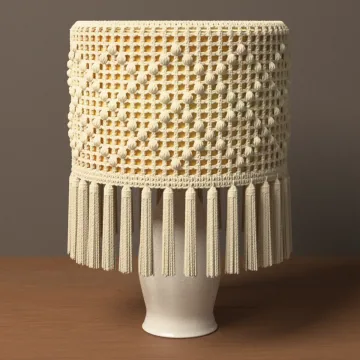
A scalloped shell lampshade cover for an empire shade, narrow above and wide below, in ivory and dusty pink stripes with a picot hem. It is worked from the top down in double crochet (UK treble). Shells stand above one another in straight lines, the bands between them widen as the shade widens, and the hem is a round of scallops with a picot on each. A cord at the top draws it in over the rim of the shade. It is for a lamp with an LED bulb only.
Sizes
- Size
- Small
- Fits
- an empire shade 16¾ in (42.5 cm) to 17½ in (44.5 cm) round the top rim, 31½ in (80 cm) to 32½ in (82.5 cm) round the lower rim and about 7½ in (19 cm) long down its side
- Finished size, about
- 17¼ × 9½ in (44 × 24 cm)
- Yarn, an estimate
- about 230 yd (210 m)
Scroll the table sideways to see every column.
| Size | Fits | Finished size, about | Yarn, an estimate |
|---|---|---|---|
| Small | an empire shade 16¾ in (42.5 cm) to 17½ in (44.5 cm) round the top rim, 31½ in (80 cm) to 32½ in (82.5 cm) round the lower rim and about 7½ in (19 cm) long down its side | 17¼ × 9½ in (44 × 24 cm) | about 230 yd (210 m) |
| Large | an empire shade 22½ in (57 cm) to 23¼ in (59 cm) round the top rim, 41 in (104 cm) to 42½ in (108 cm) round the lower rim and about 9½ in (24 cm) long down its side | 23 × 11¼ in (58 × 29 cm) | about 350 yd (320 m) |
Gauge
18 stitches and 20 rounds to 4 in (10 cm) in single crochet.
18 stitches and 9 rounds to 4 in (10 cm) in double crochet, worked in the round. The shell rounds are counted as rounds of double crochet. A shell of 4 double crochet and its chain of 2 is as wide as 6 stitches, and each double crochet between two shells, or the single chain there in round 4, is as wide as one stitch.
How to measure it
Check your gauge on the piece. Begin the pattern and measure the piece itself as you go.
The gauge is checked on the piece itself: after round 1 the tube should measure about 16 in (40.5 cm) around, laid flat and not stretched, measured across and doubled.
If the piece measures more than that, begin again with a smaller hook; if it measures less, with a larger hook.
In a thinner or a thicker yarn: how many stitches you need, and how large it comes out.
Before you start
How it is worked: Working in the round · Changing colors
Read the 11 notes
- Join the foundation chain into a ring with a slip stitch, and take care that it is not twisted. Work the first single crochet (UK double crochet) of round 1 into the first chain, the one that has the slip stitch in it, and one into each of the other chains; the slip stitch itself is not worked into.
- The right side, the outside, faces you in every round. In rounds 1 to 3 and in the last round the chain of 1 or 2 at the start does not count as a stitch; the round is joined with a slip stitch in its first stitch, and the first stitch of the next round goes into that same stitch. The last round begins in the top of the chain of 3 that the round before was joined in.
- A shell is (2 dc, ch 2, 2 dc), all in one place. In round 4 the first shell goes into the stitch that round 3 was joined in; its first double crochet is the chain of 3. From then on every shell is worked into the chain-2 space in the middle of the shell below, and the 2 double crochet on each side of that space are passed over; that is what sk next 2 sts says before and after a shell.
- Between two shells there is a band of double crochet. It begins in round 5 with one, worked into the chain-1 space, and from then on each is worked into the top of a double crochet of the band below. In the rounds where the cover widens, one stitch of every band gets 2.
- The chain of 3 at the start of a shell round counts as the first double crochet of its first shell, and the round is joined with a slip stitch in the top chain of those 3. Where the next round is in the same color, slip stitch from the join into the double crochet beside it and into the chain-2 space, to be in the middle of the shell; the round begins there. The slip stitches are not counted and are not worked into. At the end of such a round the 2 stitches before the join have nothing worked into them either: they are the chain of 3 of the round below, which you had joined in, and the double crochet beside it. Where the round begins with a new color, the line says sk next 2 sts for them.
- Where a new color begins, fasten off the old one, leaving a tail of 6 in (15 cm), and join the new one with a slip stitch in the chain-2 space of any shell; leave a tail of 6 in (15 cm) there too. Begin it at another shell each time, so that the joins do not stand above one another.
- The hem. There are two scallops of 7 double crochet to each shell of the round above: one in the chain-2 space of the shell, and one in the middle stitch, the 4th, of the 7 of the band. A single crochet in the first and in the last stitch of the band lies between them. Picot: (sc, ch 3, sc) in one place makes a small loop, the picot, between its two single crochet; there is one in the middle stitch of every scallop.
- An empire shade is narrow above and wide below. Measure yours round the top rim, round the lower rim, and down its side. The small cover is for a shade 16¾ in (42.5 cm) to 17½ in (44.5 cm) round the top rim, 31½ in (80 cm) to 32½ in (82.5 cm) round the lower rim and about 7½ in (19 cm) long down its side; the large one for a shade 22½ in (57 cm) to 23¼ in (59 cm), 41 in (104 cm) to 42½ in (108 cm) and about 9½ in (24 cm).
- How it sits: round 3 lies along the top rim of the shade. Rounds 1 and 2 stand above the rim, and the cord draws them in over it. From round 3 down the cover follows the shade. Not stretched, some of its rounds are a little wider than the shade at their place and lie loosely on it, and the others are a little narrower and stretch sideways to go round it; no round has to stretch by more than a sixth of its width. Below the lower rim the cover hangs free for about 1¼ in (3 cm) in the small size and 1 in (2.5 cm) in the large one.
- Use this cover on a shade over an LED bulb, which stays cool. It is not for a bulb that gets hot, and the cover touches the shade only, never the bulb. Leave the top of the shade open.
- Colors, round by round. Rounds 1 to 5: A. Rounds 6 to 7: B. Rounds 8 to 9: A. Rounds 10 to 11: B. Rounds 12 to 13: A. Rounds 14 to 15: B. Rounds 16 to 17: A. Rounds 18 to 19: B. Rounds 20 to 21: A. Rounds 22 to 23: B.
Instructions
Size: Small Change sizeUS termsUK terms
First read the 11 notes just above.
- “[ ]” is a repeat.
- “( )” goes into one place.
- The count at the end is what the round leaves.
- Tick a round when it is done. Your place is kept in this browser.
- Left-handed? Work everything as it is written, the other way: rows from left to right, rounds clockwise. Left-handed crochet
How to read these rounds
Square brackets “[ ]” hold a repeat: work what is inside as many times as it says. Round brackets “( )” inside a line hold stitches that all go into one place. In UK terms sl st is slip stitch, sc is double crochet, dc is treble and sk is miss.
Yarns in order of use: A, ivory; B, dusty pink.
- FoundationCh 72, sl st in first ch to form a ring.
- Rnd 1RSCh 1, sc in each ch around, sl st in first sc to joinleaves (72 sc)
- Stop and measure now, after round 1.The tube should measure about 16 in (40.5 cm) around: lay it flat without stretching it, measure across it and double that.
- Rnd 2Ch 2, repeat: dc in next 2 sts, ch 1, sk next st 24 times, sl st in first dc to joinleaves (48 dc, 24 ch-1 sps)
- Rnd 3Ch 1, repeat: sc in next 2 sts, sc in next ch-1 sp 24 times, sl st in first sc to joinleaves (72 sc)
Shells
- Rnd 4Ch 3 (counts as dc), (dc, ch 2, 2 dc) in same st, repeat: ch 1, sk next 5 sts, (2 dc, ch 2, 2 dc) in next st 11 times, ch 1, sk next 5 sts, sl st in top of ch-3 to joinleaves (48 dc, 12 ch-2 sps, 12 ch-1 sps)
- Rnd 5Sl st in next st, sl st in next ch-2 sp, ch 3 (counts as dc), (dc, ch 2, 2 dc) in same sp, repeat: sk next 2 sts, dc in next ch-1 sp, sk next 2 sts, (2 dc, ch 2, 2 dc) in next ch-2 sp 11 times, sk next 2 sts, dc in next ch-1 sp, sl st in top of ch-3 to joinleaves (60 dc, 12 ch-2 sps)
- Rnd 6Join B with sl st in any ch-2 sp, ch 3 (counts as dc), (dc, ch 2, 2 dc) in same sp, repeat: sk next 2 sts, dc in next st, sk next 2 sts, (2 dc, ch 2, 2 dc) in next ch-2 sp 11 times, sk next 2 sts, dc in next st, sk next 2 sts, sl st in top of ch-3 to joinleaves (60 dc, 12 ch-2 sps)
- Rnd 7Sl st in next st, sl st in next ch-2 sp, ch 3 (counts as dc), (dc, ch 2, 2 dc) in same sp, repeat: sk next 2 sts, dc in next st, sk next 2 sts, (2 dc, ch 2, 2 dc) in next ch-2 sp 11 times, sk next 2 sts, dc in next st, sl st in top of ch-3 to joinleaves (60 dc, 12 ch-2 sps)
- Rnd 8Join A with sl st in any ch-2 sp, ch 3 (counts as dc), (dc, ch 2, 2 dc) in same sp, repeat: sk next 2 sts, 2 dc in next st, sk next 2 sts, (2 dc, ch 2, 2 dc) in next ch-2 sp 11 times, sk next 2 sts, 2 dc in next st, sk next 2 sts, sl st in top of ch-3 to joinleaves (72 dc, 12 ch-2 sps)
- Rnd 9Sl st in next st, sl st in next ch-2 sp, ch 3 (counts as dc), (dc, ch 2, 2 dc) in same sp, repeat: sk next 2 sts, dc in next 2 sts, sk next 2 sts, (2 dc, ch 2, 2 dc) in next ch-2 sp 11 times, sk next 2 sts, dc in next 2 sts, sl st in top of ch-3 to joinleaves (72 dc, 12 ch-2 sps)
- Rnd 10Join B with sl st in any ch-2 sp, ch 3 (counts as dc), (dc, ch 2, 2 dc) in same sp, repeat: sk next 2 sts, dc in next 2 sts, sk next 2 sts, (2 dc, ch 2, 2 dc) in next ch-2 sp 11 times, sk next 2 sts, dc in next 2 sts, sk next 2 sts, sl st in top of ch-3 to joinleaves (72 dc, 12 ch-2 sps)
- Rnd 11Sl st in next st, sl st in next ch-2 sp, ch 3 (counts as dc), (dc, ch 2, 2 dc) in same sp, repeat: sk next 2 sts, 2 dc in next st, dc in next st, sk next 2 sts, (2 dc, ch 2, 2 dc) in next ch-2 sp 11 times, sk next 2 sts, 2 dc in next st, dc in next st, sl st in top of ch-3 to joinleaves (84 dc, 12 ch-2 sps)
- Rnd 12Join A with sl st in any ch-2 sp, ch 3 (counts as dc), (dc, ch 2, 2 dc) in same sp, repeat: sk next 2 sts, dc in next 3 sts, sk next 2 sts, (2 dc, ch 2, 2 dc) in next ch-2 sp 11 times, sk next 2 sts, dc in next 3 sts, sk next 2 sts, sl st in top of ch-3 to joinleaves (84 dc, 12 ch-2 sps)
- Rnd 13Sl st in next st, sl st in next ch-2 sp, ch 3 (counts as dc), (dc, ch 2, 2 dc) in same sp, repeat: sk next 2 sts, dc in next 3 sts, sk next 2 sts, (2 dc, ch 2, 2 dc) in next ch-2 sp 11 times, sk next 2 sts, dc in next 3 sts, sl st in top of ch-3 to joinleaves (84 dc, 12 ch-2 sps)
- Rnd 14Join B with sl st in any ch-2 sp, ch 3 (counts as dc), (dc, ch 2, 2 dc) in same sp, repeat: sk next 2 sts, dc in next st, 2 dc in next st, dc in next st, sk next 2 sts, (2 dc, ch 2, 2 dc) in next ch-2 sp 11 times, sk next 2 sts, dc in next st, 2 dc in next st, dc in next st, sk next 2 sts, sl st in top of ch-3 to joinleaves (96 dc, 12 ch-2 sps)
- Rnd 15Sl st in next st, sl st in next ch-2 sp, ch 3 (counts as dc), (dc, ch 2, 2 dc) in same sp, repeat: sk next 2 sts, dc in next 4 sts, sk next 2 sts, (2 dc, ch 2, 2 dc) in next ch-2 sp 11 times, sk next 2 sts, dc in next 4 sts, sl st in top of ch-3 to joinleaves (96 dc, 12 ch-2 sps)
- Rnd 16Join A with sl st in any ch-2 sp, ch 3 (counts as dc), (dc, ch 2, 2 dc) in same sp, repeat: sk next 2 sts, dc in next 4 sts, sk next 2 sts, (2 dc, ch 2, 2 dc) in next ch-2 sp 11 times, sk next 2 sts, dc in next 4 sts, sk next 2 sts, sl st in top of ch-3 to joinleaves (96 dc, 12 ch-2 sps)
- Rnd 17Sl st in next st, sl st in next ch-2 sp, ch 3 (counts as dc), (dc, ch 2, 2 dc) in same sp, repeat: sk next 2 sts, dc in next st, 2 dc in next st, dc in next 2 sts, sk next 2 sts, (2 dc, ch 2, 2 dc) in next ch-2 sp 11 times, sk next 2 sts, dc in next st, 2 dc in next st, dc in next 2 sts, sl st in top of ch-3 to joinleaves (108 dc, 12 ch-2 sps)
- Rnd 18Join B with sl st in any ch-2 sp, ch 3 (counts as dc), (dc, ch 2, 2 dc) in same sp, repeat: sk next 2 sts, dc in next 5 sts, sk next 2 sts, (2 dc, ch 2, 2 dc) in next ch-2 sp 11 times, sk next 2 sts, dc in next 5 sts, sk next 2 sts, sl st in top of ch-3 to joinleaves (108 dc, 12 ch-2 sps)
- Rnd 19Sl st in next st, sl st in next ch-2 sp, ch 3 (counts as dc), (dc, ch 2, 2 dc) in same sp, repeat: sk next 2 sts, dc in next 5 sts, sk next 2 sts, (2 dc, ch 2, 2 dc) in next ch-2 sp 11 times, sk next 2 sts, dc in next 5 sts, sl st in top of ch-3 to joinleaves (108 dc, 12 ch-2 sps)
- Rnd 20Join A with sl st in any ch-2 sp, ch 3 (counts as dc), (dc, ch 2, 2 dc) in same sp, repeat: sk next 2 sts, dc in next 2 sts, 2 dc in next st, dc in next 2 sts, sk next 2 sts, (2 dc, ch 2, 2 dc) in next ch-2 sp 11 times, sk next 2 sts, dc in next 2 sts, 2 dc in next st, dc in next 2 sts, sk next 2 sts, sl st in top of ch-3 to joinleaves (120 dc, 12 ch-2 sps)
- Rnd 21Sl st in next st, sl st in next ch-2 sp, ch 3 (counts as dc), (dc, ch 2, 2 dc) in same sp, repeat: sk next 2 sts, dc in next 2 sts, 2 dc in next st, dc in next 3 sts, sk next 2 sts, (2 dc, ch 2, 2 dc) in next ch-2 sp 11 times, sk next 2 sts, dc in next 2 sts, 2 dc in next st, dc in next 3 sts, sl st in top of ch-3 to joinleaves (132 dc, 12 ch-2 sps)
Scalloped hem
- Rnd 22Join B with sl st in any ch-2 sp, ch 3 (counts as dc), 6 dc in same sp, repeat: sk next 2 sts, sc in next st, sk next 2 sts, 7 dc in next st, sk next 2 sts, sc in next st, sk next 2 sts, 7 dc in next ch-2 sp 11 times, sk next 2 sts, sc in next st, sk next 2 sts, 7 dc in next st, sk next 2 sts, sc in next st, sk next 2 sts, sl st in top of ch-3 to joinleaves (168 dc, 24 sc)
- Rnd 23Ch 1, repeat: sc in next 3 sts, (sc, ch 3, sc) in next st, sc in next 4 sts 24 times, sl st in first sc to joinleaves (216 sc, 24 ch-3 sps)
- EndFasten off, leaving a tail of 6 in (15 cm).
Assembly
- Weave in the tails on the wrong side, each along stitches of its own color. The right side is the outside.
- The cord. With A leave a tail of 6 in (15 cm), ch 160, about 36 in (91.5 cm), and fasten off with a tail of the same length. Draw each tail back through the last few chains with the needle, and trim it. The cord goes through round 2. Begin at the first chain-1 space after the join of that round: from the outside, go in through that space, out through the next, and so on all the way round. There are 24 spaces, an even number, so the cord comes out on the outside through the last space, beside the place where it went in.
Finishing
- Turn the lamp off and take the shade off it. Slip the cover over the shade from above, and ease it down evenly all round, until round 3 lies along the top rim and rounds 1 and 2 stand above it. Draw the cord up until those two rounds lean in over the rim, tie it in a bow, and tuck the bow and its ends down between the cover and the shade. Put the shade back on the lamp.
- Spread the scallops with your fingers and pull each picot to a point.
In all: 23 rounds; 2,160 stitches.