Victorian high neck collar crochet pattern
Crochet, 15 in round, 1 color, intermediate
Size: Medium Change size
Choose the size whose length round is nearest to the neck it is for, measured where the collar will stand, and not shorter than it. The jabot is the same in all sizes.
PDF. Prints on US Letter and A4.
What you need
- Yarn Any one color (white cotton in the picture)about 130 yd (119 m), an estimate
- Weight
- Lace weight, 0 on the label, cotton
- Hook
- 2.25 mm (US B-1), or the size that gives you the gauge
- Also
- Yarn needle, scissors, tape measure, four pearl buttons, 0.4 in (1 cm) across, plum velvet ribbon 0.25 in (0.6 cm) wide, its length is given below, sewing needle and sewing thread, pins and spray starch if the collar is to stand without help
- Gauge
- 28 stitches and 15 rows to 4 in (10 cm) in double crochet (UK treble). How to check it
Instructions Medium
How to read these rows
US terms · Show UK terms
- ch chain, sl st slip stitch, sc single crochet (UK double crochet), dc double crochet (UK treble), tr treble crochet (UK double treble).
- sk skip, RS right side, the one that shows, WS wrong side, the back.
- ch-1 sp: the gap under the one chain; the hook goes in the gap.
- [ ] 51 times: work what is inside 51 times in all. ( ): all of it goes into the one place.
- (105 sc): the stitches you have when the row is done. How to read a pattern.
- The ch 3 at the start of a row counts as a dc; the last stitch of the next row is worked into the top of it. The chain stands on the first stitch of the row, so "next st" right after it is the second stitch.
- The ch 4 at the start of a row counts as a dc and a ch-1 sp. The stitch that closes over it goes into its 3rd chain. The chain stands on the first stitch of the row, so "next st" right after it is the second stitch.
- A ch 1 at the start of a row does not count as a stitch.
Special stitches
Collar
- StartCh 106.
- Row 1RSSc in 2nd ch from hook and in each ch acrossleaves (105 sc)
- Row 2WSCh 1, turn; sc in first st, sc in next 104 stsleaves (105 sc)
- Row 3RSCh 5 (counts as tr and ch-1 sp), turn; sk next st, repeat: tr in next st, ch 1, sk next st 51 times, tr in last stleaves (53 tr, 52 ch-1 sps)
- Row 4WSCh 1, turn; sc in first st, repeat: sc in next ch-1 sp, sc in next st 51 times, sc in next ch-1 sp, sc in 4th ch of turning chleaves (105 sc)
- Row 5RSCh 3 (counts as dc), turn; repeat: sk next st, (dc, ch 1, dc) in next st, sk next st, dc in next st 26 timesleaves (79 dc, 26 ch-1 sps)
- Row 6WSCh 1, turn; sc in first st, repeat: ch 2, sk next st, sc in next ch-1 sp, picot, ch 2, sk next st, sc in next st 25 times, ch 2, sk next st, sc in next ch-1 sp, picot, ch 2, sk next st, sc in top of turning chleaves (53 sc, 52 ch-2 sps, 26 picots)
- Row 7RSCh 3 (counts as dc), turn; repeat: sk next ch-2 sp, (dc, ch 1, dc) in next st, sk next ch-2 sp, dc in next st 25 times, sk next ch-2 sp, (dc, ch 1, dc) in next st, sk next ch-2 sp, dc in last stleaves (79 dc, 26 ch-1 sps)
- Row 8WSCh 1, turn; sc in first st, repeat: sc in next st, sc in next ch-1 sp, sc in next 2 sts 25 times, sc in next st, sc in next ch-1 sp, sc in next st, sc in top of turning chleaves (105 sc)
- Row 9RSCh 5 (counts as tr and ch-1 sp), turn; sk next st, repeat: tr in next st, ch 1, sk next st 51 times, tr in last stleaves (53 tr, 52 ch-1 sps)
- Row 10WSCh 1, turn; sc in first st, repeat: sc in next ch-1 sp, sc in next st 51 times, sc in next ch-1 sp, sc in 4th ch of turning chleaves (105 sc)
- Row 11RSCh 1, turn; sc in first st, repeat: sk next st, (3 dc, picot, 2 dc) in next st, sk next st, sc in next st 26 timesleaves (27 sc, 130 dc, 26 picots)
- EndFasten off.
Lower tier of the jabot
- StartCh 51.
- Row 1RSDc in 4th ch from hook (skipped chs count as dc) and in each ch acrossleaves (49 dc)
- Row 2WSCh 4 (counts as dc and ch-1 sp), turn; sk next st, repeat: dc in next st, ch 1, sk next st 23 times, dc in top of turning chleaves (25 dc, 24 ch-1 sps)
- Row 3RSCh 3 (counts as dc), turn; repeat: dc in next ch-1 sp, dc in next st 23 times, dc in next ch-1 sp, dc in 3rd ch of turning chleaves (49 dc)
- Row 4WSCh 4 (counts as dc and ch-1 sp), turn; sk next st, repeat: dc in next st, ch 1, sk next st 23 times, dc in top of turning chleaves (25 dc, 24 ch-1 sps)
- Row 5RSCh 3 (counts as dc), turn; repeat: dc in next ch-1 sp, dc in next st 23 times, dc in next ch-1 sp, dc in 3rd ch of turning chleaves (49 dc)
- Row 6WSCh 4 (counts as dc and ch-1 sp), turn; sk next st, repeat: dc in next st, ch 1, sk next st 23 times, dc in top of turning chleaves (25 dc, 24 ch-1 sps)
- Row 7RSCh 3 (counts as dc), turn; repeat: dc in next ch-1 sp, dc in next st 23 times, dc in next ch-1 sp, dc in 3rd ch of turning chleaves (49 dc)
- Row 8WSCh 4 (counts as dc and ch-1 sp), turn; sk next st, repeat: dc in next st, ch 1, sk next st 23 times, dc in top of turning chleaves (25 dc, 24 ch-1 sps)
- Row 9RSCh 3 (counts as dc), turn; repeat: dc in next ch-1 sp, dc in next st 23 times, dc in next ch-1 sp, dc in 3rd ch of turning chleaves (49 dc)
- Row 10WSCh 4 (counts as dc and ch-1 sp), turn; sk next st, repeat: dc in next st, ch 1, sk next st 23 times, dc in top of turning chleaves (25 dc, 24 ch-1 sps)
- Row 11RSCh 3 (counts as dc), turn; repeat: dc in next ch-1 sp, dc in next st 23 times, dc in next ch-1 sp, dc in 3rd ch of turning chleaves (49 dc)
- Row 12WSCh 4 (counts as dc and ch-1 sp), turn; sk next st, repeat: dc in next st, ch 1, sk next st 23 times, dc in top of turning chleaves (25 dc, 24 ch-1 sps)
- Row 13RSCh 3 (counts as dc), turn; repeat: dc in next ch-1 sp, dc in next st 23 times, dc in next ch-1 sp, dc in 3rd ch of turning chleaves (49 dc)
- Row 14WSCh 1, turn; sc in first st, repeat: ch 3, sk next 3 sts, sc in next st 11 times, ch 3, sk next 3 sts, sc in top of turning chleaves (13 sc, 12 ch-3 sps)
- Row 15RSCh 1, turn; sc in first st, repeat: (3 dc, picot, 3 dc) in next ch-3 sp, sc in next st 11 times, (3 dc, picot, 3 dc) in next ch-3 sp, sc in last stleaves (13 sc, 72 dc, 12 picots)
- EndFasten off.
Upper tier of the jabot
- StartCh 51.
- Row 1RSDc in 4th ch from hook (skipped chs count as dc) and in each ch acrossleaves (49 dc)
- Row 2WSCh 4 (counts as dc and ch-1 sp), turn; sk next st, repeat: dc in next st, ch 1, sk next st 23 times, dc in top of turning chleaves (25 dc, 24 ch-1 sps)
- Row 3RSCh 3 (counts as dc), turn; repeat: dc in next ch-1 sp, dc in next st 23 times, dc in next ch-1 sp, dc in 3rd ch of turning chleaves (49 dc)
- Row 4WSCh 4 (counts as dc and ch-1 sp), turn; sk next st, repeat: dc in next st, ch 1, sk next st 23 times, dc in top of turning chleaves (25 dc, 24 ch-1 sps)
- Row 5RSCh 3 (counts as dc), turn; repeat: dc in next ch-1 sp, dc in next st 23 times, dc in next ch-1 sp, dc in 3rd ch of turning chleaves (49 dc)
- Row 6WSCh 4 (counts as dc and ch-1 sp), turn; sk next st, repeat: dc in next st, ch 1, sk next st 23 times, dc in top of turning chleaves (25 dc, 24 ch-1 sps)
- Row 7RSCh 3 (counts as dc), turn; repeat: dc in next ch-1 sp, dc in next st 23 times, dc in next ch-1 sp, dc in 3rd ch of turning chleaves (49 dc)
- Row 8WSCh 1, turn; sc in first st, repeat: ch 3, sk next 3 sts, sc in next st 11 times, ch 3, sk next 3 sts, sc in top of turning chleaves (13 sc, 12 ch-3 sps)
- Row 9RSCh 1, turn; sc in first st, repeat: (3 dc, picot, 3 dc) in next ch-3 sp, sc in next st 11 times, (3 dc, picot, 3 dc) in next ch-3 sp, sc in last stleaves (13 sc, 72 dc, 12 picots)
- EndFasten off.
Assembly
- Pleats: lay the upper tier on the lower tier, both with the right side up, their foundation edges together. Along these edges mark the 1st st with a pin, and every 4th st after it: the 5th, the 9th and so on to the 49th, 13 pins. Thread the yarn needle with about 20 in (50.8 cm) of yarn, fasten it at the 1st st, and run the needle through both layers at every pin in turn, from front to back at one and from back to front at the next. Take out the pins and draw up the yarn until the edge lies in six folds toward you and is about 1.8 in (4.6 cm) wide. Bring the needle back through the folds the same way, close below, and fasten off.
- Sewing on the jabot: with the right sides of the collar and of the jabot up, slip the pleated edge up behind the lower edge of the collar, so far that it lies behind rows 1 and 2, its middle behind the 53rd st of the foundation edge, counted from either end, which is the center front. With about 24 in (61 cm) of yarn whip stitch the foundation edge of the collar to the jabot over 13 sts, the center one and 6 on each side of it, and then, on the wrong side, the pleated edge to row 2.
- Buttons: with the right side facing you and the upper edge at the top, sew four buttons with sewing thread to the right hand back edge, about 0.2 in (0.5 cm) in from it: one at row 1, one at row 4, one at row 7 and one at row 10.
- Button loops: at the left hand back edge join the yarn with a sl st in the end of row 1, ch 6, sl st in the end of the row above, fasten off; do the same at rows 4, 7 and 10, each time from the end of that row to the end of the row above it. A loop of 6 chs is about 0.7 in (1.8 cm) long; try a button in it before you fasten off.
- Ribbon in the holes: take a piece of ribbon for row 3 and one for row 9. With the right side facing you begin at a back edge: the ribbon lies over the first tr, goes down through the first hole, under the next tr, up through the next hole, over the next tr and so on to the other back edge, where it lies over the last tr. Leave it flat and a little loose. Turn about 0.5 in (1.3 cm) at each end to the wrong side and sew it down with sewing thread.
- Bow: tie the last piece of ribbon in a bow with loops about 1.2 in (3 cm) long and sew its knot with sewing thread to the center front of the collar, over rows 1 and 2, where the jabot begins. Trim the ends slanting, about 2.6 in (6.6 cm) long.
Finishing
- Weave in the ends.
About
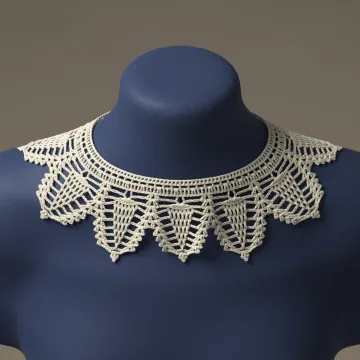
A Victorian high neck collar in white cotton lace with velvet ribbon, a pleated jabot in two tiers and pearl buttons at the back. Intermediate, three sizes. It stands up round the neck and is worn over a plain blouse. The collar is made in rows of double crochet (UK treble), treble and picots from the lower edge up; the jabot is two flat pieces pleated together and sewn on.