Fan stitch
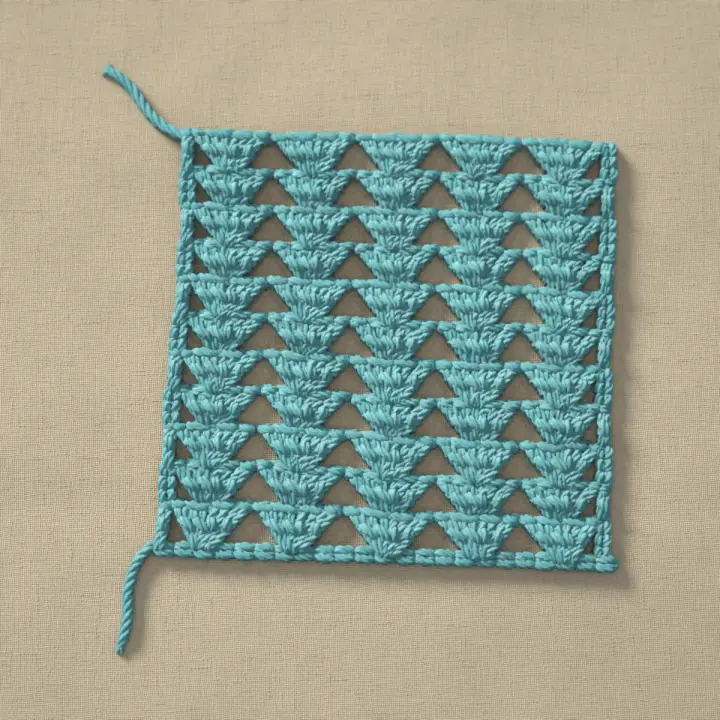
A fan is a group of tall stitches worked into one stitch or space, so that they spread like an open fan. The fan shown here is two stitches of double crochet (UK treble), one chain and two more double crochets, and each fan is worked into the fan below it. Double crochet is the one stitch to know first. Patterns use the words fan and shell loosely, so read what yours means by them.
How to work it
Never held a hook? How to crochet. Red is what is new. Left-handed? Read each picture as its mirror image.
Two double crochets, then chain 1

To try it, chain 23, which gives five fans. Skip four chains, which stand for a double crochet at the edge, and work two double crochets into the fifth chain from the hook. Then chain 1. The chain will be the opening in the middle of the fan. (The picture shows the second fan of a row: one is made already.)
Two more in the same place

Work two more double crochets into the same place as the first two. One fan is made: four double crochets rising from one place, with a chain between the second and the third.
In the next row, work into the chain space

Chain 3 to stand for the first double crochet, and turn the work. Work each new fan into the chain space in the middle of the fan below: put the hook under the single chain, and work two double crochets, chain 1 and two double crochets there. The fans stand one above the other.
The stitch pattern, row by row
- Multiple
- Chain a multiple of 4 plus 3 (15 or more).
- Starting chain
- The rows here are written for a chain of 23, which is 5 times the multiple of 4, plus 3.
- The ch 3 at the start of a row counts as a dc. The last stitch of the next row is worked into the top of it.
- Row 1 is the right side.
- A stitch worked into a chain space passes over any stitches that lie before the space; they are left unworked.
- Stitches in parentheses, or several of one stitch, are all worked into the one place named after them.
- Sh, short for shell, is the name these rows give to the fan of this page.
- In row 2 the top of the turning ch is the top of the 4 chs skipped at the start of row 1: the last ch made.
- Foundation. Ch 23.
- Row 1 (RS). Sh in 5th ch from hook (skipped chs count as dc), [sk next 3 chs, sh in next ch] 4 times, sk next ch, dc in next ch (2 dc, 5 sh).
- Row 2. Ch 3 (counts as dc), turn; [sh in next ch-1 sp] 5 times, sk next 2 sts, dc in top of turning ch (2 dc, 5 sh).
Repeat row 2 for the pattern.
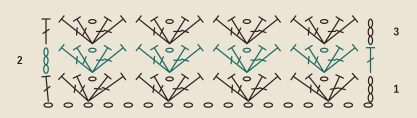
What each symbol meansHow to read a chart
Abbreviations in these rows
- ch
- chain stitch
- dc
- double crochet (UK treble)
- RS
- right side
- sk
- skip
- sp
- space
- st
- stitch
- sh
- shell: (2 dc, ch 1, 2 dc) in the same st or sp.
What a pattern means by a fan is not fixed. One online stitch library draws a line: a fan has at least one chain space among its stitches, a shell is made of stitches only, and fans are usually stacked one above the other. A printed stitch dictionary keeps the same habit: its fans are groups such as three double crochets, a chain and three more.
Others do not hold to that line. A book of crochet techniques says that shells are often known as fan stitches too. One tutorial gives shell stitch and fan stitch as two names for one technique. Several stitches named for their fans have no chain in the group at all. And the rows printed below call this page's own group a shell, written sh, as other patterns that use the same group do.
So go by the pattern in your hands. A pattern that uses a fan says once what its fan is, as a list of stitches and chains in brackets, and everything in the brackets goes into one place.
Fans come in many sizes. Patterns named for their fans use groups of three, five and nine tall stitches, with chains or without, and each has a multiple of its own.
When it goes wrong
- My fans do not line up above each other.
- A fan has gone into the gap between two fans. Each fan goes into the chain space in the middle of a fan: look for the single chain with two double crochets at each side of it.
- My rows are getting shorter.
- The last stitch has been left out. After the last fan, work one double crochet into the top of the three chains that began the row below.
Left-handed
The pictures show the hook held in the right hand. For the left hand, read each picture as its mirror image.
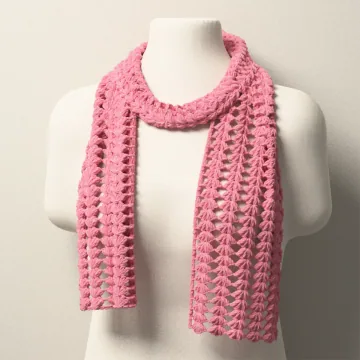
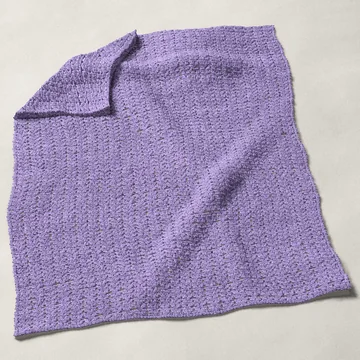
Patterns that use it
At a glance
- Level
- Easy
- Kind
- Shells, fans and V-stitches
- Also called
- iris stitch
- Used for
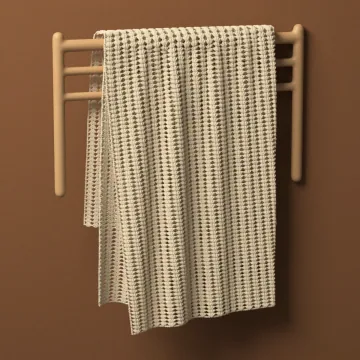
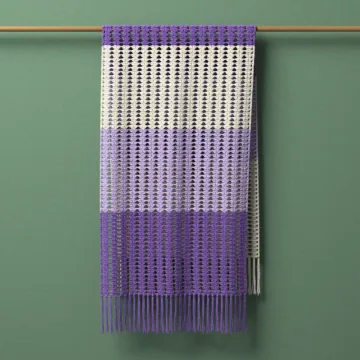
- shawls, wraps and light scarves; light blankets and baby blankets
- The fan on this page
- Two double crochets, chain 1, two double crochets, all in one stitch or space.
- Multiple
- The chain is a multiple of 4 plus 3 (15 or more).
- Chains for 10, 20 or 40 fans
- 43, 83 and 163
- Chain for other fans
- Little fans: a multiple of 6 plus 2, or of 8 plus 2. Fantail stitch: a multiple of 10 plus 2.
- Row repeat
- Row 2.
- Edges
- Straight. Every row begins with chain 3, which counts as a double crochet, and every row ends with one double crochet in the top of the chain that began the row below.
- These rows are also published as
- Iris stitch.
Tips and variations
Tips
- Work into the space under the chain, not into the chain. The hook goes in under the whole chain.
- If the top of the turning chain is hard to find, some patterns work the last stitch into the space beside the chain instead.
Variations
- Fantail stitch. Wider fans, 3 double crochets, chain 1 and 3 double crochets in one place, set over the gaps of the row of fans before. Between two fans stand a single crochet (UK double crochet), one chain and a single crochet. The next row is open: a single crochet in the middle of each fan, and in each gap a small V of half double crochet (UK half treble), chain 1, half double crochet, with three chains on both sides of it. The fans of the row after go into those Vs, and a half fan of four double crochets stands at each end of that row. Chain a multiple of 10 plus 2, and repeat four rows after the first. The name fantail shell is also given to a fan of nine double crochets with no chain in it.
- Little fans. Small fans with a single crochet at each side, and an open row between two rows of fans: a single crochet in the middle of each fan, a double crochet in each single crochet, and chains between them. The stitch is published on a multiple of 6 plus 2, with fans of five double crochets and two chains in the open row, and on a multiple of 8 plus 2, with a chain between each two of the five and three chains in the open row.
- Peacock stitch. Large fans of nine stitches of treble crochet (UK double treble), with an open row between.
- Arcade stitch. Fans that stand on arches of chains.
- Shell stitch. Fans with no chain in the middle, set between each other and held down by single crochets.
- Petal stitch. Two different stitches have this name. One is groups of four treble crochets, with two chains, a single crochet and two chains between groups and a row of single crochets and chains after each row of groups. Each group stands in a single crochet. The other is made of closed clusters round one space, so that the petals of two rows meet like a daisy. Look at which your pattern means before you chain.
Questions
- Is a fan the same as a shell?
- Often it is. Many patterns use the two words for the same group of stitches worked into one place. Where a difference is made, a fan has chain spaces among its stitches and a shell has none. The pattern you are following says what it means.
- What is the multiple for fan stitch?
- It depends on the fan. For the stacked fans on this page the starting chain is a multiple of 4 plus 3. Wider fans need more chains for each repeat. The starting chain calculator works out the number for a width of your own.
- Is this the same as iris stitch?
- Yes. Rows of this fan, each worked into the chain space of the fan below, are published under the name iris stitch.
- What is the difference between fan stitch and fantail stitch?
- The fans on this page are small and stand one above the other in columns. In fantail stitch each fan has three double crochets at each side of its chain, the fans of one row stand over the gaps of the row before, and an open row comes between.