Sand stitch
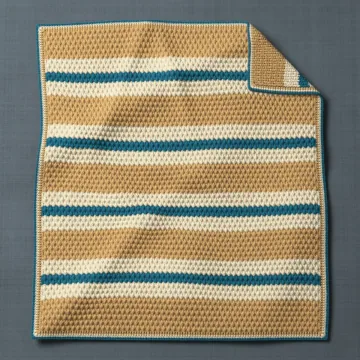
Sand stitch is single crochet (UK double crochet) and chain 1 in turn, with a new color on every row. Each single crochet goes into the gap under a chain of the row below, so the colors break up into small dots, like grains of sand. With three colors, one row each, no yarn is cut: the color you need is always waiting at the edge. Start with an even number of chains.
How to work it
Never held a hook? How to crochet. Red is what is new. Left-handed? Read each picture as its mirror image.
Change color in the last stitch

Work the last single crochet of the row until two loops are on the hook. Let A go; do not cut it. Lay color B over the hook, with a tail of 6 in (15 cm), and draw it through both loops. The loop on the hook is now B.
Work into the first space

Under the first chain of the row below there is a gap: the chain space. Put the hook into it from the front, under the whole chain. Work a single crochet there. Its two legs come down over the chain of color A and cover part of it.
Chain 1 and go to the next space

Chain 1, pass over the next single crochet, and work a single crochet in the next chain space, the ringed one in the picture. Go on along the row: a chain, then a single crochet in the next space.
Go on, one row of each color

Work row 3 in C just as row 2, then row 4 in A, row 5 in B, row 6 in C. The order never changes. In every row the stitches stand between those of the row below, so each color shows as dots in the row under it.
Pick up the waiting yarn

At the end of row 3 color A is hanging at the edge you have come to: it was left there at the end of row 1. Bring it up past the two rows between, loosely, and draw it through the last two loops of the row. From here on this is true at the end of every row. Look at the picture: each dotted line is one yarn on its way up.
The stitch pattern, row by row
- Multiple
- Chain a multiple of 2 (8 or more).
- Starting chain
- The rows here are written for a chain of 22, which is 11 times the multiple of 2.
- The ch 2 at the start of a row does not count as a stitch. It makes the turning ch sp, and the last stitch of the next row is worked into that space.
- Change color on the last pull of the last sc of a row. Do not cut the yarn you leave.
- For one color, work the same rows and leave the changes out.
- The chart is drawn for a chain of 18: 8 sc in a row. Read it from the bottom up, odd rows from right to left and even rows from left to right. Green is A, brown is B and red is C. A plus sign is a single crochet, an oval a chain; the two upright ovals are the ch 2.
- Foundation. With A, ch 22.
- Row 1. Sc in 4th ch from hook, [ch 1, sk next ch, sc in next ch] 9 times; change to B (10 sc, 9 ch-1 sps, 1 turning ch sp).
- Row 2. With B, ch 2, turn; [sc in next ch-1 sp, ch 1] 9 times, sc in turning ch sp; change to C (10 sc, 9 ch-1 sps, 1 turning ch sp).
- Row 3. With C, ch 2, turn; [sc in next ch-1 sp, ch 1] 9 times, sc in turning ch sp; change to A (10 sc, 9 ch-1 sps, 1 turning ch sp).
- Row 4. With A, ch 2, turn; [sc in next ch-1 sp, ch 1] 9 times, sc in turning ch sp; change to B (10 sc, 9 ch-1 sps, 1 turning ch sp).
Repeat rows 2 to 4 for the pattern.

What each symbol meansHow to read a chart
Abbreviations in these rows
- ch
- chain stitch
- sc
- single crochet (UK double crochet)
- sk
- skip
- sp
- space
The rows are those of moss stitch, also called linen stitch. What makes it sand stitch is the color. Books and lessons that give the name mean three colors, one row of each. In one color the same rows give a quiet, nubby cloth that lies flat.
Tweed stitch is one more name for these rows. Some books print it for one color and some for several, and other patterns use the word for other stitches, half double crochet (UK half treble) among them. If your pattern says tweed stitch, look at its rows: single crochet, chain 1, and stitches into the spaces are the rows on this page.
Why three colors work: a row takes you to the other edge, so after three rows you stand at the edge where the first color was left. The sum comes out for every odd number of colors. With an even number, one row each, the yarn you want is at the far edge.
Two colors, one row of each, make very thin lines. In flat rows the yarn must be cut each time, so work two rows of each, or work the piece in joined rounds, where every color waits at the join. So black and white take two rows each. Add gray as a third color and the rows can go back to one each.
When it goes wrong
- The color I need is at the other edge.
- A row was left out or worked twice in one color, or the number of colors is even. Go back to the last row that fits the order A, B, C.
- My rows get shorter.
- The last stitch was missed. It goes in the turning space under the two chains at the edge. Count half your starting chain, less 1.
- I see stripes and not dots.
- The hook is going into the tops of the single crochets. Put it in the gap under the chain, so that the new stitch crosses the color below.
- The edges pull in or pucker.
- The yarns were brought up the side too tightly. Leave each strand slack enough to lie flat against two rows.
- The strands show along the sides.
- They are meant to be covered. Work the border over them, one stitch for each row.
- The dots are muddy.
- The colors are too near each other in lightness. Use one light, one middle and one dark.
Left-handed
The pictures show the hook held in the right hand. For the left hand, read each picture as its mirror image: odd rows then run from left to right.
Patterns that use it
At a glance
- Level
- Easy
- Kind
- Changing color
- Also called
- tweed stitch, tricolor sand stitch
- Used for
- blankets and afghans in three colors; dishcloths; scarves; scraps of five or seven colors
- Multiple
- An even number of chains. Every two chains more add one single crochet and one space.
- Stitches in a row
- Half the chain, less 1: chain 22 for 10 single crochets
- Row repeat
- One row; with three colors, three rows
- Colors that need no cutting, one row each
- 3, 5 or 7: any odd number from 3 up
- Two colors
- Two rows of each, and nothing is cut
- To try it
- Smooth yarn of medium weight, and the hook its label names
- Sums for the widths
- They count a single crochet or a chain as one place and suppose 14 places to 4 in (10 cm). Measure a small trial square of your own first.
- Scarf, 7 in (17 cm) wide
- Chain 26: 12 single crochets
- Dishcloth, 8 in (20 cm)
- Chain 30: 14 single crochets
- Bag panel, 12 in (30 cm)
- Chain 44: 21 single crochets
- Baby blanket, 30 in (75 cm)
- Chain 106: 52 single crochets
- Throw, 50 in (126 cm)
- Chain 176: 87 single crochets
- Afghan, 60 in (152 cm)
- Chain 212: 105 single crochets
- Sand stitch
- Single crochet and chain 1; a new color every row; stitches go into spaces
- Seed stitch
- Three stitches bear the name; most often single and double crochet (UK treble) in turn, worked into stitches
- Silt stitch
- Small groups of a single and two double crochets, with a row of double crochet between
- In UK terms
- Single crochet is double crochet; the stitch keeps its name
Tips and variations
Tips
- With three colors only one yarn waits at the edge you come to, left two rows below. With five there are two: take the lower one.
- Work loosely. If the carried strand is tight, the edge draws in.
Variations
- Moss stitch. The same rows in one color, and how they go in the round, from a corner, wider and narrower.
- Granule stitch. Single crochet with small knots in it. The name sand stitch is sometimes given to it as well.
- Five colors of scraps. One row of each, in the same order. Each strand now passes four rows on its way up, so leave it a little longer.
Questions
- Is sand stitch the same as moss stitch?
- The rows are the same: single crochet, chain 1, and every stitch in a space. The name sand stitch is used when the color changes on every row.
- What is the difference between seed stitch and sand stitch?
- Seed stitch is most often single and double crochet (UK treble) in turn, each worked into the top of a stitch. Sand stitch has chains in place of the tall stitches, and its stitches go into the spaces.
- Is tweed stitch the same as sand stitch?
- In many books, yes: single crochet and chain 1 worked into the spaces. Other patterns use tweed for other rows, so read the rows and not the name.
- My sand stitch pattern has double crochet in it. Is it this stitch?
- No. The name is used for other rows too. Our sand stitch throw, for one, is a row of single crochet and a row of single and double crochet (UK treble) in turn, and the taller stitches stand out as grains. Follow the rows your pattern prints.
- How do I crochet tweed or sand stitch in two colors?
- Work two rows of A, then two rows of B, and change on the last pull of the second row. Each yarn then waits at the edge where it is needed.
- Can I use four colors?
- Not one row each without cutting: four is even. Use three or five, or work two rows of each color.
- How many chains do I need for a sand stitch afghan?
- For 60 in (152 cm) at 14 stitches and chains to 4 in (10 cm), chain 212. For another width, every inch (2.5 cm) takes 3.5 of them: multiply, go down to the nearest even number, and add 2.
- What is nubby sand stitch?
- In knitting books it is a knitted stitch of knits and purls. In crochet, for a bumpy cloth, look at the granule stitch; for a fine dotted one, stay here.
- Does sand stitch look the same on both sides?
- The rows are alike on both sides, because every row is worked the same way and the piece is turned after each. Only the woven-in ends tell the back.