Cross stitch guide
Full coverage cross stitch
A full coverage design is stitched in every square, so the finished piece is a solid rectangle of thread with no bare cloth showing. It asks for smaller stitches, enough strands to hide the fabric, and a plan for a long, many-colored chart.
On this page 7 parts
What full coverage means
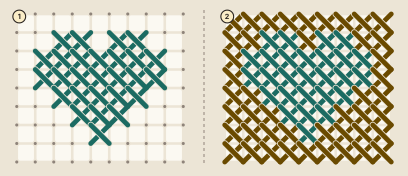
Most cross stitch designs are a motif on bare cloth: the fabric is the background (1 in the picture). In a full coverage design the background is stitched too (2). Every square inside the edge of the design has a cross in it.
Full coverage charts are often pictures: a painting, a landscape, a photograph turned into a chart. They tend to be large and to use many colors, often changing every stitch or two.
How it differs from a design with bare cloth
| Bare cloth round the design | Full coverage | |
|---|---|---|
| The fabric's color | Part of the design: choose the color the chart was made for | Hardly matters: little or none of it shows |
| The fabric's texture | Shows, so linen and evenweave earn their look | Hidden under the stitches |
| Where to start | The center | The center, or the top left corner |
What it asks of the cloth and the strands
The aim is that no cloth shows between the crosses. Two things decide that.
- The count. Smaller stitches leave less cloth to see. The same two strands that leave specks of cloth on 14 count can cover on 16 or 18. This matters most where thread and fabric are far apart in color: pale thread on dark cloth, or dark on pale.
- The strands. Too few, and specks of cloth show between the legs of every cross. Too many, and the stitches crowd the holes and turn lumpy. How many strands to use gives the number for each count.
Before you commit a large cloth, stitch a small square on a scrap of it in your darkest and your palest thread, and look at it. If you can see the fabric, go up a strand or up a count.
A finer count also makes the piece smaller: a design 300 stitches wide is about 21.4 inches (54.4 cm) across on 14 count and about 16.7 inches (42.3 cm) on 18. The table below comes from the same arithmetic as the fabric calculator on this site.
What each count gives
| Fabric | Stitches to the inch | 100 stitches measure | Tapestry needle | Strands |
|---|---|---|---|---|
| 14 count Aida | 14 | 7 1/8 in (18.1 cm) | Size 24 | 2 |
| 16 count Aida | 16 | 6 1/4 in (15.9 cm) | Size 26 | 2 |
| 18 count Aida | 18 | 5 1/2 in (14.1 cm) | Size 26 | 1 or 2 |
| 28 count evenweave or linen, over two | 14 | 7 1/8 in (18.1 cm) | Size 24 | 2 |
| 32 count evenweave or linen, over two | 16 | 6 1/4 in (15.9 cm) | Size 26 | 2 |
| 36 count evenweave or linen, over two | 18 | 5 1/2 in (14.1 cm) | Size 28 | 1 or 2 |
How stitchers manage one
- Cut the cloth with margin to spare and bind its edges. It will be handled for a long time.
- Grid it. In a field of similar shades there is nothing to count from, and a grid puts a line every ten stitches.
- Start at the top left corner or the center. For a corner start, measure the margin in from the edge of the cloth first, at least 3 inches (7.5 cm).
- Choose a way through the colors. Where the color changes every stitch or two, the parking method keeps the place. Where there are solid patches, one color at a time is quicker.
- Do not work in hard squares. If every row ends on the same grid line, the edge of each square can show in the finished piece. Let rows run past the line by different amounts.
- Mark the chart as you go. In a full coverage piece, the chart is the only record of what is done.
Tips for large projects covers frames, pages and keeping the work clean.
Making a full coverage chart from a picture
The picture to pattern converter on this site turns a photograph into a chart. It can leave a plain background as bare fabric or chart it to be stitched: choose the second and the chart is full coverage.
Where to go next
Read the parking method before the first stitch of a many-colored piece, and work out the cloth with the fabric calculator, opened here on 300 by 400 stitches on 18 count. For a smaller piece first, look through the landscape patterns.