Cross stitch guide
The parking method in cross stitch
Parking means working a small part of the chart in every color, and leaving each thread waiting on the front of the cloth at the square where its color is needed next. Nothing is counted across a gap, because every stitch is made beside a finished one.
On this page 7 parts
How parking works
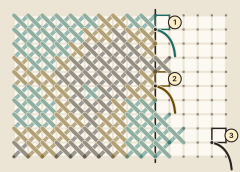
In the picture the block on the left is finished. Each of its three colors has been brought up in the next block, at the lower corner of the first square that needs it (1, 2 and 3), and left there. When the stitching reaches one of those squares, the thread is already waiting in it.
Parking, step by step
- Choose a small area. One row of the chart, or one block of ten by ten squares. A grid on the cloth makes the block easy to see.
- Start at one corner of it with the color of the first square. Stitch every square of that color in the area.
- Find where that color comes next: the nearest square of it that you have not stitched, in this area's next row or in the block beside it.
- Park the thread. Bring the needle up at the corner of that square where its first leg will begin. Pull the thread through until it lies snug against the back. Then let it hang on the front.
- Take up the next color: the color of the first empty square in your area. Stitch it, then park it the same way.
- When you come to a square with a thread waiting in it, pick that thread up and carry on with it.
- If a color is not needed again close by, end it. Do not park far ahead: a thread trailed a long way across the back is the thing to avoid. Guides differ on how far is too far. The careful ones park only a few squares on. Others park anywhere inside the next block or two.
If you forget which color a parked thread is, look at the chart: the square it comes out of tells you.
Threads left hanging
A parked piece has threads hanging from its front, and they need managing.
- Start small. Two or three parked threads are enough to learn on. Some stitchers keep dozens going, others never more than four or five.
- Needle on or off. Many leave a needle on every parked thread, which saves threading it again and needs a needle for each color. Others move one needle from thread to thread.
- Watch for tangles. Threads hanging close together catch on each other. The fewer there are, and the shorter they are, the less they tangle.
- Keep them in order. Stitchers do it in different ways: some bundle the hanging threads to one side with clips, others rest the needles on a needle minder, a small magnet that sits on the front of the cloth.
Cross country
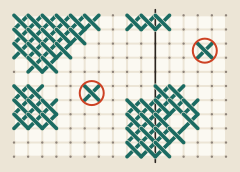
Cross country is the opposite order: one color at a time, across the whole piece or a large part of it, wherever that color falls. The picture shows the same two blocks with only the first color stitched.
| Parking | Cross country | |
|---|---|---|
| Finding your place | Easy: each stitch is next to the last | Harder: early stitches stand in bare cloth, so a grid or a marked chart helps |
| Thread | Many threads in use at once | One thread at a time, in long runs |
| Changes of color | Constant | Few |
| The back | Short hops | Longer carries between patches |
| Suits | Many colors that change every stitch or two | Solid patches and simple charts |
Many stitchers mix the two: one color at a time inside a small area, with a thread parked nearby when its color carries on. What order to cross stitch in compares the ways of working more fully.
Confetti stitches
Confetti stitches are single stitches of a color scattered among other colors, like the two ringed in the picture. A chart with a great many colors and gradual shading can be full of them. They are the best reason to park: the thread comes up for its one stitch, then waits at the next square of its color a little way on. Where the next one is too far to carry to, the stitch has to be started and ended by itself. How to start and end a thread has the ways to hold a lone stitch.
One caution
Do not finish every block to a hard edge. Where all the rows of a solid color stop on the same line, the join can show as a faint stripe or checkerboard. Let a color run a stitch or two over the line in some rows, so the edge of each block is ragged.
Where to go next
Parking belongs with big, many-colored pieces: see tips for large projects and full coverage cross stitch. The back of your cross stitch explains what carried threads do behind the cloth.