Cross stitch guide
Grime guards
A grime guard is a sleeve of fabric with elastic in both edges that wraps round a hoop or frame. It covers the spare cloth where your hands hold the work, so the cloth stays clean, and it keeps that spare cloth bundled out of the way. You can sew one from a strip of cotton and two lengths of elastic.
On this page 8 parts
What a grime guard does
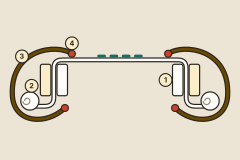
Where you hold a hoop, your hand rests on the cloth outside the ring. Oil and moisture from skin collect there, and dirt sticks to them. Over a long project that edge gets dirty.
A grime guard (3) is a loop of fabric that wraps over the ring (1). Elastic in each edge (4) pulls it snug: one edge sits on the front of the cloth just inside the ring, and the other sits behind. Your hand then holds the guard, not the cloth. The spare cloth (2) is rolled up and tucked inside, so it no longer hangs in your way.
When it helps
- On a large project, where the same cloth is handled again and again.
- When a hoop or frame is moved across a big piece, and there is a lot of spare cloth to hold.
A guard does not replace clean hands. Wash them before you stitch.
What you need
- A strip of woven cotton fabric.
- Narrow elastic, about 1/4 inch (6 mm) wide.
- Sewing thread, a safety pin, pins, an iron and a sewing machine.
Work out the strip
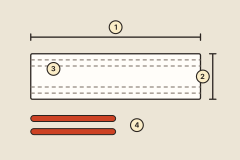
Length (1). Measure the distance round the outside of the hoop with a tape measure. Or multiply the hoop's size by 3.14. Then add 2 inches (5 cm) for the seam and a little ease.
- An 8 inch (20 cm) hoop: 8 × 3.14 is about 25 inches (64 cm) round. Add 2 inches (5 cm): cut the strip 27 inches (69 cm) long.
- A clip frame: add up its four sides, then add 2 inches (5 cm). A frame 11 inches (28 cm) square is 44 inches (112 cm) round, so cut 46 inches (117 cm).
If your fabric is too short, join two strips end to end first.
Width (2). Cut the strip 5 to 6 inches (13 to 15 cm) wide. A wider strip, up to 8 inches (20 cm), leaves more room inside for spare cloth.
Elastic (4). Cut two pieces, each half the length of the strip: 13 1/2 inches (34 cm) each for the 8 inch (20 cm) hoop. Some makers add up to 2 inches (5 cm) for the overlap and trim it to fit.
Sew it
- Press the strip flat.
- Put the two short ends together, right sides facing, and sew them. You now have a loop. Press the seam.
- Fold one long edge over by 1/2 inch (1.3 cm), toward the wrong side, all the way round. Fold it over again by the same amount and press (3). The raw edge is now hidden inside a channel.
- Sew the channel down close to its inner fold. Stop about 1 inch (2.5 cm) before you reach the start, so that there is an opening.
- Do the same on the other long edge.
- Fasten a safety pin to one end of a piece of elastic. Push the pin through the opening and all the way round the channel. Pin the other end so that it is not pulled inside. Keep the elastic flat, not twisted.
- Try the guard on the hoop. It should grip without being a struggle to put on. Trim the elastic if it is loose.
- Overlap the two ends of the elastic by about 1 inch (2.5 cm) and sew them together firmly.
- Let the elastic slip into the channel and sew the opening shut.
- Thread and join the second piece of elastic in the other channel.
Use it
Put the cloth in the hoop first. Roll the spare cloth up to the ring, then stretch the guard over ring and roll together. The back stays open: the guard only wraps the rim.
Take the guard off when you take the cloth out of the hoop at the end of a session.
Common mistakes
- Cutting the strip to the hoop's size. The strip goes round the hoop, so it is a little more than three times as long as the hoop is wide.
- Joining the elastic before trying the fit. Elastic varies in how far it stretches. Put the guard on the hoop first, and trim the elastic if it is loose.
- Letting the elastic twist. Keep it flat as it goes through the channel, and check it again before you sew the ends together.
Where to go next
Hoops, frames and stands explains the holders a guard fits. Large projects has more on handling a big piece of cloth. If the edge is already marked, how to wash cross stitch shows how to clean the finished piece.