Cross stitch guide
How to hang cross stitch
A framed piece hangs from a hanger on the back of its frame, a hoop hangs from its own screw fitting or a ribbon, and an unframed piece hangs from a dowel slipped through a channel sewn along its top.
On this page 9 parts
Four ways, and what each needs on the back
| How it hangs | Suits | What the back needs |
|---|---|---|
| In a frame | Any piece you want protected | The frame's backing board and a hanger |
| In a hoop | Small pieces, round designs | The spare cloth gathered in, and a felt cover if you like |
| From a dowel | Samplers, banners, long pieces | A channel sewn along the top, and hems on the other sides |
| By a ribbon loop | Ornaments | A loop sewn into the top seam |
A framed piece
A ready-made frame carries its hanger on its backing board. If that board cannot go back in over the mounted piece, or has no hanger, fix a hanger to the frame itself. Before you close the frame, hold it up by the hanger and check that the design sits straight. How to frame a cross stitch covers the rest.
A hoop
A hoop hangs from its own screw fitting, hooked over a nail, or from a ribbon tied through the fitting. The back matters too. Gather the spare cloth in flat behind the hoop, and cover it with felt if the back will be seen. How to finish cross stitch in a hoop shows how.
From a dowel
This is the frameless way: the piece becomes a small banner.
- Wash and press the piece.
- Hem the sides and the bottom. Fold each of these edges to the back along a row of the weave, so the fold is straight. Press the folds and sew them down. How to finish cross stitch edges has the hem.
- Sew a channel along the top. Fold the top edge to the back by enough to wrap loosely around the dowel. Test the fit with the dowel itself, then sew the fold down below the place the dowel takes.
- Slide the dowel in, so that an end shows at each side.
- Tie on a cord. Knot a length of cord or ribbon to each end of the dowel and hang it over a nail.
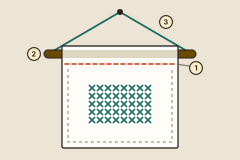
The dashed line (1) is the seam that makes the channel. The dowel (2) carries the weight, and the cord (3) hangs it.
A back is optional. Felt cut a little smaller than the piece hides the thread ends: how to back a cross stitch has the steps.
A long, narrow piece
A long, narrow design can be finished as a bell pull. A bell pull was once the strip of cloth that rang a servants' bell, often with a tassel at its foot. Today it is made mostly for show.
Ornaments
An ornament hangs from a loop of ribbon. The loop is laid between the stitched piece and its backing, with its ends at the top edge, before the two are sewn together, so the seam holds it. Finishing ornaments goes through it.
Standing instead of hanging
Not everything has to go on a wall. Some small frames have a stand on the back as well as a hanger, and a finished hoop can stand on a shelf wherever a picture frame can.
Where not to hang it
- In direct sun. Sunlight fades thread.
- In steam or grease. A bathroom or the wall above a stove is a bad place for cloth. In a kitchen, or near smoke, candles or an open fire, put the piece under glass.
Where to go next
For every way to finish a piece, hung or not, see how to finish and display cross stitch.