Cross stitch guide
Metallic and specialty threads
Metallic thread frays and tangles, so change three things: cut it shorter, about 12 inches (30 cm); use a needle one size larger; and stitch slowly. The same habits tame blending filament and glow in the dark thread. Variegated floss needs one thing only: finish each cross before you start the next.
On this page 6 parts
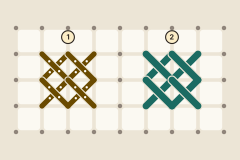
Metallic thread
Metallic thread is not cotton. It is made of synthetic fibers such as polyester and viscose, so it is stiffer and more slippery, and it wears where it rubs. Every pass through the cloth scrapes it a little. The habits below all cut down that rubbing.
- Cut it short. Use lengths of about 12 inches (30 cm). A long thread goes through the cloth too many times before you reach its end.
- Go up a needle size. If you would use a size 26, use a 24. The larger needle opens the hole a little wider, and its larger eye is kinder to the thread.
- Tie it to the needle. Metallic thread slides out of the eye. For two strands, cut one strand twice as long, fold it in half, push the fold through the eye, then pass the two ends through the loop and pull snug. The thread is now knotted at the eye and cannot slip.
- Stitch slowly. Pull gently. Do not hurry and do not tug.
- Let it unwind. Every few stitches, let the needle hang from the cloth until the thread stops turning.
- Leave a longer tail. The thread is springy and works loose, so hold it under more stitches than you would cotton, at the start and at the end.
A thread conditioner, drawn lightly along the thread, helps many stitchers with metallics.
Metallic thread comes in two forms. Metallic floss has six strands that you divide the same way as cotton: two strands on 14 count. A metallic braid is a single round thread used as it comes, and one strand of a fine braid stands in for two strands of floss.
Blending filament
Blending filament is the thinnest metallic of all, close to a strand of tinsel. It is made to be mixed: one strand of filament goes in the needle together with your cotton strands, and the stitches come out with a faint shimmer. Use short lengths, stitch slowly, and knot the filament to the eye of the needle so that it cannot slide off on its own.
If two kinds of thread in one needle fight each other, do it in two passes. Stitch the area in cotton first. Then go over it with the filament alone, laid on top of the finished crosses.
Glow in the dark thread
Glow in the dark thread soaks up light and gives it back: after time under a lamp or in daylight it glows for about 15 minutes, and longer under a black light. It kinks and twists more than cotton, so keep lengths to 15 to 18 inches (38 to 46 cm) at most, stitch slowly, and let the needle hang to unwind. Washing does not harm the glow. Keep the iron and bleach away from it.
Variegated floss
Variegated floss changes color along its length. Some is dyed by machine, some by hand, where it is also sold as overdyed or hand-dyed. How the colors land on the cloth depends on the order you make the legs in.
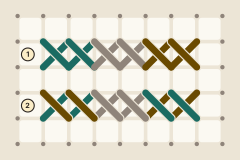
- One cross at a time (1 in the picture). Finish each cross before you start the next. Both legs come from the same inch of thread, so each cross is one color and the colors drift along the row in bands. This is the usual way with variegated floss.
- In rows (2 in the picture). Work a line of half stitches, then come back to cross them. The first legs and the second legs come from different parts of the thread, so the colors mix inside each cross and the patch looks flecked. Choose it only when that is the look you want.
Two more things keep the color changes in order. Do not use a loop start: folding the strand puts two different parts of it side by side. And buy all you need at once, because no two batches of a variegated color are quite alike.
Common problems
| What you see | What to do |
|---|---|
| The metallic thread shreds or snaps | Shorter lengths, a larger needle, a gentler pull. Start a fresh length as soon as one looks worn. |
| The thread keeps slipping out of the needle | Knot it to the eye, as in step 3. |
| The stitches look thin and wiry | Lay each leg flat before you pull it snug, or use a braid in place of floss. |
| Tails work loose on the back | Run them under more stitches, and do not trim them right at the cloth. |
| You need to press the finished piece | Metallic thread does not like heat: press from the back with a cool iron, or let the piece dry flat and skip the iron. Do not iron glow in the dark thread at all. |
Where to go next
Beads are the other way to add sparkle: see adding beads to cross stitch. When a key gives two color numbers for one symbol, read blended threads. The needle size chart shows which needle is one size up from yours, and cross stitch thread and floss covers plain cotton.