Cross stitch guide
Cross stitch on pegboard
Pegboard is a ready-made grid: a board with holes an inch apart. Thread a big blunt needle with doubled yarn and work one cross in each square between four holes, exactly as on Aida. Every square of the chart comes out an inch across, so a small chart makes a large piece for the wall.
On this page 8 parts
Why pegboard works
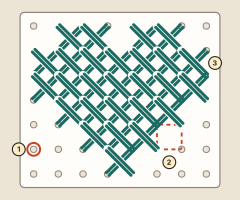
Pegboard is hardboard drilled with rows of evenly spaced holes. On the common kind the holes are 1 inch (2.54 cm) apart, across and down. That makes it a counted ground like Aida, only far larger: the holes (1 in the picture) are where the needle goes, and the square between four holes (2) takes one cross (3).
How big a chart comes out
One square of the chart is one square of the board, and a square is as wide as the holes are apart: 1 inch (2.54 cm).
- Count squares, not holes. A row of holes has one square fewer than it has holes. A board 2 feet (61 cm) wide has 24 holes in a row and room for 23 crosses.
- Multiply. A chart 23 squares wide fills that board. A full sheet is 4 feet (122 cm) wide, which is room for about twice as many.
- Choose a small chart, or part of one. A design that is tiny on cloth is big here. Very few charts are as small as 23 squares each way. Many of the small patterns fit a board 4 feet (122 cm) wide, and a larger chart can be cropped to the part you like.
Count the holes on your own board before you settle on a chart. Boards are cut to size, and the cut decides how many whole squares are left.
What you need
- Pegboard. Hardware stores sell it in large sheets and will usually cut it for you. One side is often white already.
- Yarn in the colors of the chart. Each color in the key is a ball of yarn, so a chart with few colors is cheaper and simpler. The Easy patterns use four or fewer.
- A large yarn needle. A plastic one is blunt and kinder to fingers on a big, awkward board.
- Paint, if you want a ground that is not white or brown.
- Tape or a glue gun for the ends on the back.
How to stitch it
- Clean the board. Drilling leaves fine brown dust in and around the holes. Wipe or vacuum it off, so that it does not rub into the yarn.
- Paint it if you are going to, and let it dry.
- Mark the board to match the chart. Find the center square, and mark every tenth square along the edge with a marker or a slip of paper. Then the counting is the same as on cloth: how to count cross stitch.
- Thread the needle with a long piece of yarn, doubled. One strand of ordinary yarn looks thin on a grid this size. Two strands, or one very thick yarn, show much better.
- Fasten the end on the back. Either tie a knot too big to pull through the hole, or hold the tail against the back and catch it under your first stitches.
- Make the cross the usual way: up through one hole, down through the hole diagonally opposite, up through the hole beside it, and down across the first leg. Keep the top legs leaning the same way all over the board.
- Work one color at a time, an area at a time.
- Finish each length on the back. Run it under a few stitches, or tape the end down and fix it with a dab of hot glue.
Coverage, and where to hang it
Yarn does not fill a pegboard square the way floss fills Aida. Some board shows between the legs, which is part of the look. For a fuller picture use thicker yarn, or stitch with ribbon, which lies flat and covers more.
A pegboard picture is coarse close up and comes together from a distance, so give it a wall you can stand back from. The board is thin, 1/8 to 1/4 inch (3 to 6 mm), so hang it with short fixings that will not come through the front, or put it in a frame.
Wire mesh and screens
Any stiff grid of holes can take crosses, as long as the holes are spaced the same across as down. A wire screen or mesh stretched in a frame is worked like Aida or plastic canvas: one cross over each crossing of the wires, from a chart.
Open mesh has one catch. You can see through it, so anything carried across the back shows from the front. Finish each color where it ends, and do not jump from one part of the design to another.
Chain-link fences
A chain-link fence is woven in diamonds that stand on their points. The standard diamond measures 2 inches (5.1 cm) from one flat side to the other, so each opening is far bigger than a square of pegboard, and a design grows fast. Openings that large want something much bulkier than yarn to fill them.
A fence belongs to someone. Ask before you decorate one.
Where to go next
For a stiff grid at a smaller scale, see plastic canvas and perforated paper. If you have not stitched before, how to cross stitch shows the stitch itself, and it is the same stitch here.