Cross stitch guide
Cross stitch on plastic canvas
Any chart in whole crosses can be stitched on plastic canvas. Use 14 count canvas with round holes and two or three strands of floss, stitch it in the hand with no hoop, then cut the piece out leaving one whole bar of plastic round the stitches.
On this page 9 parts
What plastic canvas is
Plastic canvas is a sheet of stiff plastic with a grid of holes. It bends a little but holds its shape, and it never frays. It is sold in sheets and in ready-cut shapes.
The count is the number of holes to the inch. The usual counts are 5, 7, 10 and 14.
- 14 count, with round holes, is the one made for cross stitch. Stitches on it are the size of stitches on 14 count Aida.
- 5, 7 and 10 count, usually with square holes, are made for yarn. Most plastic canvas work is done on these, in needlepoint stitches. You can cross stitch on them, but each cross is much bigger and needs more thread to cover.
Which charts work
A chart works on plastic canvas if it has:
- Whole crosses and backstitch only. Quarter stitches and French knots do not work on plastic canvas. Every cross stitch pattern on this site is charted in full crosses.
- A simple outline. You will cut round it.
- Few bare squares inside the shape. Empty plastic showing between stitches does not look good.
What size a chart comes to
Divide the stitches by the count, as you do for cloth. A design 42 stitches wide is 3 inches (7.6 cm) on 14 count, 4.2 inches (10.7 cm) on 10 count and 6 inches (15.2 cm) on 7 count. The fabric calculator, opened on 42 by 42 stitches at 10 count, works out any other size. The guide to other fabric counts has more on the low counts.
Thread and needle
- On 14 count: two or three strands of floss. Two pull through easily. Some stitchers find that the plastic shows between them and use three.
- On 10 count and lower: more strands, up to all six, or yarn.
- Needle: a blunt tapestry needle, size 24 or 26. Plastic is stiffer than cloth, so many stitchers pick the smaller of the two.
How to stitch on it
- Keep the sheet big. Leave at least 1 1/4 inches (3 cm) of spare canvas round the design, to hold. Stitch first and cut afterwards.
- Find the center by measuring. Plastic canvas cannot be folded. Measure across and down with a ruler to find the middle hole.
- Start without a knot, as on cloth. Hold the tail against the back and stitch over it.
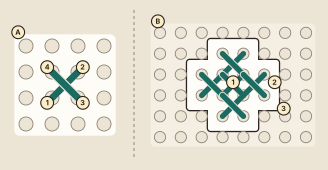
- Work each cross over one crossing of the bars (A in the picture). There is no hoop. The canvas is its own frame.
- End under the stitches. Run the needle under four or five stitches on the back and snip.
Cutting it out
Cut with old scissors, not your fabric ones. Leave one whole bar of plastic round the stitches, all the way round (B in the picture). That bar is what holds the outer stitches on. Never cut into a hole that has thread in it.
Edging and backing
The bare edge can be covered with thread. Fasten a length under the stitches on the back, bring it over the edge and down through the next hole, and go on round, one hole at a time. The same stitch, taken through two pieces at once, joins them into boxes and other standing shapes.
A piece of felt on the back hides the thread ends.
What people make
Tree ornaments, fridge magnets, key rings, coasters, bookmarks and small boxes. Plastic canvas needs no hoop and is easy to hold, so it is also a common first surface for children.
Where to go next
- To finish a piece: finishing ornaments and making magnets.
- To stitch with a child: teaching children to cross stitch.
- For thin card with the same grid: cross stitch on perforated paper.
- For designs with a simple outline: the ornaments.