Cross stitch guide
What you can cross stitch on besides Aida
You can cross stitch on almost any cloth. What changes is where the grid comes from. A cloth with threads you can count is stitched as it is. A cloth you cannot count is stitched through waste canvas laid on top, or through holes made before the first stitch.
On this page 9 parts
Cloth you can count
A cross stitch chart needs a grid. These surfaces have one of their own, so you stitch straight onto them.
- Evenweave and linen are woven in single threads and worked over two of them. Linen has its own guide, and so does stitching over two threads.
- Hardanger fabric is a 22 count cotton with a blocked look. It is counted the way Aida is. See 22 count fabric.
- Canvas for needlepoint is an open mesh. See the section on canvas below.
- Aida band is a narrow strip of Aida with finished edges. See Aida band.
- Perforated paper is light card with holes punched in a grid. See perforated paper.
- Plastic canvas is a stiff plastic grid for things that stand up. See plastic canvas.
- Silk gauze is a very fine canvas woven of silk, for miniature work. It has its own section just below.
Silk gauze
The name misleads: silk gauze is not a soft, sheer dress fabric. In needlework it means a very fine canvas woven of silk, made for miniature work. It is counted in holes to the inch, the way needlepoint canvas is: from about 18 at the coarse end to 40 and 48, and finer still for the smallest pieces.
It is worked from a counted chart, one stitch to a square, most often in tent stitch, the small slanting stitch of needlepoint. A design comes out tiny: 80 stitches on 40 count measure 2 inches (5.1 cm).
Three things make it manageable:
- Hold the gauze taut in a mount. It is often sold already mounted in a small frame. A loose piece is fixed over a window: taped to a card mount with an opening cut in it, or sewn to a larger piece of cotton that is then cut away behind the gauze and put on a frame.
- Use a fine thread, a single strand of floss or finer, so that the stitches do not crowd the small holes.
- Stitch in good light, with a magnifier if you need one for the finer counts.
Plain cloth and clothes: waste canvas
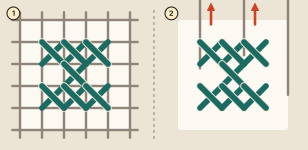
A T-shirt, a denim jacket, a tote bag or a plain cotton has threads too fine or too uneven to count. The answer is waste canvas: a loose, stiffened canvas that lends its grid for as long as you stitch.
- Tack the canvas to the cloth, square with the weave of the cloth. Leave canvas spare on every side.
- Stitch the design through the holes of the canvas and through the cloth beneath. Do not catch the threads of the canvas, and do not pull the stitches tight.
- Dampen the canvas, and draw its threads out one at a time. The crosses stay on the cloth.
A canvas that dissolves in water does the same job with nothing to pull out. Waste canvas goes through both kinds step by step.
Felt
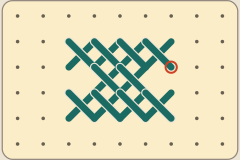
Felt is made of matted fibers, not woven threads, so there is nothing to count. There are two ways round that.
- Waste canvas on top, as for any cloth that cannot be counted.
- Holes made first. The crosses are worked through a grid of holes made in the felt before the first stitch, the way they are worked through the holes of Aida.
A blunt tapestry needle suits ready-made holes: it finds the hole where a sharp one can pierce the felt beside it.
Leather
Leather is stitched through holes made first. Lay a guide on top and prick through it with a sharp needle or a pin at every place the needle will pass. The guide can be a paper pattern, or a piece of Aida, whose holes give the grid for cross stitch. Leather closes up round the holes, so they are hard to see. Feel for each one with the point of the needle.
Tulle
Tulle is a very fine, lightweight net, thin enough to see through. It has no threads in a square grid, so a chart cannot be counted on it as it is. The grid has to come from a counted canvas laid on top, as on plain cloth. Whatever is stitched on tulle shows from both sides, so keep the back of the work tidy.
Canvas
The word covers two different things.
Needlepoint canvas is a stiff, open mesh, sold by its threads to the inch, as cross stitch cloth is. Cross stitch has long been worked on it, often in wool, and was very popular that way in the nineteenth century. A chart is followed square for square. The needlepoint part of this site is about canvas and the stitches made on it.
Canvas cloth, as in a tote bag or a canvas shoe, is a heavy plain-woven cloth. It is stitched through waste canvas, like clothes.
Fabric names explained
Mills name their cloths, and labels and patterns use the names without saying what they are. A name is a fact about a product: it tells you the cloth and its count. It is not a grade, and a cloth of the same kind and count from another mill gives stitches of the same size.
| Name on the label | What it is |
|---|---|
| Hardanger | A cotton with a blocked weave, usually 22 count |
| Lugana | An evenweave of cotton and rayon, sold in 25 count and other counts |
| Cashel | 28 count linen |
| Belfast | 32 count linen |
| Edinburgh | 36 count linen |
| Fiddler's cloth | A cotton blend woven like Aida, oatmeal in color with a homespun look, in 14, 16 and 18 count |
Printed background fabric
Some Aida and linen is printed with a pattern after it is woven, and the print becomes the background of the design. Printed cloth has a right side, the printed one. It is stitched like any cloth of its count.
A different print is a counting grid: lines that wash out when the piece is finished. It saves gridding the cloth yourself.
What to do with offcuts
- Keep them, with the count written on. If the label is gone, count the squares or threads in one inch (2.54 cm) with a ruler.
- Try out threads. A scrap of the same cloth is the place to stitch a few crosses and see how many strands cover best.
- Stitch something small. Many of the small patterns fit a piece left over from a larger project.
To see whether an offcut is big enough, give the fabric calculator a small design, such as 30 by 30 stitches on 14 count with an ornament margin. It tells you the piece the design needs.