Cross stitch guide
How to start and end a cross stitch thread
To start, hold a short tail of thread against the back of the cloth and work your first stitches over it. To end, slide the needle under the last few stitches on the back and snip. Neither end needs a knot.
On this page 8 parts
Why there is no knot
A knot is a small lump. When the finished piece is pressed flat in a frame, lumps on the back show on the front as bumps, and a knot can work its way through a hole in the cloth. So the end of the thread is trapped under stitches instead, where it lies flat.
To start: stitch over the tail
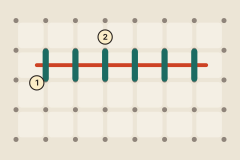
- Bring the needle up from the back where the first stitch begins. Stop pulling when a short tail is left behind the cloth. Guides give about 1 inch (2.5 cm), and some two or three times that.
- Hold that tail (1) flat against the back with a finger, pointing along the row you are about to stitch.
- Work the first four to six stitches. On the back, each stitch should cross over the tail (2). Turn the cloth over after the second stitch to see that it does.
- Snip off whatever tail is left.
If finished stitches are already beside the spot, there is a quicker way: on the back, slide the needle under four or five of them, pull the thread through until the end just disappears, and begin.
The waste knot and the away knot
A waste knot is a knot you cut off. It holds the thread for the first stitches, so the end cannot pull out, and it is gone before the piece is finished.
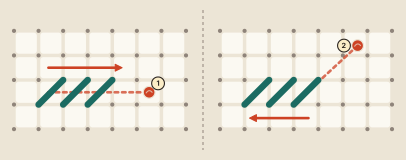
The waste knot (1). Knot the end of the thread. Take the needle down through the front of the cloth four or five squares along the row you are about to stitch, so the knot sits on the front. Come up at the start of the row and stitch toward the knot. Each stitch crosses the thread lying behind the cloth. When the stitches reach the knot, lift it and snip it off.
The away knot (2), also called an away waste knot. Put the knot well away from the stitching, from 1 inch to about 3 inches (2.5 to 7.5 cm) off and out of the path of the row. Stitch as usual. Later, snip the knot, turn the cloth over, thread the loose tail into the needle and run it under the backs of finished stitches. It works where a loop start cannot: with an odd number of strands, or with two colors in one needle.
The pin stitch
A pin stitch is one or two tiny stitches made inside a single square of Aida, where a cross is about to go. The cross then covers them. It is worked from the front, so it suits a piece on a frame whose back is hard to reach, and it needs no neighboring stitches to hide under.
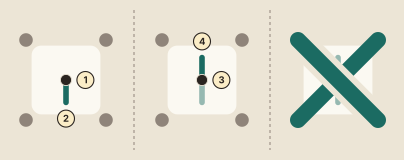
- Start at the middle of the square (1), parting the threads of the block, and keep hold of a short tail. Make one tiny stitch from there, a thread or two long (2).
- Go back to the middle (3) and make a second tiny stitch to the other side (4). Pull both snug: they sink between the threads of the cloth.
- Stitch the cross over the top, and trim the tail close.
Stitchers work it with small differences. Some begin with the needle going down through the middle from the front and keep the tail on top, where it is easy to hold and to trim. Others come up from the back. In Aida the tiny stitches sink into the woven block. Linen and evenweave have no woven block for them to sink into, so there the stitch is worked a little differently, and stitchers disagree on how well it hides: some use it on linen by choice, others keep it for Aida.
To end: run the thread under the back
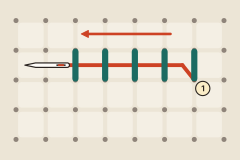
- Finish the last stitch so the needle is at the back.
- Slide the needle under the backs of the last four to six stitches (1), and pull the thread through. Guides give anything from three to six.
- Snip the end close to the cloth.
Run a thread under stitches of its own color, or one close to it. A dark thread tucked under pale stitches can show through to the front. Cut every end short: a loose end left hanging gets caught by later stitches and can be pulled through to the front.
One stitch by itself
A single cross with no stitch of its color near it has nothing to hide a tail under. Two ways start it:
- A loop start, when the stitch uses an even number of strands.
- A pin stitch in the same square, when it uses an odd number.
To end it, turn the cloth over and weave the needle back and forth under the threads the cross itself leaves on the back, more than once, then snip.
Common questions
The thread pulled right out on my first stitch. The tail was too short or was not held. Leave a longer tail and keep a finger on it, or use a waste knot until the habit forms.
Can I just tie a knot? Nobody will stop you, and a knot is the simplest start there is. The cost is the bump under a framed piece. On a piece whose back is seen and handled, a knot sticks out and can come loose with wear and washing.
Where to go next
With two strands, the loop start leaves no tail at all, and it has a page of its own. Threading a needle comes before any of this. The back of your cross stitch says how tidy the back needs to be, and Changing colors and carrying thread picks up where one color ends and the next begins.