Cross stitch guide
The back of your cross stitch
The back of a cross stitch never looks like the front, and for a piece that will be framed or hung it does not need to be neat. It needs to be flat, with no knots and no long ends. A tidy back matters more when the back will be seen, handled or washed.
On this page 6 parts
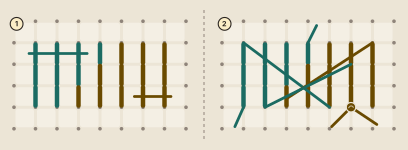
What the back looks like
A cross on the front is two slanting legs. On the back, the thread only travels from the end of one leg to the start of the next, so the back of sound work is mostly short upright bars in rows (1 in the picture). Rows stitched out and back leave bars alone. Crosses finished one at a time leave bars with slants between them.
No amount of care makes the back match the front. Cross stitch is not a reversible stitch. A stitch that does look the same on both sides is worked differently: see double-sided cross stitch.
How tidy a back can be also depends on the design. Solid patches of a few colors leave neat rows. A design with single stitches scattered everywhere leaves a busy back however well it is worked (2).
When it does not matter
A piece that will be framed, set in a hoop or hung against a wall has its back covered. Nobody sees it, and a busy back still holds the stitches. If you enjoy stitching and the front looks right, the back is nobody's business.
When it does
- Knots and lumps under a flat mount. A piece stretched flat in a frame can show knots and thick lumps as bumps on the front.
- Dark thread behind bare cloth. A thread carried across the back where nothing is stitched can show through as a shadow. This is a matter for the front, and the reason carries are kept short.
- A back that will be seen. Towels, banners, blankets and anything else used from both sides, such as a bookmark with no backing.
- A piece that will be washed and handled. Knots and loose ends on a visible, working back can come undone with wear.
- A piece entered in a competition. Judges may turn it over.
Habits that keep a back tidy
- No knots. Start by stitching over the tail or with a loop start. End by running the thread under four to six stitches. How to start and end a thread shows each way.
- Cut ends short. An end left long gets caught by later stitches and can be dragged through to the front.
- Tuck ends under their own color, or one close to it. A dark end under pale stitches can show.
- Carry thread only a short way. Across a stitched area, slide the needle under the stitches on the back. Across bare cloth, end the thread instead. Changing colors and carrying thread gives the distances.
- Stay with one color while it lasts. Fewer threads started and ended means fewer ends on the back.
- Work rows the same way every time, out along the row and back. The bars then fall in straight lines.
If the back is already busy
Leave it. Check three things before you finish the piece: no knot sits where it will press against the front, no end is long enough to work through, and no dark carry crosses bare cloth. Snip and tuck where one does. Then cover the back: a frame does it, and backing a cross stitch covers the other ways.
Where to go next
For something meant to be seen from both sides, look at the bookmark patterns with these habits in mind, and read about double-sided cross stitch.