Working methods · Advanced
Double-sided cross stitch
Double-sided cross stitch puts a whole cross on both faces of the cloth, so the work has no wrong side. Each row is stitched in four journeys instead of two: two that make every second cross, and two that fill in the crosses between.
How to work it
First journey: a half stitch in every second square
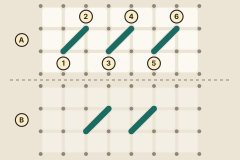
Each picture shows the front of the cloth (A) above its back (B). Working from left to right, make a half stitch in the first square (1 to 2), miss a square, and make the next (3 to 4), and so on. The last square of the row must be one you stitch (5 to 6). On the back, the thread has crossed each square you missed.
The turn: two short stitches in the last square
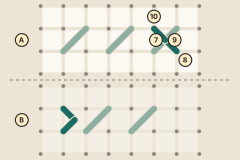
Bring the needle up in the middle of the last square (7) and take it down at the bottom right corner (8). Come up in the middle again (9) and go down at the top left corner (10). The two short stitches cross the last half stitch and finish that cross on the front.
Second journey: cross the half stitches
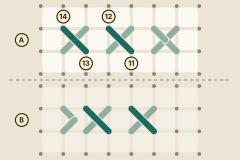
Work back from right to left, crossing each half stitch of the first journey (11 to 12, 13 to 14). Every second square now has a whole cross on the front, and each square between them has a whole cross on the back.
Third journey: a half stitch in each square you missed
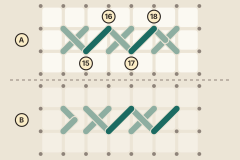
Work from left to right again. Come up at the bottom right corner of the first cross (15) and make a half stitch in each empty square (15 to 16, 17 to 18).
Fourth journey: cross them, and close the row
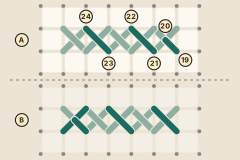
Come up at the bottom right corner of the last square (19) and go down in its middle (20), a short stitch over one that is already there. Then work back from right to left, crossing the half stitches of the third journey (21 to 22, 23 to 24). To finish, take the thread behind the cloth to the bottom left corner of the first cross and fasten it there: that last journey lays the one leg still missing on the back.
At a glance
- Also called
- reversible cross stitch, two-sided cross stitch, double sided cross stitch
- Used for
- bookmarks; towels, tablecloths and other linen seen from both sides; borders on garments
- Journeys
- Four along each row. Plain cross stitch takes two.
- Easiest on
- Evenweave or linen with each cross worked over two threads, where the middle of a cross is a hole. On Aida the short stitches of the turn have to pierce the middle of a block.
- Other names
- Two-sided cross stitch and reversible cross stitch.
Ordinary cross stitch has a right side and a wrong side. The front shows crosses and the back shows short upright stitches, however neatly it is worked. Double-sided cross stitch changes the path of the needle so that the thread crosses every square on both faces. Turned over, the work looks the same.
It is meant for stitching that is seen from both sides: a bookmark, a towel, a tablecloth, the edge of a garment. It is an old method, found in the linen embroidery of earlier centuries and in the needlework books that describe it.
It has limits. It works along a straight, unbroken row of crosses, so it suits simple blocks of color and straight borders best. Single stitches standing apart, and broken shapes such as letters, are not worked this way: old manuals give a separate, fiddlier stitch for them. A row takes twice the journeys, and at the turn the thread lies double, so the last cross of a row carries a little more thread than the rest.
As worked here, a row ends on a square of the first journey, so it holds an odd number of crosses. Plan a band or a border with that in mind.
With no wrong side there is nowhere to hide a knot. Older instructions begin with two or three tiny running stitches that the first cross then covers. Another way is a waste knot, whose tail is woven into the stitches afterwards.
Tips
- Work a row of five on a scrap first, with the pictures beside you, and turn the scrap over after every journey. The back should match picture B each time.
- Keep to one order of journeys in every row, so that the top legs lean the same way on both faces.
When it goes wrong
- One cross on the back is missing a leg
- It is the first cross of the row. The thread has to travel once more behind the cloth, from the end of the fourth journey to the bottom left corner of the first cross.
Variations
- A cross on the front and a square on the back. Marking cross stitch is neat on both faces without being the same on both: crosses on one, small squares on the other. It was the stitch for letters and initials on household linen, where each cross is finished before the next is begun.
- Two-sided Italian cross stitch. A cross framed by straight stitches, alike on both faces. It is one of the specialty stitches.
Questions
- Can cross stitch look the same on both sides?
- Yes. Worked in four journeys along each row, with two short stitches at the turn, every square holds a whole cross on the front and on the back.
- Can any pattern be stitched double-sided?
- Rows of crosses side by side can. Single scattered stitches and letters cannot be worked by this method.
- Is a neat back the same as double-sided cross stitch?
- No. The back of ordinary cross stitch, however tidy, is upright stitches and not crosses. Only the four-journey method puts crosses on both faces.