Stitches · Intermediate
Half stitch, quarter stitch and three-quarter stitch
A half stitch is a single slanting leg, half of a cross. A quarter stitch is shorter: it goes from one corner of the square only as far as the middle. A three-quarter stitch is a quarter stitch with one whole leg laid across it. Charts use them to round an edge that full crosses would leave in steps.
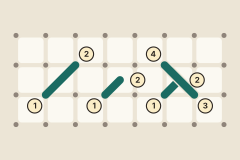
How to work it
The half stitch
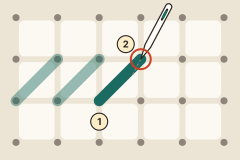
Bring the needle up through the bottom left hole of the square (1) and take it down through the top right hole (2). That one slanting leg is the whole stitch: the first half of a cross, left uncrossed. A row of them is worked like the first pass of a row of crosses.
The quarter stitch
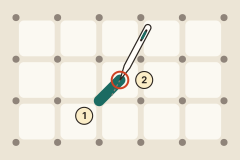
Come up through the corner hole the chart points to (1) and go down in the middle of the square (2). On Aida there is no hole in the middle, so the needle has to be pushed through the block itself.
The three-quarter stitch
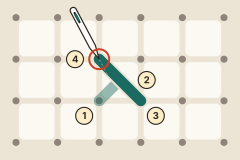
Work a quarter stitch first (1 to 2). Then make one whole leg across it, from corner to corner (3 to 4). Three corners of the square are now covered and the fourth is left bare. Most stitchers make the short arm first, as here. Some lay the whole leg first and pin it down with the quarter stitch.
Two colors in one square
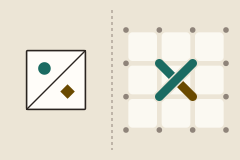
When a slanted line splits a square of the chart and each half has its own symbol, two colors share that square. Stitch one color as a three-quarter stitch and the other as a quarter stitch. If the chart does not say which is which, give the three-quarter stitch to the color of whatever stands in front in the picture.
At a glance
- Also called
- half cross stitch, quarter stitch, three-quarter stitch, 3/4 stitch, 1/4 stitch, fractional stitches, partial stitches
- Used for
- rounding the edge of a shape; two colors in one square; areas that should look lighter than full crosses
- On the chart
- A quarter stitch is a small symbol in one corner of a square, or a square split by a slanted line. A three-quarter stitch is often drawn the same way, so read the key.
- Easiest on
- Evenweave or linen stitched over two threads, where the middle of every stitch is already a hole.
- Which way a half stitch slants
- The way the key says. If it says nothing, choose one way and keep to it.
Full crosses fill whole squares, so a curve stitched in them comes out as a staircase. Quarter and three-quarter stitches fill part of a square and take the corners off the steps. Half stitches do another job: they cover the cloth more thinly than crosses do, so an area worked in them looks lighter and softer than the crosses beside it.
The cloth matters for quarter and three-quarter stitches. On evenweave or linen worked over two threads, the needle goes down between the two threads in the middle of the stitch. On Aida it has to pierce the middle of a woven block. Many stitchers change to a sharp needle for these stitches, because a sharp point parts the block where a blunt one will not. Half stitches use the corner holes only, so they are the same on every cloth.
Charts do not all mark these stitches the same way, and a quarter stitch and a three-quarter stitch can look alike on paper. So look for these marks in the chart and its key before you begin, and settle what each kind means. Then stitch every mark of one kind the same way.
From the front, a half stitch is the tent stitch of needlepoint. In needlepoint the half cross is one of three ways to work tent stitch. The other two, continental and basketweave, look the same from the front, but the thread travels further behind the canvas and leaves more of itself on the back. So every half cross stitch is a tent stitch, and not every tent stitch is a half cross.
Every cross stitch pattern on Floss Field is charted in full crosses only. This page is for charts from elsewhere that use partial stitches.
Tips
- The whole leg of a three-quarter stitch may slant either way, whichever the shape needs. It is an accepted exception to the rule that every top leg leans the same way.
- Where a whole area is charted in half stitches and the key gives no direction, look at what the area shows: half stitches that lean the same way as your top legs blend in with the crosses.
When it goes wrong
- The needle will not go through the middle of an Aida block
- A blunt needle is made to slide into holes, not to pierce. Change to a sharp needle for these stitches only.
- The chart does not say which half of a split square is the three-quarter stitch
- Choose by the picture. The color of the thing in front takes the three-quarter stitch and the color behind it takes the quarter stitch.
Variations
- Half cross stitch on canvas. In needlepoint the same slanting stitch, worked over one crossing of the canvas, is tent stitch, the most basic stitch of that craft.
Questions
- Is a half cross stitch the same as a tent stitch?
- From the front, yes: both are one slanting stitch. Tent stitch is the needlepoint name, and half cross is one of the three ways of working it. Continental and basketweave are the other two, and they differ on the back.
- Which way should half stitches slant?
- The way the chart's key says. If it gives no direction, choose one and keep to it for the whole area. Half stitches that lean the way your top legs do blend in with the crosses.
- Can I work quarter stitches on Aida?
- Yes. The needle goes down through the middle of the block instead of a hole. A sharp needle makes that easier. On evenweave over two threads the middle is a hole and no piercing is needed.
- Do the cross stitch patterns on Floss Field use fractional stitches?
- No. Every cross stitch pattern here is charted in full crosses only.