Cross stitch guide
Cross stitch stitches
A counted chart is nearly all full crosses, with a few other stitches for the detail. These are the stitches a chart may ask for: the everyday ones, each with a page of its own, and fourteen specialty stitches, each explained here in a few lines.
On this page 7 parts
The everyday stitches
Five stitches cover nearly every chart. Each has its own page.
- Full cross stitch. Two slanting legs that cross in one square: How to cross stitch.
- Half stitch. One leg of a cross, left uncrossed: Half stitch, quarter stitch and three-quarter stitch.
- Quarter and three-quarter stitch. Part of a square, to round an edge or put two colors in one square. On the same page as the half stitch.
- Backstitch. A line of short straight stitches for outlines and lettering: Backstitch.
- French knot. A small raised dot: French knot.
Every cross stitch pattern on Floss Field is charted in full crosses only. The rest of this page is for charts from elsewhere, above all samplers, which were first made to keep a record of different stitches.
How to read the pictures
Each square is one block of Aida cloth, with a hole at each corner. The numbers give the order of the needle: up at the odd numbers and down at the even ones. Several of these stitches span two blocks each way, so that every end falls in a hole. The last two pictures show evenweave, drawn as single threads with a hole between every two.
Crossed stitches
Smyrna cross, or double cross stitch
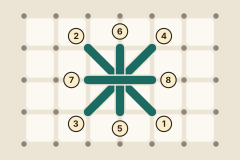
A cross with an upright cross laid over it, which makes a small star. Work the slanting cross first (1 to 4), then an upright cross over it: here the upright stitch (5 to 6), then the level one (7 to 8). Keep one order for every stitch, so that the same arm always lies on top. It is also called Leviathan stitch and star stitch. Needlepoint has an entry for it: Smyrna cross stitch.
Upright cross stitch
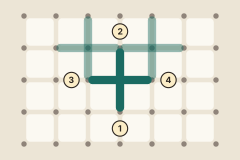
A cross shaped like a plus sign: one upright stitch (1 to 2) crossed by one level stitch (3 to 4), which is always the one on top. As a filling, the crosses of each row sit in the gaps of the row before. See Upright cross stitch.
Long-armed cross stitch
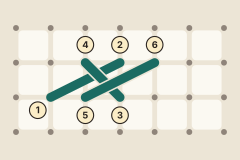
A cross with one arm much longer than the other: here the long arm is twice as wide as the short one. Make a long slanting stitch two blocks wide (1 to 2). Come up straight below (3) and cross it with a short stitch that slants back one block (4). The next long stitch begins one block further on (5 to 6). The stitches overlap into a band that looks plaited, and the back shows short upright stitches. It is the stitch most often used for the background of Assisi work, and is also called long-legged cross stitch.
Italian cross stitch
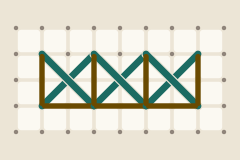
A cross with one straight stitch along its foot and another up its side, so that a row of them looks like crosses set in small boxes. Worked the traditional way it is the same on both faces of the cloth, and it is also called two-sided Italian cross stitch. It is worked in more than one order, so follow your chart. For plain crosses that match on both faces, see Double-sided cross stitch.
Four-sided stitch
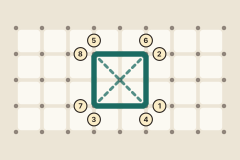
Four straight stitches round a square, with the thread crossing from corner to corner behind the cloth. One order of working is drawn here: the right side (1 to 2), the bottom (3 to 4), the top (5 to 6) and the left side (7 to 8), which is also the first side of the next square. Pulled firmly on evenweave or linen, it draws the threads of the cloth together and leaves a row of small holes, so it is used for openwork borders.
Straight stitches
Straight stitch
A single stitch from one point to another, in any direction: up at one end and down at the other. Charts use it for fine single lines, such as blades of grass. See Straight stitch.
Long stitch
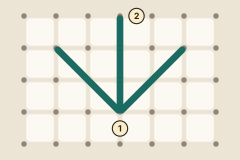
A straight stitch that runs over several squares in one go (1 to 2). A long stitch does not sit as neatly or keep its place as well as a short one, which is why backstitch is usually worked a square at a time instead.
Satin stitch
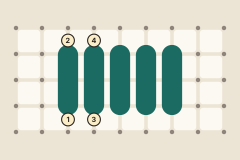
Straight stitches laid side by side until they fill a shape. On counted cloth every stitch runs over the same number of blocks or threads (1 to 2, 3 to 4), and the weave keeps them even. A block of such stitches is the kloster block of Hardanger work. See Satin stitch.
Line stitches
Stem stitch
A line stitch in which each stitch begins halfway back along the one before, so that the line looks like a fine rope. It is used for stems and outlines. See Stem stitch.
Chain stitch
A line of loops, each one held down by the next, like the links of a chain. See Chain stitch.
Lazy daisy stitch
One loop of chain stitch on its own, held at its tip by a tiny stitch. It is also called detached chain. See Lazy daisy stitch.
Canvas stitches
Tent stitch
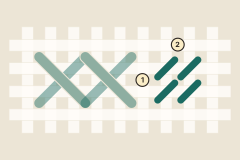
One slanting stitch over a single crossing of threads: the first leg of a cross, and the basic stitch of needlepoint. Worked beside cross stitch on evenweave or linen, it carries the finest detail: where the crosses are worked over two threads, four tent stitches over one thread fit in the space of one cross (1 to 2). Worked this fine it is called petit point. Needlepoint works it as Continental stitch or Basketweave stitch.
Tramming
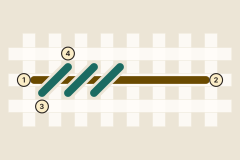
Not a stitch but a way of padding one. A long thread is laid along the row first (1 to 2), and the stitches are then worked over it (3 to 4), which raises them. Some needlepoint canvases are sold with the design already laid on them in threads of the right colors, to be stitched over.
Turkey work
Loops of thread, each locked in place by a small stitch, then cut and trimmed into a pile like the surface of a rug. Charts use it for fur and hair. See Turkey work.
Which stitches will your chart use?
Look at the key. It lists every stitch the chart uses, with its symbol, its thread and the number of strands. How to read a cross stitch pattern goes through a key. If you would rather stitch full crosses and nothing else, every one of the Samplers on this site is worked that way.