Filigree hummingbird hand embroidery pattern
Intermediate · 8 colors · 6 kinds of stitch
Download free PDFPDF, US Letter · 57 KBFor your own stitching, gifts and handmade pieces you sell. Do not resell or share this PDF. What you may do, in full
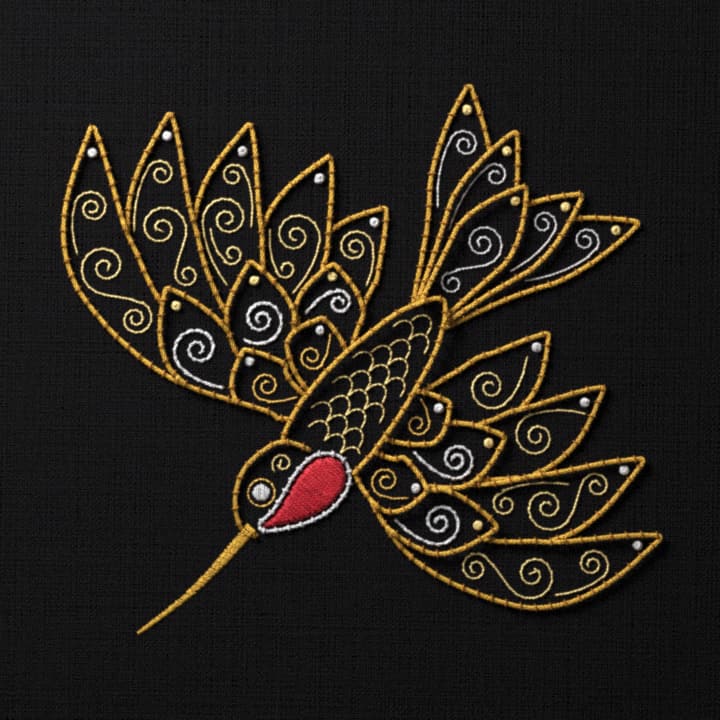
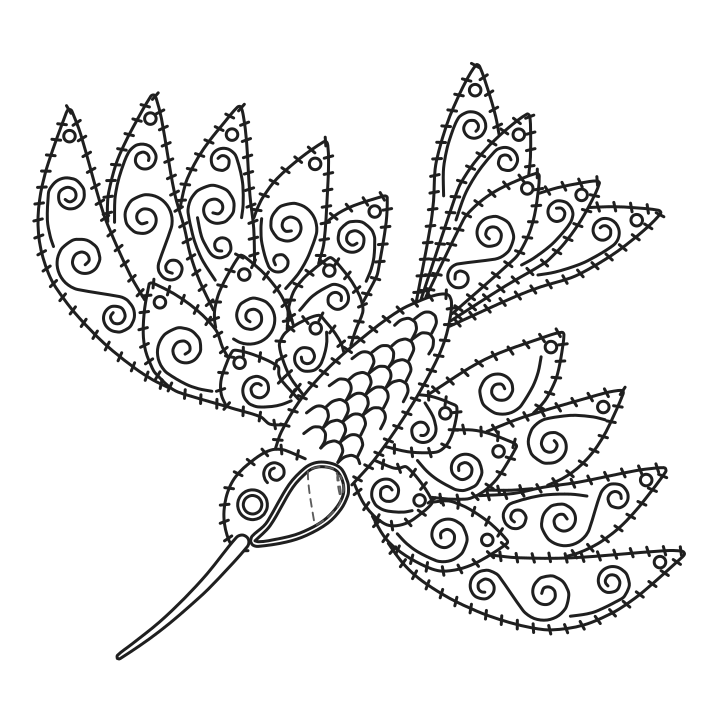
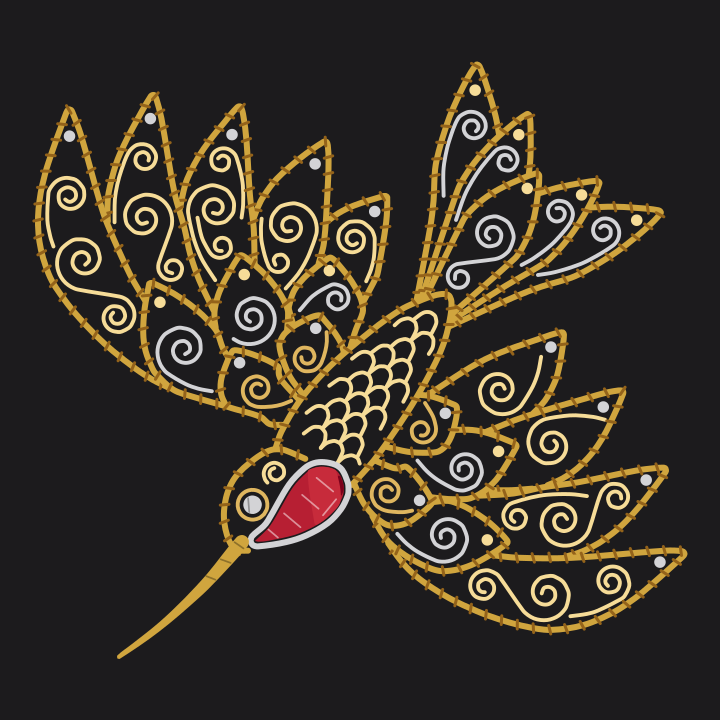
A hummingbird dives across black cloth with one wing thrown wide and the other shorter, like a brooch made of wire. Every feather is outlined in couching in old gold, and fine scrolls in split stitch curl inside it without crossing. French knots sit like metal beads in the feather tips, and back stitch makes the scales on the back. The throat is one drop of padded satin stitch in ruby red with a couched silver rim, and the bill and eye are satin stitch. In the picture of where the colors go, the fine lines show which way the stitches lie.
Size and details
Intermediate. Uses couching and eight colors.
8 colors of floss and 6 kinds of stitch:
| Hoop | Inches | Centimeters | Satin stitch up to |
|---|---|---|---|
| 3 in (8 cm) | 1.7 × 1.5 in | 4.3 × 3.8 cm | 1/8 in (3 mm) |
| 4 in (10 cm) | 2.5 × 2.3 in | 6.4 × 5.8 cm | 3/16 in (5 mm) |
| 5 in (13 cm) | 3.4 × 3.1 in | 8.6 × 7.9 cm | 1/4 in (6 mm) |
| 6 in (15 cm) | 4.2 × 3.9 in | 10.7 × 9.9 cm | 5/16 in (8 mm) |
| 8 in (20 cm) | 5.9 × 5.4 in | 15 × 13.7 cm | 7/16 in (11 mm) |
- In a 3, 4 or 5 inch hoop the French knots are drawn smaller than about 2 mm (a little over 1/16 in). Use one strand of floss for them there, or choose a larger hoop.
The pattern is drawn inside a circle about half an inch (1.3 cm) smaller all around than the hoop.
What you need
- DMC 415 Pearl GrayTail scrolls, covert scrolls, ruby setting and eye, granules (darker)
- DMC 3820 Dark StrawShoulder scrolls and eye ring
- DMC 3822 Light StrawFeather scrolls, back scales and head scrolls, granules (lighter)
- DMC 729 Medium Old GoldWing outlines, tail outlines, body outline and head outline (lighter), bill
- DMC 780 Ultra Very Dark TopazWing outlines, tail outlines, body outline and head outline (darker)
- DMC 304 Medium RedRuby (middle)
- DMC 814 Dark GarnetRuby (dark)
- DMC 321 RedRuby (light)
Skeins: one of each color is enough. An estimate for the largest size, the 8 inch hoop: the length of each line and the area of each filled shape, a fifth added for tails and ends, a tenth of every 8 m (8.7 yd) skein kept spare.
The floss is six-strand cotton; the stitch guide says how many strands to use. You also need a hoop, an embroidery needle (a size 7 to 9 suits two or three strands) and plain cotton or linen fabric. To frame the piece in its hoop, cut a square 3 inches (8 cm) wider than the hoop: a 9 inch (23 cm) square for a 6 inch hoop.
When it is stitched, how to finish a hoop shows how to back it for the wall.
Stitch guide
- Put the pattern on the fabric (how to transfer a pattern) and the fabric in the hoop.
- Stitch the filled parts first, what lies behind before what lies in front of it.
- Then stitch the lines: stems, veins and outlines over the edges of the filled parts.
- Keep the knots for the end, so that the hoop and your hand do not flatten them.
Start each thread with a small knot on the back or one of the knotless starts, and end it by running the needle under the backs of a few stitches (starting and ending a thread). Use the strands this list gives, also where a page about a stitch names another number.
- French knot 2 strands, two wrapsGranules
- Split stitch 1 to 2 strandsShoulder scrolls, covert scrolls, feather scrolls, tail scrolls, head scrolls
- Back stitch 1 strandBack scales, eye ring
- Couching 3 to 6 strandsTail outlines, wing outlines, body outline, head outline, ruby setting
- Padded satin stitch 2 strandsRuby
- Satin stitch 2 strandsEye, bill
Getting it onto your fabric
The PDF holds the pattern twice at actual size: once as drawn, and once mirrored for an iron-on transfer pen. Print it at 100% with scaling off and check the one-inch square (25.4 mm) with a ruler before you trace. How to transfer a pattern explains tracing, carbon paper and the other ways. The files are under Downloads.
Downloads
- Download free PDF PDF, US Letter, 3 pages, for a 6 inch (15 cm) hoop
- Download free PDF, A4 PDF, A4, 3 pages, for a 6 inch (15 cm) hoop
More patterns like this
Easy 3–8 in hoop · 7 colors
Simple hummingbird
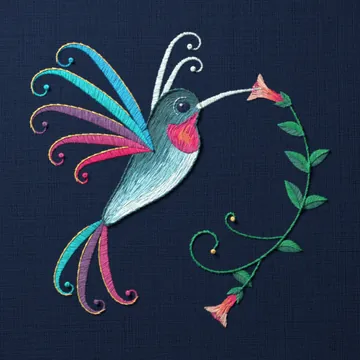
Intermediate 3–8 in hoop · 15 colors
Swirly hummingbird
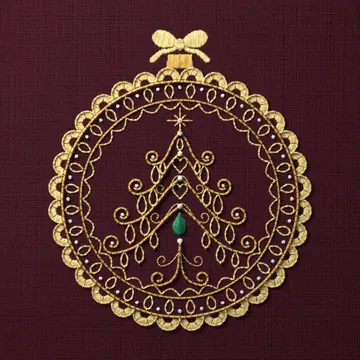
Intermediate 3–8 in hoop · 6 colors
Filigree Christmas tree ornament
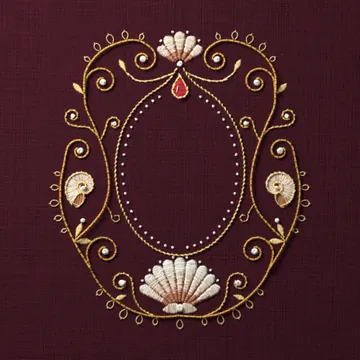
Advanced 3–8 in hoop · 8 colors
Filigree seashell monogram frame
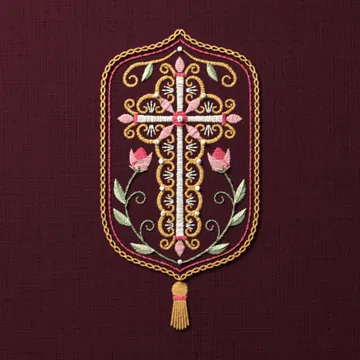
Easy 3–8 in hoop · 7 colors
Easy filigree cross bookmark
Advanced 3–8 in hoop · 17 colors
Primitive hummingbirds and coneflower
Advanced 3–8 in hoop · 5 colors
Filigree lace angel ornament
Intermediate 3–8 in hoop · 9 colors
Western shirt yoke with roses
New to hand embroidery? Starting hand embroidery, step by step