Owl in the forest hand embroidery pattern
Advanced · 21 colors · 5 kinds of stitch
Download free PDFPDF, US Letter · 167 KBFor your own stitching, gifts and handmade pieces you sell. Do not resell or share this PDF. What you may do, in full
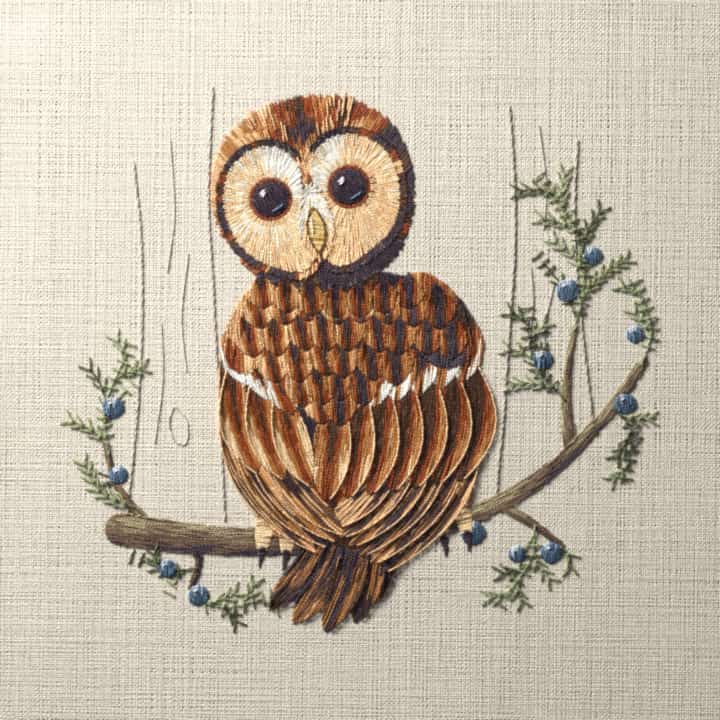
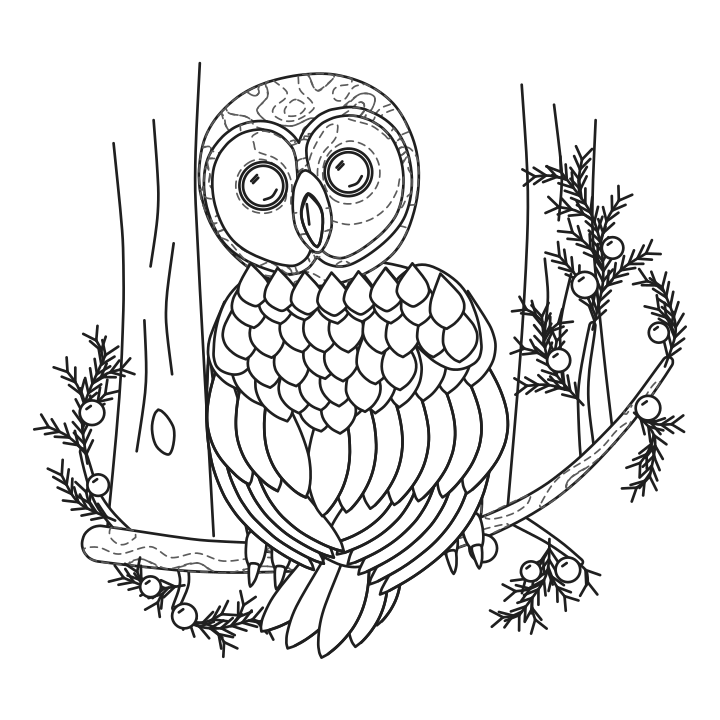
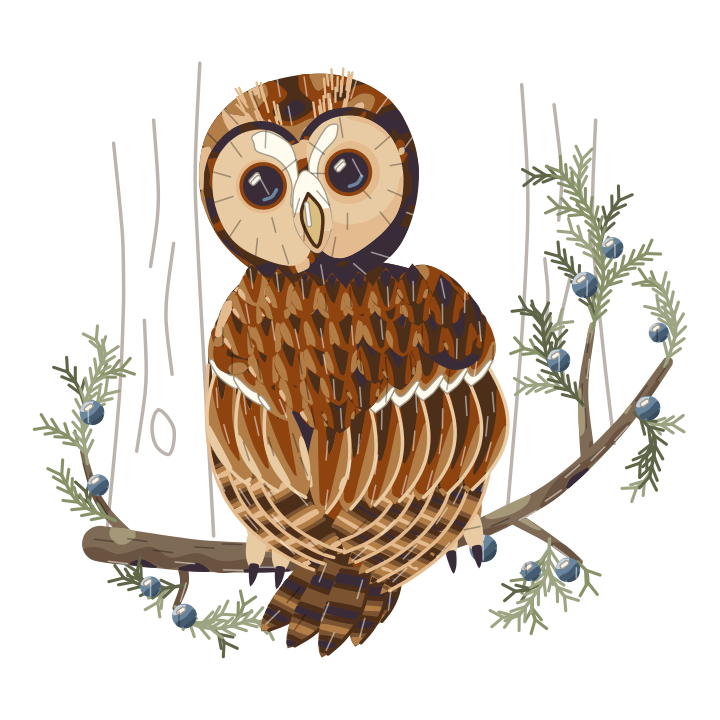
A tawny owl sits with its back to us on a slanting juniper branch and turns its face right round, its dark eyes lit. Small mantle feathers, cream tipped coverts and long barred flight feathers fall in three layers, all in long and short stitch with fine split stitch feather edges. The eyes, toes, claws and bill are satin stitch. Juniper needles are fern stitch, the dusty blue berries are long and short stitch, and one berry is tucked under a foot. Two grey trunks stand behind in split stitch. In the picture of where the colors go, the fine lines show which way the stitches lie.
Size and details
Advanced. Uses long and short stitch over much of the design, 21 colors and a great deal of stitching.
21 colors of floss and 5 kinds of stitch:
| Hoop | Inches | Centimeters | Satin stitch up to |
|---|---|---|---|
| 3 in (8 cm) | 1.9 × 1.7 in | 4.8 × 4.3 cm | 1/8 in (3 mm) |
| 4 in (10 cm) | 2.8 × 2.6 in | 7.1 × 6.6 cm | 3/16 in (5 mm) |
| 5 in (13 cm) | 3.8 × 3.4 in | 9.7 × 8.6 cm | 1/4 in (6 mm) |
| 6 in (15 cm) | 4.7 × 4.3 in | 11.9 × 10.9 cm | 5/16 in (8 mm) |
| 8 in (20 cm) | 6.6 × 6 in | 16.8 × 15.2 cm | 7/16 in (11 mm) |
The pattern is drawn inside a circle about half an inch (1.3 cm) smaller all around than the hoop.
What you need
- DMC 648 Light Beaver GrayTree trunks
- DMC 3790 Ultra Dark Beige GrayBranch and twigs (light)
- DMC 3781 Dark Mocha BrownBranch and twigs (dark)
- DMC 642 Dark Beige GrayBranch and twigs (lightest)
- DMC 3371 Black BrownFace rim, back, mantle, head, tail and flight feathers (darkest) and 5 more parts
- DMC 3051 Dark Green GrayJuniper needles (dark)
- DMC 3052 Medium Green GrayJuniper needles (middle)
- DMC 3053 Green GrayJuniper needles (light)
- DMC 738 Very Light TanFace, feather edges and legs (light), toes, wing coverts (lightest) and 1 more part
- DMC 435 Very Light BrownFlight feathers, wing coverts, mantle and spotted coverts (light) and 4 more parts
- DMC 437 Light TanFeather edges (middle), head (lightest), face (dark) and 5 more parts
- DMC 712 CreamSpotted coverts, face and legs (lightest), bill bristles (light)
- DMC 931 Medium Antique BlueJuniper berries (light), eye shine
- DMC 3750 Very Dark Antique BlueJuniper berries (darkest)
- DMC 930 Dark Antique BlueJuniper berries (dark)
- DMC 3752 Very Light Antique BlueJuniper berries (lightest)
- DMC 433 Medium BrownTail (light), flight feathers (middle), face (darkest)
- DMC 898 Very Dark Coffee BrownBack, head, mantle and flight feathers (dark), wing coverts (darkest) and 5 more parts
- DMC 400 Dark MahoganyMantle and spotted coverts (middle), wing coverts (dark), back (light) and 3 more parts
- DMC 3865 Winter WhiteBerry lights, eye lights and bill light
- DMC 834 Very Light Golden OliveBill
Skeins: 2 for face rim, back, mantle, head, tail and flight feathers (darkest) and 5 more parts, 3 for back, head, mantle and flight feathers (dark), wing coverts (darkest) and 5 more parts and 2 for mantle and spotted coverts (middle), wing coverts (dark), back (light) and 3 more parts; one of each other color. An estimate for the largest size, the 8 inch hoop: the length of each line and the area of each filled shape, a fifth added for tails and ends, a tenth of every 8 m (8.7 yd) skein kept spare.
The floss is six-strand cotton; the stitch guide says how many strands to use. You also need a hoop, an embroidery needle (a size 7 to 9 suits two or three strands) and plain cotton or linen fabric. To frame the piece in its hoop, cut a square 3 inches (8 cm) wider than the hoop: a 9 inch (23 cm) square for a 6 inch hoop.
When it is stitched, how to finish a hoop shows how to back it for the wall.
Stitch guide
- Put the pattern on the fabric (how to transfer a pattern) and the fabric in the hoop.
- Stitch the filled parts first, what lies behind before what lies in front of it.
- Then stitch the lines: stems, veins and outlines over the edges of the filled parts.
Start each thread with a small knot on the back or one of the knotless starts, and end it by running the needle under the backs of a few stitches (starting and ending a thread). Use the strands this list gives, also where a page about a stitch names another number.
- Split stitch 1 to 2 strandsTree trunks, feather edges, eye shine, bill edge
- Long and short stitch 1 strandTwigs, branch, legs, juniper berries, tail, back, flight feathers, wing coverts, spotted coverts, mantle, head, face rim, face, bill bristles
- Fern stitch 2 strandsJuniper needles
- Satin stitch 2 strandsToes, claws, eye rims, eyes, bill
- Straight stitch 1 to 2 strandsEye lights, bill light, berry lights
Getting it onto your fabric
The PDF holds the pattern twice at actual size: once as drawn, and once mirrored for an iron-on transfer pen. Print it at 100% with scaling off and check the one-inch square (25.4 mm) with a ruler before you trace. How to transfer a pattern explains tracing, carbon paper and the other ways. The files are under Downloads.
Downloads
- Download free PDF PDF, US Letter, 3 pages, for a 6 inch (15 cm) hoop
- Download free PDF, A4 PDF, A4, 3 pages, for a 6 inch (15 cm) hoop
More patterns like this
Advanced 3–8 in hoop · 19 colors
Cute sleeping owl with a heart
Advanced 3–8 in hoop · 15 colors
Graduation owl card
Advanced 3–8 in hoop · 22 colors
Enchanted forest mushroom path
Advanced 3–8 in hoop · 23 colors
Waterfall in a mossy forest
Advanced 3–8 in hoop · 18 colors
Forest bear scratching its back
Advanced 3–8 in hoop · 18 colors
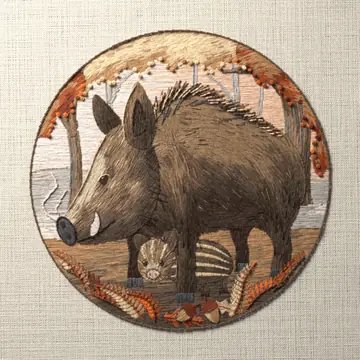
Wild hog in the oak woods
Advanced 3–8 in hoop · 17 colors
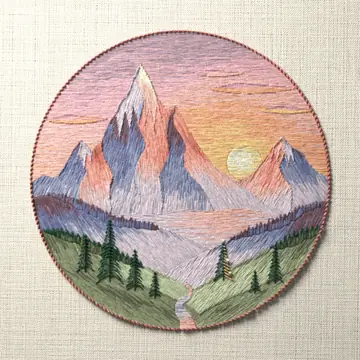
Mountains and sun in a ring
Advanced 3–8 in hoop · 17 colors
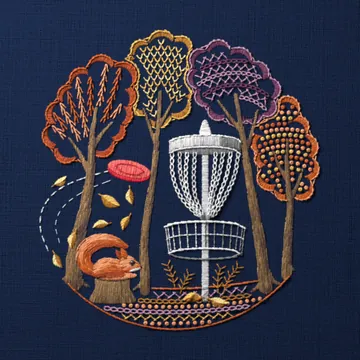
Disc golf basket in autumn woods
New to hand embroidery? Starting hand embroidery, step by step