Needlepoint guide
Needlepoint alphabet charts
Eight alphabets charted square by square, with the numbers. One filled square is one tent stitch, on any mesh. Copy a letter from the screen, print a chart, or type your words on the page of an alphabet and have them charted for you.
On this page 7 parts
Which alphabet to choose
| Alphabet | Capitals, in stitches | On 13 mesh | On 18 mesh | "Olivia", in stitches across | Small letters |
|---|---|---|---|---|---|
| Small serif | 10 | 0.8 in | 0.6 in | 43 | yes |
| Plain, bold | 11 | 0.8 in | 0.6 in | 49 | yes |
| Typewriter | 11 | 0.8 in | 0.6 in | 70 | yes |
| Rounded hand | 12 | 0.9 in | 0.7 in | 46 | yes |
| Quaker capitals | 13 | 1.0 in | 0.7 in | 67 | no |
| Book serif | 15 | 1.2 in | 0.8 in | 53 | yes |
| Script | 18 | 1.4 in | 1.0 in | 66 | yes |
| Old English | 18 | 1.4 in | 1.0 in | 58 | yes |
Measure the space in stitches first, across and down. Take the tallest alphabet that leaves two rows of ground above and below it, and then count the name in it. The same chart on a higher mesh gives a smaller word: 10 stitches are 3/4 inch on 13 mesh and just over 1/2 inch on 18.
- Little room, as on a belt, a key fob or the edge of an ornament: the small serif or the plain one. On a belt's page the letters can be typed and seen in the middle of its pattern. Smaller still are the capitals 5 stitches high.
- The cuff of a stocking: the Quaker capitals, the book serif or the script. On a stocking with a plain cuff the name can be typed and seen, in plain capitals, a script, a book serif or Old English.
- A sampler or a pillow: Old English, the book serif, or a script for a line of words.
- A child's piece: the rounded hand or the plain one, which are the letters a child learns.
- A label, a date or a line on the back: the typewriter. Its letters are of one width, so lines of figures stand one under another.
The charts
Each filled square is one tent stitch over one crossing of the canvas. The heavier lines are ten squares apart. The letters of a line stand on one level, so a letter that hangs below it, such as g or y, is drawn where it hangs.
Small serif, 10 stitches high
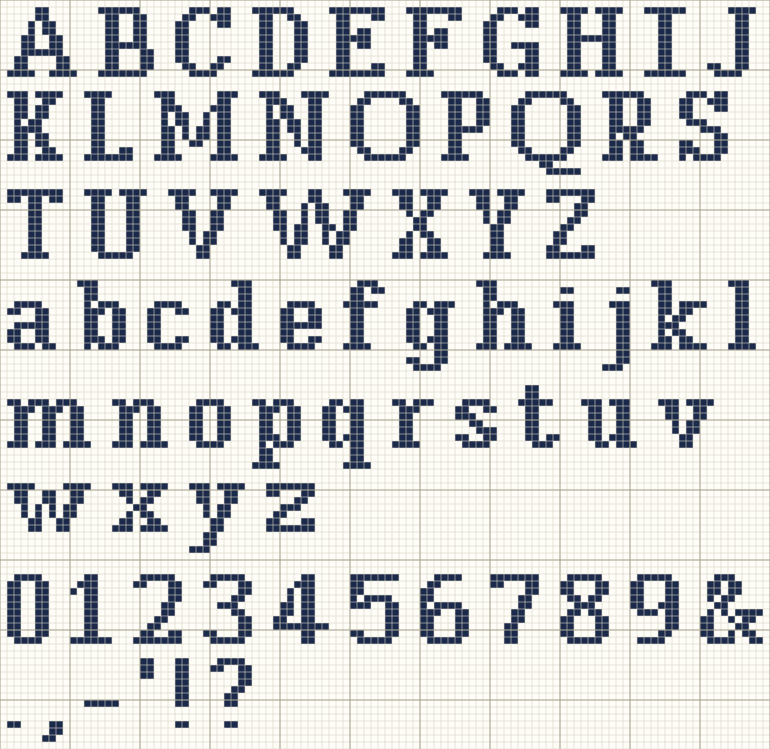
For a name or a line where space is short. Leave one empty stitch between letters. Print the small serif (PDF)
Plain, bold, 11 stitches high
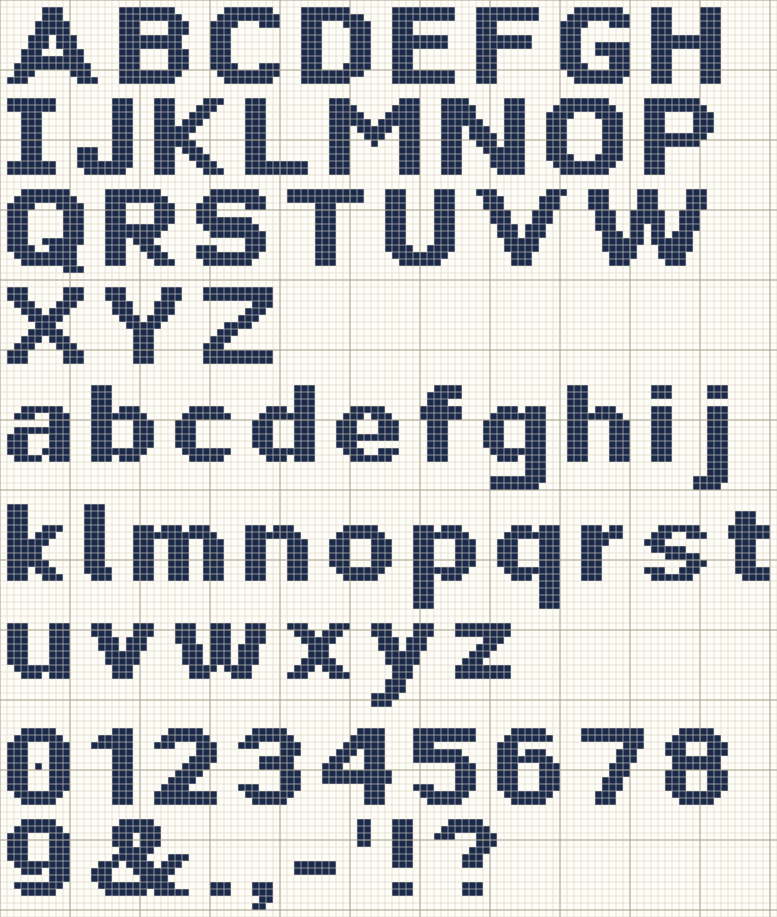
Heavy and clear, for a short name or a number on a ground with a pattern. Leave two empty stitches between letters. Print the plain alphabet (PDF)
Typewriter, 11 stitches high
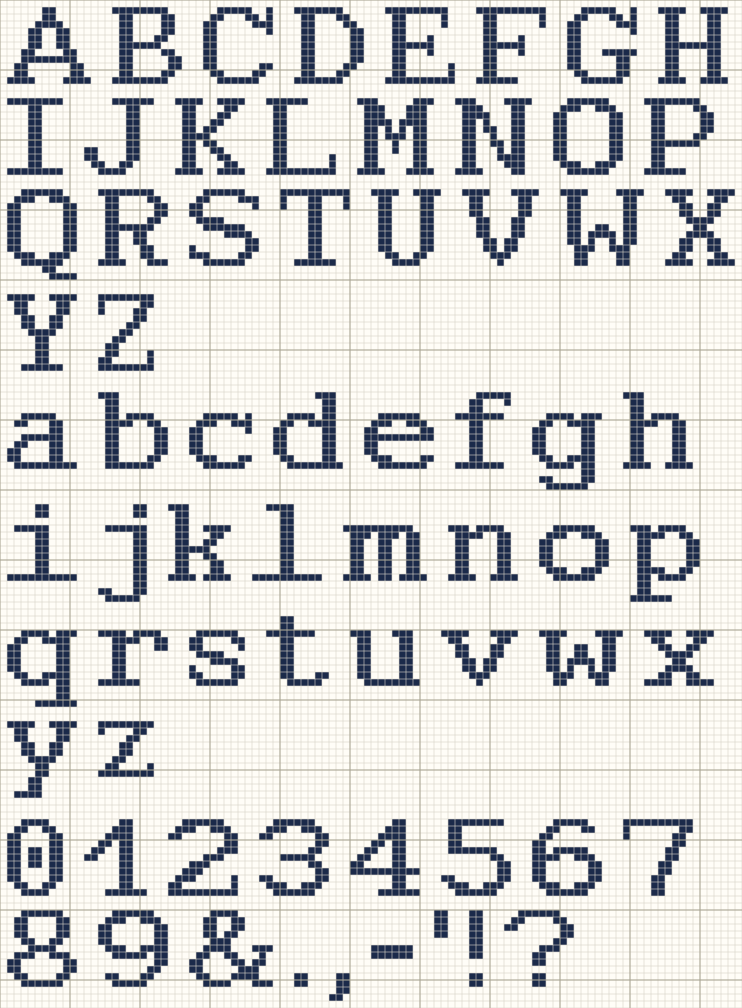
Give every letter twelve stitches, its own gap among them, and count nine for the space between two words. Print the typewriter (PDF)
Rounded hand, 12 stitches high
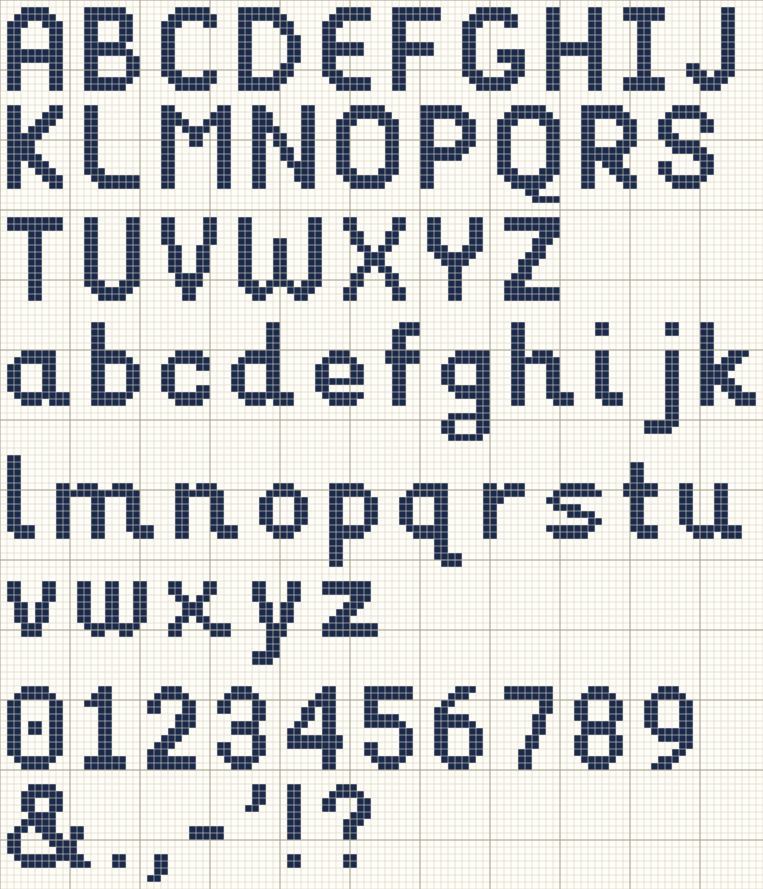
A friendly letter for a nursery or a school piece. Leave two empty stitches between letters. Print the rounded hand (PDF)
Quaker capitals, 13 stitches high
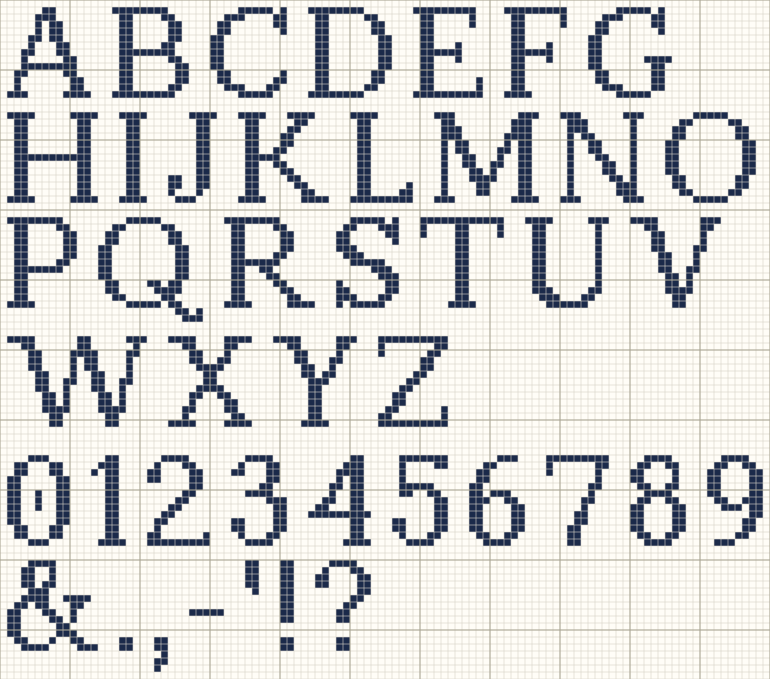
Plain Roman letters in the manner of old school samplers, spaced wide. Leave four empty stitches between letters, or two where room is short. Print the Quaker capitals (PDF)
Book serif, 15 stitches high
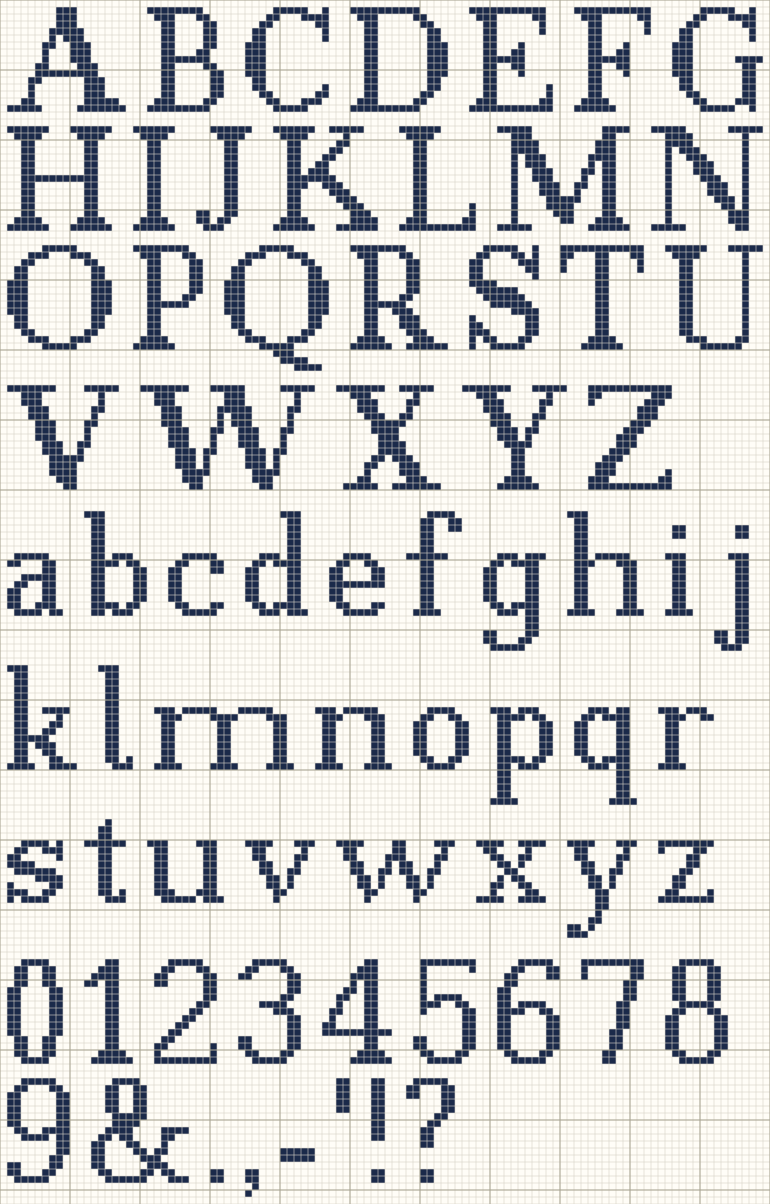
The letter of a printed page, for names and for a line on a pillow. Leave one or two empty stitches between letters. Print the book serif (PDF)
Script, 18 stitches high
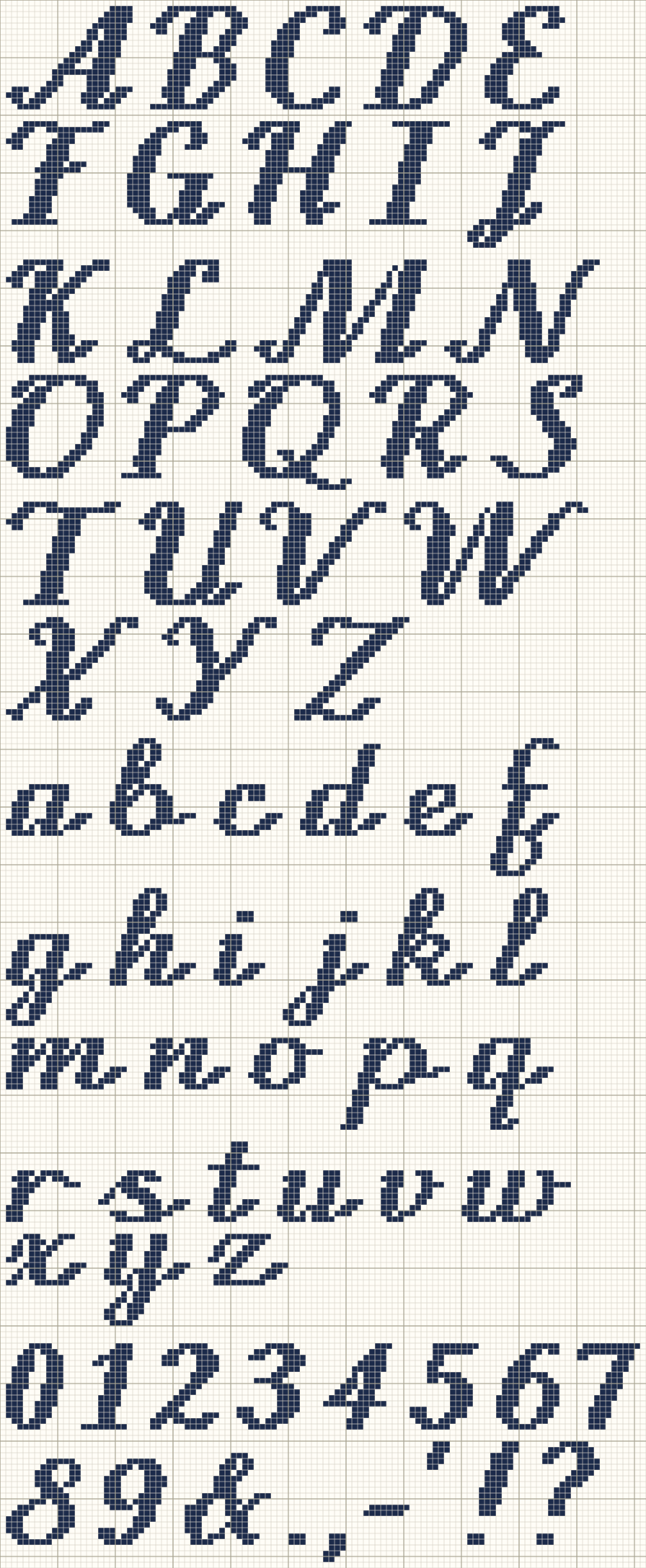
Set the small letters close, so that the last stroke of one runs into the next. The slope goes the way the stitch does, so the long strokes are smooth. Cursive in needlepoint shows how two letters join. Print the script (PDF)
Old English, 18 stitches high
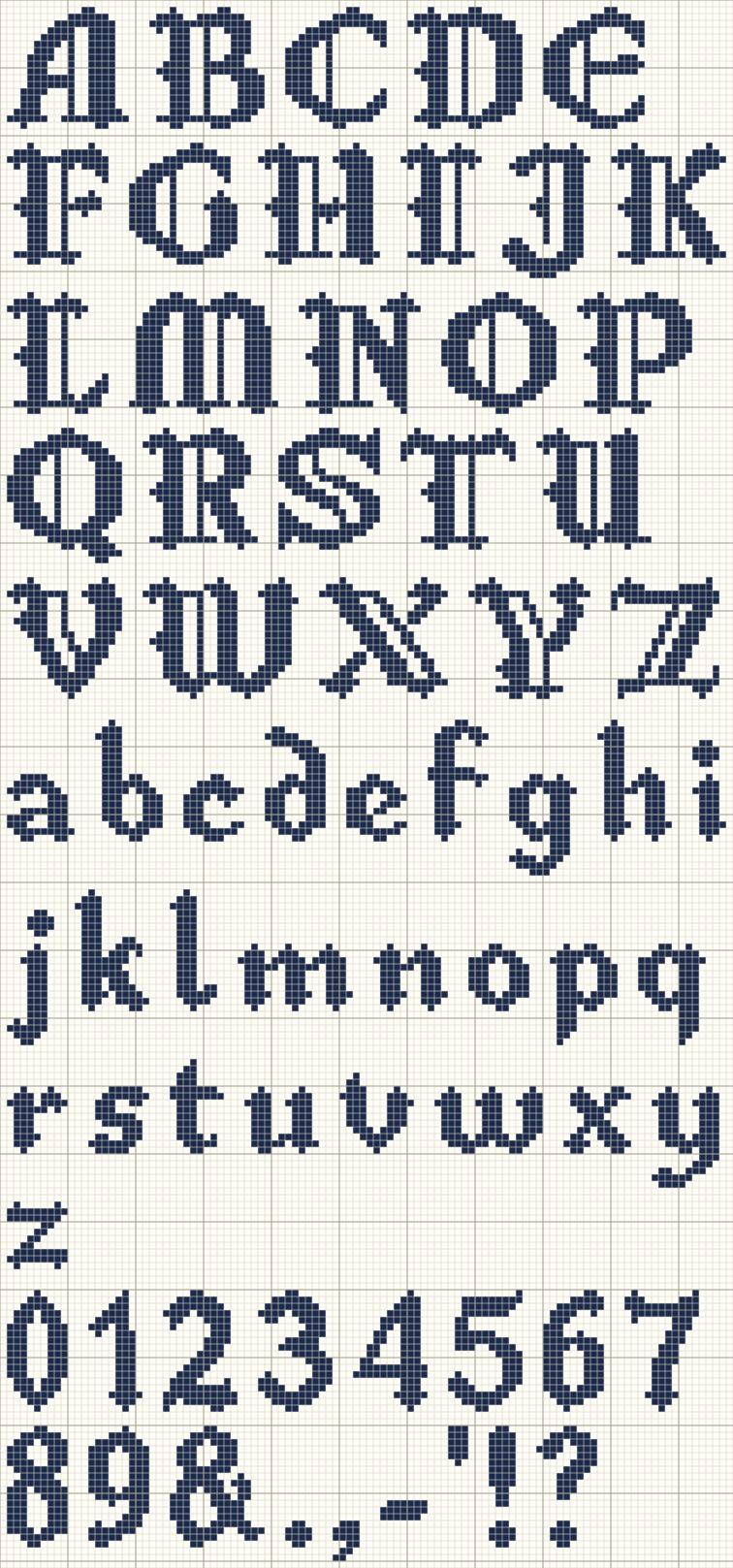
For a verse, a family name or a sampler. Use it for words and not for a row of capitals, which are hard to read side by side. To draw thick and thin letters of your own, see calligraphy. Print the Old English (PDF)
How to copy a letter from a chart
- Write the word out first, on squared paper or on a printed chart, with the gaps between the letters in it.
- Count its width and find its middle. Find the middle of the space on the canvas in stitches, and begin there.
- Count squares on the chart and crossings on the canvas. A crossing is where two threads meet; holes are not counted.
- Stitch the letters first, from the middle outward, and the ground round them after. The guide to lettering has each step, and a name worked out on a cuff.
Type the words instead
Words can also be charted for you, with nothing to copy and nothing to count.
Is there a needlepoint text generator?
Yes, there are two here, both free. Most of the needlepoint alphabets, the typewriter among them, have a box on their page that charts words by themselves, and the pattern maker sets words into a drawing. What you type stays on the page. For words across a picture, see a picture with words on it.
| An alphabet's page | The pattern maker | |
|---|---|---|
| Best for | A name, initials, a saying alone, a key fob | Words beside a picture or in a border |
| How much | Up to four lines of 24 letters, centered line by line | A line of up to 24 letters at a time, put where you like |
| Letters | Its own, and a list of others 10 to 30 stitches high, these eight among them | The same list |
| What you see | The words as they would be stitched, with their size on 10, 13 and 18 mesh | The whole piece, in squares or stitched |
| The file to print | The chart of the words and the threads | The chart, its key and the canvas to cut |
- Open an alphabet with a box, such as the typewriter, go down to "Set your own words in it" and type the words in the box. For a new line press Enter.
- Choose the letters, the thread and the mesh under the picture.
- Press Download free PDF of your words, which stands under that picture once you have typed. The button at the top of the page gives the whole alphabet and not your words.
- Print the file.
Letters decorated with flowers
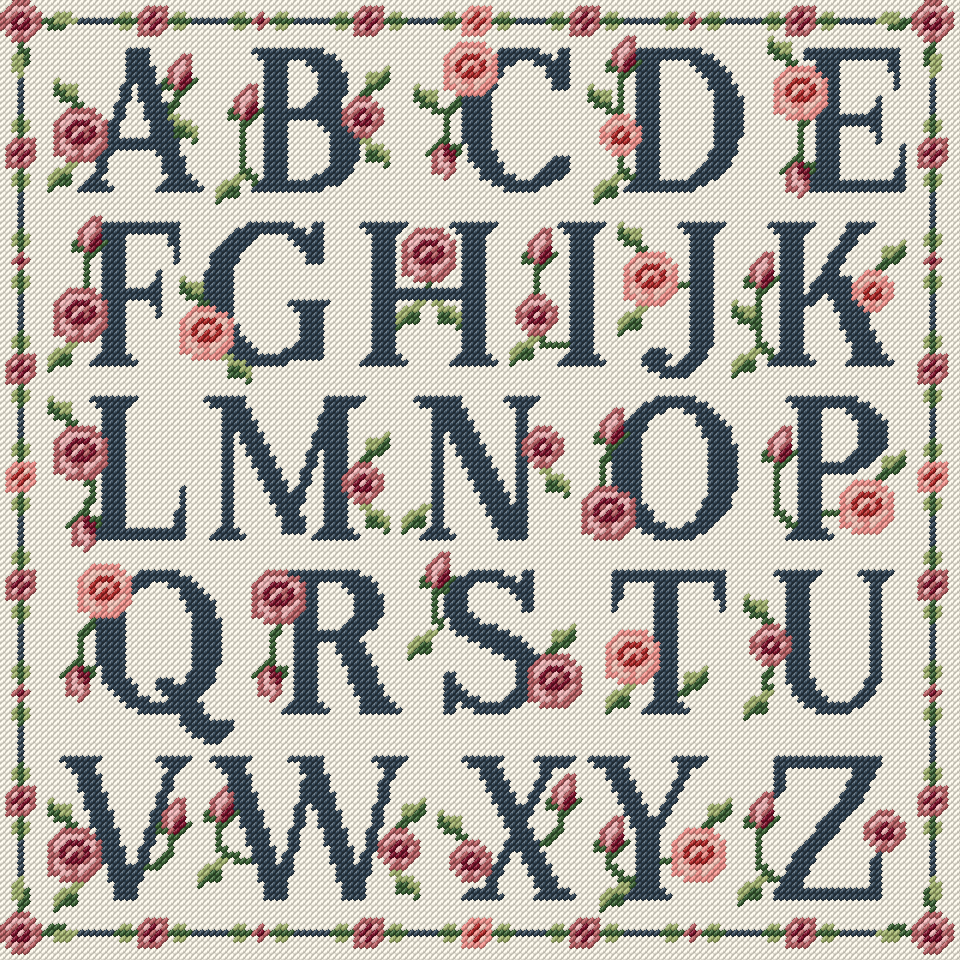
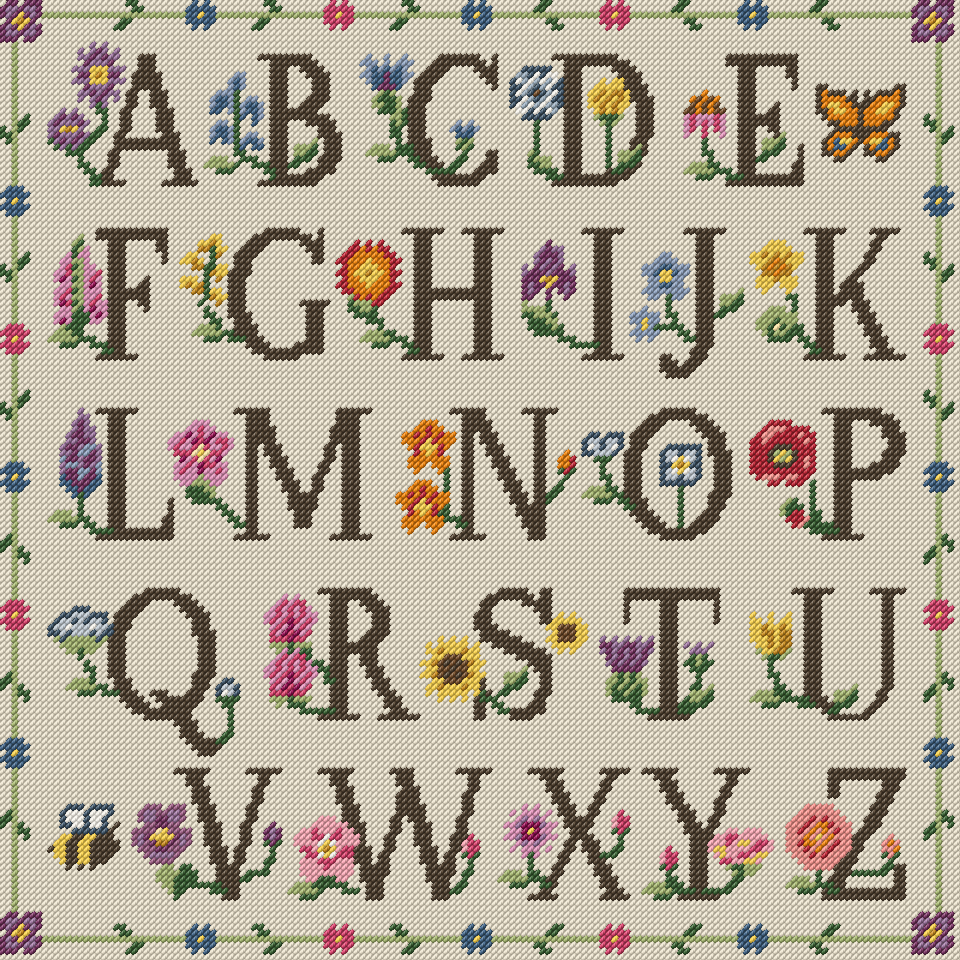
The quickest floral letter is one that is charted already: needlepoint monograms has a script initial with four roses, any letter of the twenty-six, and the alphabets have letters with roses, wildflowers and vines. On the pages of the rose letters and the wildflower letters you can type your own. To put flowers to a letter of your own, take one of three ways.
| Way | What you do | Room it wants, in stitches |
|---|---|---|
| Flowers round the letter | Set a flower with its stem (A) at each side, or in two opposite corners, two stitches clear of the letter | A letter 18 wide with two such flowers, 7 by 11 each: 36 across |
| A letter over flowers | Chart the flowers all over the panel. Lay the letter on the chart, and take out every stitch it covers and one row round it | A letter 30 high on 48 by 48, with a flower every eighth stitch |
| Flowers inside the strokes | Put one flower without its stem above another in each broad upright stroke (B) | An upright stroke 8 or 9 wide, in a letter about 30 high |
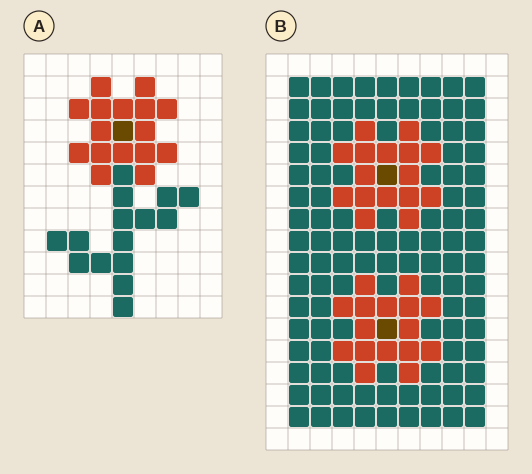
- Where to find a stroke that broad. Make the plain, bold letters three times as large, three by three stitches for every square: they are then 33 high, with uprights 9 wide, as in B. Or type the word on the typewriter alphabet's page and choose Great deco, 30 stitches high, under Letters. The broad uprights of most of its capitals are 8 wide: draw the flowers on the printed chart, two stitches from one side of the stroke and one from the other.
- Colors. Make the letter the darkest thing on the panel or the lightest. Choose flowers in colors between the two in depth: lighter than a dark letter and darker than its pale ground. Two or three colors are enough for them.
- Order of work. The letter, then petals and centers, then leaves and stems, then the ground.
- For raised flowers leave the letter plain, and add French knots on top at the end. Stitches for flowers has others.
Why these letters hold in tent stitch
A tent stitch leans one way, up to the right. A stroke one stitch wide that leans the other way touches the next stitch only at its corners, and comes out as a row of dots. Wherever a stroke in these charts climbs to the left it is two stitches wide or more, or a step of two stitches (of three in the & of the small serif). An alphabet drawn for cross stitch can be used too, since a square is a square, but look along its left-leaning strokes first and thicken the thin ones.
Questions
What is the smallest alphabet for needlepoint? Capitals five stitches high are the smallest that can be read: 3/8 inch on 13 mesh and just over 1/4 inch on 18. Small letters need about ten.
How many stitches is one inch? As many as the mesh: 13 on 13 mesh and 18 on 18. A capital 13 stitches high is one inch on 13 mesh.
How far apart do lines of letters stand? Two empty rows at the least between the foot of one line and the top of the next, and more where small letters hang below the line.
Are there alphabets to stitch whole? Yes: the needlepoint alphabets are pieces of their own, with flowers, animals, a quilt, a typewriter or a ship, and their letters can be taken one by one. For a single letter in a frame, see needlepoint monograms.