Decorating with needlepoint
Needlepoint looks best with room round it, in one place in a room, and out of the sun. Treat several small pieces as one large one, keep them near the furniture below, and change what is out with the season.
On this page
- What to do first
- Room by room
- One wall: three arrangements, worked out
- Pillows: how many, and which sizes together
- Old needlepoint in a modern room, and the other way about
- With other patterns
- Dorm rooms and rented rooms: nothing nailed
- A mantel, and the turn of the year
- Ornaments that stay out all year
- Outdoors
- Light and damp, in a few lines
- What makes it look tired
- Questions people ask
What to do first
- Find the wall or the seat that is out of the sun at every hour, away from steam, a stove and a fire that is lit. That narrows the house quickly.
- Choose one thing for the eye: a chair, a wall or a table. Needlepoint is full of detail, and three places in one room compete.
- Put it there with nothing else patterned beside it. Look from the door. Then add.
- Use the sums below for a wall, and the table of sizes for pillows.
How to hang a piece, and how high, is in how to hang and display needlepoint. How to frame it is in how to frame needlepoint. This page says where things go.
Room by room
| Place | What works | How it is held | Keep in mind |
|---|---|---|---|
| Sofa | One to four pillows; a row of frames over the back | Pillows loose; frames on the wall | Frames 6 to 8 inches (15 to 20 cm) above the back, so that nobody's head meets them |
| Armchair | One pillow, 12 to 16 inches (30 to 41 cm), or a wide one | Loose | A seat or a cover of its own: how to upholster |
| Bedroom | One wide pillow at the front of the bed; a pair of small frames over a chest | Pillow loose; frames on the wall | The pillow comes off the bed at night |
| Hall | A bell pull, a long narrow strip with a bar at each end, or another narrow hanging; a tray for keys; a bench pad | Rod; table | Often the darkest wall in the house, and so the best for old work |
| Dining room | Chair seats; a runner down the middle for guests, off for the meal | Fitted; laid | Wool seats bear crumbs, not wine |
| Study or bookshelf | Stand-ups, stuffed figures with a flat base; a small flat piece on an easel; a box lid; bookmarks in a jar; a brick in a needlepoint cover as a bookend | Shelf | Turn them from the window |
| Kitchen | A coaster set, a key fob on a hook, a small framed piece far from the stove | Hook, wall | Grease stays in wool. Glass, or not at all |
| Bathroom | Nothing in a room with a shower. In one without, a small frame under glass | Wall | Steam brings mold |
| Nursery or child's room | A name or an animal in a frame, high up; a pillow for a chair | Two hooks in the wall | Nothing with beads, buttons or cords within a child's reach, and nothing in a crib |
| Table | Coasters, a tray, a game board | Laid | Under glass where drinks stand |
| Floor | A small rug by a bed or a desk, not by a door | Over a pad | Kinds of rugs |
| Front door, porch | See "Outdoors" |
One wall: three arrangements, worked out
Two mistakes are seen on most walls: pictures hung too high, and pictures too small for the space. Small needlepoint can fill a large space if you add a wide mat, the card border round it, and hang several as one.
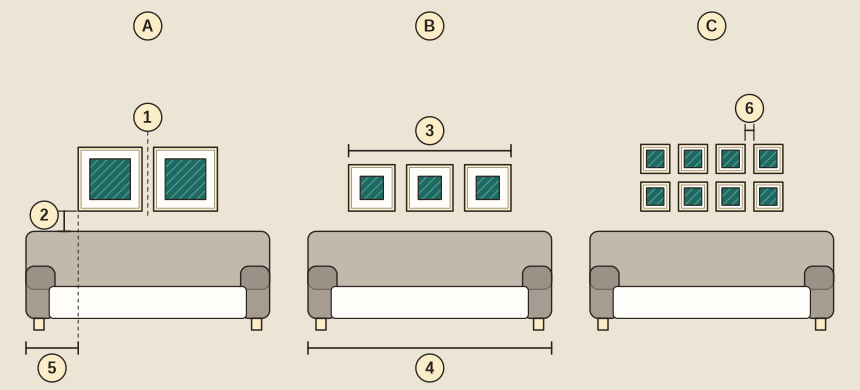
| A. Pair | B. Row of three | C. Grid of eight | |
|---|---|---|---|
| Needlepoint | 14 in (36 cm) square | 8 in (20 cm) square | 6 in (15 cm) square |
| Mat, each side | 3 in (8 cm) | 3 in (8 cm) | 1 in (2.5 cm) |
| Frame, each side | 1 in (2.5 cm) | 1 in (2.5 cm) | 1 in (2.5 cm) |
| One frame, outside | 22 in (56 cm) | 16 in (41 cm) | 10 in (25 cm) |
| Gap | 4 in (10 cm) | 4 in (10 cm) | 3 in (8 cm) |
| Width of the group | 22 + 4 + 22 = 48 in (122 cm) | 3 × 16 + 2 × 4 = 56 in (142 cm) | 4 × 10 + 3 × 3 = 49 in (124 cm) |
| Height of the group | 22 in (56 cm) | 16 in (41 cm) | 2 × 10 + 3 = 23 in (58 cm) |
| Width of the group as a share of the sofa | 57 percent | 67 percent | 58 percent |
| From each end of the sofa | 18 in (46 cm) | 14 in (36 cm) | 17 1/2 in (44 cm) |
- Measure the furniture (4). A group from about half to three quarters of its width looks as if it belongs to it.
- Add up the group (3): frames, plus one gap fewer than there are frames in the row.
- Take the group from the furniture and halve it. That is the distance from each end (5): 84 less 56 is 28, and half of it is 14.
- Set the bottom edge 6 to 8 inches (15 to 20 cm) above the furniture (2). Where nothing stands below, the middle of the group goes at 57 inches (145 cm), as in how high to hang it.
- Keep every gap (6) the same, and smaller than a frame is wide.
- Tape up paper in the same sizes before the first nail. If you waver between two sizes, take the larger.
One large or several small? One large piece suits a plain room, a wide view and a bold design. Several small ones suit a hall or a stair, where people come close. Mixed shapes hang together best when one thing is the same in all: the frame, the mat, or a color.
Pillows: how many, and which sizes together
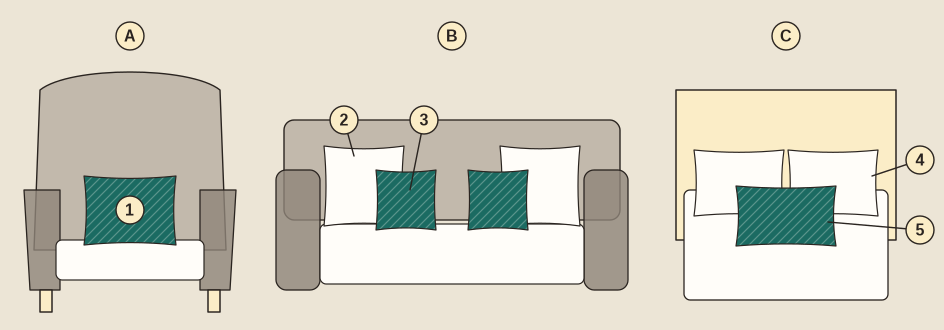
| Where | How many | Sizes that go together |
|---|---|---|
| Armchair | One | 16 by 12 in (41 by 30 cm), or 14 in (36 cm) square |
| Bench, 4 feet (122 cm) | Two, or one long | Two of 14 in (36 cm), or one of 20 by 12 in (51 by 30 cm) |
| Loveseat, 5 feet (152 cm) | Two | One of 16 in (41 cm) and one of 16 by 12 in (41 by 30 cm) |
| Sofa, 7 feet (213 cm) | Two cloth, two needlepoint | Cloth 20 in (51 cm) behind, needlepoint 14 to 16 in (36 to 41 cm) in front |
| Twin bed | One | 14 to 16 in (36 to 41 cm) square |
| Wide bed | One | 20 by 12 in (51 by 30 cm). A smaller one is lost among the others |
| Window seat | Odd numbers | 10, 12 and 14 in (25, 30 and 36 cm), one color in all |
- Let cloth rest the eye. For each needlepoint pillow one of plain linen or velvet in a color from it.
- Backs count. A pillow seen from the side or from behind shows its back: give it a strong color.
- Hard on faces. Wool scratches. Keep it in front and take it off to lie down.
- Counts, canvas and inserts, the cushions that go inside, are for every size in how to make a pillow, and patterns under pillows.
Old needlepoint in a modern room, and the other way about
A room needs one old thing among new ones or one new thing among old ones more than it needs a match.
| The piece | The room | What to do |
|---|---|---|
| Roses on black, from a chair or a pillow | White walls, plain sofa | One pillow, backed in a clear color from the roses. Nothing else with flowers |
| A fine old picture in a heavy frame | A modern hall | Keep the frame. Hang it alone, low light, space all round |
| Four or six small kit pictures | Anywhere | One plain frame for all, wide pale mats, a grid |
| A bell pull, or any long strip | A narrow wall by a door | Hang it long and alone |
| A bold geometric or bargello piece | A room of antiques | A pillow on a wing chair, a footstool |
| A worn piece | Anywhere | Under glass in a tray, or a part of it: what to do with old needlepoint |
Anything old, fine or signed is kept whole, out of strong light, and is shown for some months only. Old needlepoint comes first.
Furniture can carry old work too: old tables with needlepoint tops says how it is kept, and new work goes on a dresser and its drawer fronts.
Frames and mats. Take the mat from the lightest color of the canvas, not white. A thin frame makes a piece look newer and a wide molding older. Glass needs a gap: glass or no glass.
With other patterns
- Count the sizes of pattern. One large, one middle, one small. The detail of needlepoint makes it the small one, unless it is bargello.
- Repeat one color in all three.
- Set stripes or a check beside flowers, not a second bouquet.
- Put needlepoint against something plain and rough, such as linen, or plain and smooth, such as leather. Against a patterned rug or a print it disappears.
Dorm rooms and rented rooms: nothing nailed
| Idea | How it is held |
|---|---|
| A pillow with a school color, a mascot of your own drawing, a motto | Loose |
| A small banner on a dowel | A removable hook, for the weight it names. Weigh the piece first |
| A frame on the desk, or leaning on a shelf | Its own stand. A lump of removable putty at each lower corner keeps it from sliding |
| A door sign on plastic canvas | Ribbon over the handle |
| A key fob, a luggage tag, a laundry tag | On the thing itself |
| A row of small pieces on a ribbon with clips | Tied to the bed frame |
| A tray for jewelry or keys | On the desk |
Keep it off the wall above a heater and off the sunny sill. A name on the back of each piece helps it home. Patterns: school, small patterns.
A mantel, and the turn of the year
A mantel is a shelf over a heat source. While a fire burns below, needlepoint is better elsewhere: heat dries wool and soot settles in it. With no fire it is the best stage in the house.
- One large piece or three small ones. Not a row of ten.
- Start from the middle with the tallest, or from one end with the tallest and go down.
- Vary the depth. A frame leaning at the back, a stand-up in front of it, something plain beside them.
- Secure what leans, with putty or a small nail in front of its foot.
- Hang stockings from hooks made for the weight, and only while the fireplace is cold.
- Change it all at once when the season ends.
| Season | On the mantel or a shelf | Patterns |
|---|---|---|
| Spring, Easter | Egg stand-ups in a wire basket, a rabbit at each end, a runner of plain linen beneath: how Easter pieces are finished | Easter, egg ornaments, spring |
| Summer | One blue and white piece, shells in a bowl | Summer, nautical |
| Fall | Pumpkin stand-ups in three sizes | Pumpkins, Halloween |
| Winter | A village of small houses, a row of stockings | Christmas, mini stockings, winter |
Put the last season away the same day, clean, flat, labeled, with the month on the box: how to store needlepoint. A museum of textiles advises four months in the light and the rest of the year in the dark, and a change of season does that for yours.
Ornaments that stay out all year
Yes, ornaments can stay up all year if the place is dim and dry. The cost is light: what hangs for twelve months takes in twelve times the light of what hangs for one.
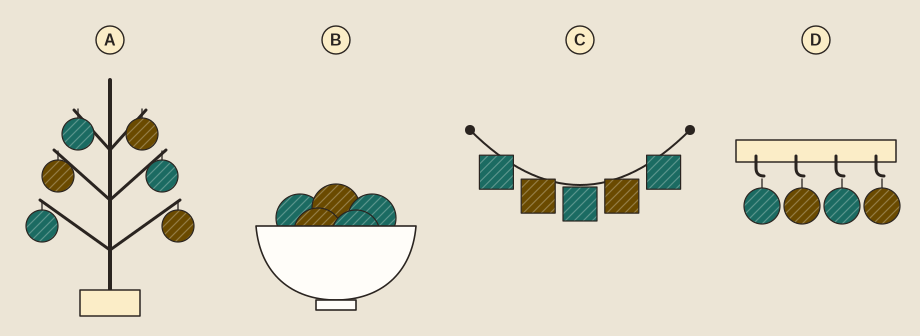
- A small tree (A) of wire or bare branches, set with whatever the month asks for: hearts, eggs, flags, leaves, snow.
- A bowl (B) for round ones, on a table away from the window. Turn them now and then.
- A garland (C) of small flat squares on a cord, pinned under a shelf.
- A row of hooks (D) or the knobs of a cupboard, one to a knob.
- On a present, as the tag.
Choose ones that are not tied to a holiday: birds, shells, houses, fruit.
Outdoors
Do not leave needlepoint out of doors. Rain loosens the stiffening in canvas and makes colors run, damp brings mold, and daylight fades wool. What can be stitched for such a place is in needlepoint for a porch or the garden.
| Place | What can be there |
|---|---|
| In the rain or the sun | Nothing on woven canvas |
| Front door under a deep roof | A sign or a wreath on plastic canvas with acrylic yarn, for one season |
| Covered porch | A pillow that comes in with you |
| Glassed-in porch | Light is the trouble there: a piece for a season |
| Garden party, picnic | Coasters, napkin rings, a wrap for a bottle. Bring them in at dusk |
Light and damp, in a few lines
- Light adds up and cannot be undone. Shades down in the sunniest hours. Daylight does the most harm, and lamps do some.
- Damp: a steady 40 to 50 percent is the museum's wish. Keep off outside walls in cold rooms.
- Dust cuts thread. What has no glass is vacuumed through a screen: how to clean needlepoint.
- Swap. About once a month let the pillow nearest the window change places with the one farthest from it, so that the same side does not take all the light. Let two framed pieces take turns, one on the wall and one in a dark drawer.
What makes it look tired
| What you see | Cure |
|---|---|
| A pillow like a flat bread | A new insert, which is the cushion inside, 1 inch (2.5 cm) larger than the cover |
| One faded side | What has faded stays faded. Move the piece out of the light now, and swap pillows monthly from here on |
| A frame that hangs crooked | Two hooks in place of one |
| Pieces spread over every wall | Gather them into one group |
| A picture the size of a postcard over a sofa | A wide mat and a larger frame, or a group as in the three arrangements |
| Gray edges | Dust. Vacuum through a screen |
| Trim that came loose | Sew it back on, with no glue |
| A Christmas piece in March | Put it away |
Questions people ask
Does needlepoint look good in a house? It does where it has room: one fine piece on a quiet wall or one pillow on a plain chair. It looks fussy when every surface has some, and that is a matter of how much, not of needlepoint.
Is needlepoint out of fashion? A single traditional pillow on a modern chair, or a bright geometric one on an old chair, looks of no particular year. A whole room in one design dates faster.
How many pieces are too many? If the eye finds no place to rest when you stand at the door, take one away.
What should I stitch for a room that has none? A pillow in its two main colors, or a pair of small pictures for a hall. What to make gives sizes, and wall art charts.
Can needlepoint be part of a gallery wall with photographs? Yes. Give it the same frame as the photographs and put it where the light is lowest.