Needlepoint guide
Embroidery floss, pearl cotton and silk for needlepoint
Yes, you can use embroidery floss for needlepoint. Put enough strands in the needle to cover, 4 to 6 on 18 mesh and 7 or 8 on 13, and lay them side by side. Pearl cotton is simpler, one thread and no parting, and silk gives the most shine.
On this page 12 parts
Which one to take
- Easiest: pearl cotton. Size 5 on 16 or 18 mesh, size 3 on 13 or 14. One thread, nothing to part.
- Smoothest, and any mesh: floss. You choose the number of strands.
- Softest shine: spun silk, which is short silk fibers spun into a thread. It comes as strands you part, or as one thread sold for your mesh.
- No shine at all: matte cotton, on 12 to 14 mesh.
- Belts, key fobs and seats: pearl cotton or wool, not loose strands that catch.
Mesh is the number of holes to the inch (2.5 cm) of the canvas: canvas and mesh sizes shows how to count it.
How much for each mesh
For tent stitch, the small slanted stitch over one crossing of the canvas, as a starting point. Where there are two figures, begin with the lower number of strands and with the finer needle, which has the larger number. They are the same figures as in the thread and needle chart, which adds the wools.
| Mesh | Floss, strands | Pearl cotton | Stranded silk, strands | Tapestry needle |
|---|---|---|---|---|
| 10 | 8 to 10 | Size 3, two together | 8 to 10 | 16 or 18 |
| 12 | 8 | Size 3, two together | 8 | 18 or 20 |
| 13 | 7 or 8 | Size 3, one | 6 or 7 | 20 |
| 14 | 6 or 7 | Size 3, one | 5 or 6 | 20 |
| 16 | 6 | Size 5, one | 5 | 22 |
| 18 | 4 to 6 | Size 5, one | 4 | 22 |
| 22 | 3 | Size 8, one | 3 | 24 or 26 |
| 24 | 2 | Size 8, one | 2 | 24 or 26 |
| 28, silk gauze | 2 | Too thick | 2 | 26 |
| 40, silk gauze | 1 | Too thick | 1 | 28, or a crewel needle 10 |
The silk figures on 10 and 16 mesh are worked out from the figures around them. Floss on 10 and 12 mesh is possible but takes a great many strands: wool is the usual choice there.
Try it first. Stitch ten by ten in the bare margin. Canvas showing between the stitches: add a strand. Stitches that push each other up: take one out. Pearl cotton cannot be parted: if it is thin, put one strand of floss in the needle with it. If it is thick, take the next finer size. A crewel needle is an embroidery needle, which is sharp.
How each behaves
| Thread | What it is | Look | Handling | Best stitches |
|---|---|---|---|---|
| Floss | Six fine strands that part | Smooth, soft sheen | Strands twist: lay them | Tent, satin, Scotch, most others |
| Pearl cotton | Two plies in one tight twist, never divided | Beaded, clear shine | Firm; the shine wears off where it rubs | Tent, crosses, French knots, textured stitches |
| Matte tapestry cotton | Thick, soft, not polished | Like old cotton cloth, no shine | Does not stretch; breaks if dragged | Tent, on 12 to 14 mesh |
| Stranded spun silk | Short silk fibers spun, then stranded | Soft glow | Snags on rough skin and raw edges | Satin, long straight stitches, tent |
| Filament silk, twisted | Long fibers, twisted | Bright | Manageable; snags | Straight stitches |
| Filament silk, flat | Long fibers, no twist | Brightest | Hard: it flies apart | Not for a first piece |
| Silk and wool | Spun together, single strand | Muted, woolly | Forgiving | Backgrounds, basketweave |
Pearl cotton by size. 3 is the thickest, for 13 and 14 mesh, and doubled for 10 and 12. 5 is for 16 and 18. 8 covers 22 and 24 mesh, thinly on 18. 12 is for outlines, for stitches laid over others, and for couching, which is tying a thicker thread down.
"Silk floss" may mean stranded silk, or the flat kind. Read the card: strands and the mesh are on it.
Prepare floss or stranded silk
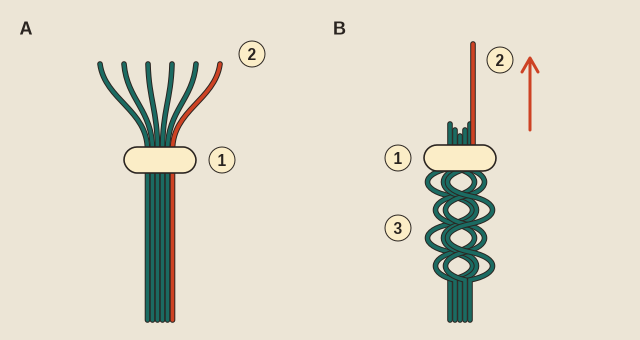
- Cut a length. About 18 inches (45 cm) of cotton, 15 (38 cm) of silk.
- Hold it near one end (1 in the picture) and tap the cut end until the strands spread.
- Draw one strand straight up. Only one at a time, however many you need.
- Let the rest fall straight before you take the next.
- Lay the strands side by side. Keep the ends that you drew out together at one side, so that all run the way they came.
- Add from another length when you need more than six.
- Thread them all through the eye, with those ends level. Never fold them double.
Part them even when you use all six. Twisted together they are a thin rope; side by side they spread and cover.
Open a skein of pearl cotton
A skein is a ring of thread folded in two and held by paper bands. Where it is folded there is one large bend. At the other end there are two loops.
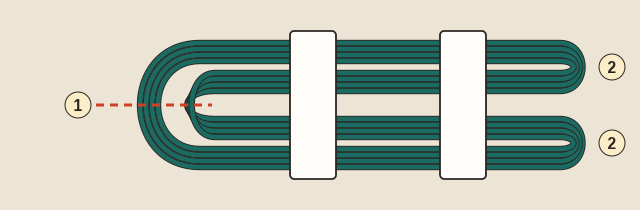
- Slide the bands to the middle, and leave them on.
- Cut through the single bend, 1, right through every thread.
- Draw one length from the two-loop end, 2, when you need it.
- Find the knot. One length does not come out, because the knot is in it. Take others until you can see the knot, pull that length out by it, and cut the knot off.
A ball needs only a bag, so that it does not roll.
Lay the strands flat
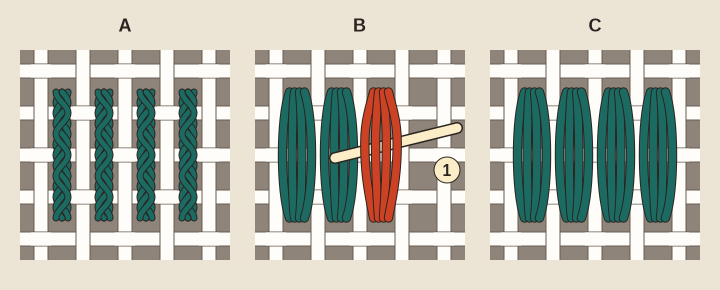
A laying tool is a smooth stick held in the hand that is not stitching. A large blunt needle does the same work.
- Free both hands. Put the canvas on a frame, on a stand or against a table.
- Come up and pull the thread all the way through.
- Lay the thread over the canvas toward the hole where the stitch will end.
- Press the tool down on it, just beyond the hole it came from.
- Stroke along the thread toward the needle, until the strands lie side by side.
- Go down where the stitch ends, with the tool still on the thread, and begin to pull from below. A loop is left on top.
- Slide the tool under the loop, so that the strands lie flat on it as the loop gets smaller. This is B in the picture.
- Slip the tool out just before the stitch closes.
- Untwist. Every few stitches let the needle hang, or turn it in your fingers against the twist.
Tent stitch is so short that a stroke every few stitches will do. Satin, long and slanted stitches want it every time. Tools and supplies describes the tools.
Direction, needle and length
Wool has a grain you can feel. Cotton's is slight, so use it as it comes. With silk, put the same ends of all the strands in the eye. Wool yarn shows how to find a grain. Use the needle for the mesh. If the thread fuzzes, take the next thicker one. With pearl cotton keep the tail in the eye short, because the part in the eye loses its shine, and stop before you reach a dull place.
Bargello and upright stitches in cotton
Upright stitches lie along the canvas threads and not across both, so more canvas shows between them, and they need a fuller thread than tent stitch. Cotton does not swell as wool does.
- Floss or stranded silk: one strand more. On 18 mesh 5 to 7 of floss, on 13 mesh 8 or 9.
- Pearl cotton: size 3 on 18 mesh. On 13 and 14, size 3 with a strand or two of floss in the same color.
- Either: choose canvas near the main color, or paint it first, so that what shows does not matter. Bargello has the stitch.
Mixing cotton, silk and wool
Mix freely in a picture or an ornament: shine beside wool is how a window or a ribbon is made to stand out. For things that are sat on, keep one fiber in any one area, since they wear at different rates. Match thickness, not strands: two areas look level when both just cover. If the piece will be wetted to block it, which is to pull it back to its shape, every thread in it must be colorfast: its dye must not run in water.
Wear and washing
| Wear | Light and water | |
|---|---|---|
| Pearl cotton | Good: one tight strand | Usually fast; check reds and dark colors |
| Floss | Fair: loose strands can snag on long stitches | Usually fast; hand-dyed often is not |
| Matte cotton | Good where it covers fully: one thick strand | As floss |
| Silk, tightly twisted | Good | Sensitive to sun and to water: check every color |
| Silk, soft or flat | Poor where rubbed | The same |
Press a wet length on white cloth before you stitch, and use no thread that leaves color: the wet cloth check has the steps. Silk is best worked on a frame, so that it need not be blocked wet. How to clean needlepoint covers the finished piece.
Numbers and amounts
Charts here give DMC numbers, which are those of its six-strand cotton. Its pearl cotton uses the same numbers for the shades it is made in. Tapestry wool and silks have numbers of their own.
A skein of floss holds about 8.7 yards (8 m). With six strands in the needle it gives that many yards of working thread; with four, half as much again. These and all amounts are estimates, and the thread calculator works one out.
What goes wrong
| What you see | Why | What to do |
|---|---|---|
| Canvas peeps through floss | Strands twisted, or too few | Part and lay them; add one |
| A bumpy surface in pearl cotton | That is its twist | Use floss or silk where it should be smooth |
| Dull patches | Thread worn in the eye | Shorter lengths, short tail |
| Silk catches | Rough hands or an unbound edge | Smooth hands, tape the canvas edge |
| Stitches lean or bulge | Thread too thick, or tugged | Take a strand out, pull less |
Questions people ask
Is needlepoint thread different from embroidery floss? Some is a single strand made to fit one mesh. Floss does the same work with several strands together.
Can I use one skein's six strands as they come? You can, and they cover less. Part them first.
Which is best for a beginner? Pearl cotton, or wool. Both are a single strand, and neither needs laying. The thread guide compares them all.
Can crochet cotton stand in for pearl? Often. Choose one as thick as the size in the table and try it in the margin.