Needlepoint guide
Wool yarn for needlepoint
Three wools do most needlepoint. Tapestry wool is one thick strand, used whole on 10 to 14 mesh. Persian is three strands that you part, to suit any mesh from 5 to 18. Crewel is one fine strand, used several together on 10 mesh and finer.
On this page 11 parts
Which wool to use
- 10 to 14 mesh, large areas: tapestry wool, one strand.
- Several meshes, or a canvas you have not chosen yet: Persian. Take out strands as the mesh gets finer.
- 16 to 24 mesh, shading, or a color to blend: crewel.
- A chair seat, a kneeler, a bag: whichever of the three fits your mesh in the table of strands, worked in basketweave on mono canvas or continental on Penelope, which is woven of pairs. Both stitches have a full back, and wool is the hard-wearing thread.
- A rug on 5 or 7 mesh: rug wool, or Persian, six or eight strands together. See how to make a rug.
Mesh is the number of holes to the inch (2.5 cm) of the canvas. Canvas and mesh sizes shows how to count it.
The kinds of wool
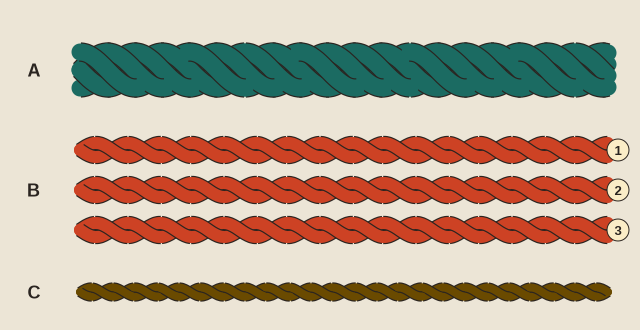
| Wool | What it is | Divide it? | How it is sold (lengths are estimates) | Good for |
|---|---|---|---|---|
| Tapestry | One strand, usually of four plies, tightly twisted | No | Skein, 8 to 11 yards (7 to 10 m); hank of 25 grams, about 60 yards (55 m) | Backgrounds, seats, kits |
| Persian | Three loosely held strands, each of two plies | Yes, always | Card, 8 yards (7 m); hank of 1/4 pound (113 g), about 170 yards (155 m) | Any mesh, any stitch |
| Crewel | One fine strand of two plies | No, put several together | Skein, about 27 yards (25 m); hank of 25 grams, about 197 yards (180 m) | Fine mesh, shading |
| Rug wool, or rug yarn | One thick, rough strand of three plies | No | By weight | 5 mesh, and coarser |
| Merino | A soft wool from one breed of sheep, spun in several weights | As its label says | Skein or card | Smooth stitches, small pieces |
| Wool and silk | A blend, smoother, with a soft shine | As its label says | Skein or card | Backgrounds with a glow |
A skein is a small bundle held by paper bands. A hank is a large loop twisted on itself like a rope. A card is wool wound on a flat piece of cardboard.
Wools of one weight still differ in hairiness, spring and twist, so do not change brands halfway through a background.
How many strands on each mesh
For tent stitch, the small slanted stitch over one crossing of the canvas. Basketweave and continental are two ways to work it. The figures are where to begin. Where there are two, start with the lower, and add a strand if the canvas shows.
| Mesh | Tapestry | Persian | Crewel | Tapestry needle |
|---|---|---|---|---|
| 5 | Rug wool, or 2 | 8 | Too fine | 13 |
| 7 | 1 or 2 | 6 | Too fine | 13 or 16 |
| 10 | 1 | 3 | 4 or 5 | 16 or 18 |
| 12 | 1 | 2 | 3 or 4 | 18 or 20 |
| 13 | 1 | 2 | 3 | 20 |
| 14 | 1 | 2 | 2 or 3 | 20 |
| 16 | Too thick | 1 or 2 | 2 | 22 |
| 18 | Too thick | 1 | 1 or 2 | 22 |
| 22 and 24 | Too thick | Too thick | 1 | 24 or 26 |
The crewel figures on 10 and 12 mesh are worked out from the figures around them. Add one strand for upright stitches such as bargello. A larger number is a finer needle: begin with the finer, and take the thicker if the wool frays. Every other thread is in the thread and needle chart.
What ply means
A ply is one of the thin yarns twisted together to make a strand. A strand is a whole one that you can thread. So tapestry wool is one strand of four plies, and Persian is three strands of two plies each. Labels muddle the two: wool sold as 3-ply Persian means the three strands. "Use 2-ply" in an old pattern for Persian means use two strands.
Separate strands, never plies. A ply pulled out of a strand has no twist left to hold it, and comes to pieces in the needle.
Opening a skein or a hank
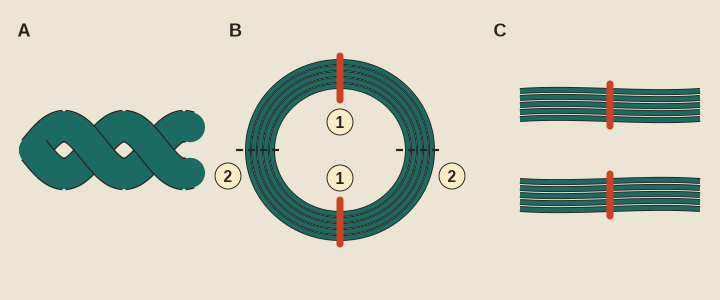
A hank:
- Untwist it. It opens into one large loop, held by a tie or two.
- Tie it again. If it has only one tie, knot a short piece of yarn loosely round all the strands at two places opposite each other.
- Cut across the loop (2 in the picture) halfway between the ties, right through every strand. Cut on both sides. (Cut on one side only, the lengths are twice as long.) A Persian hank cut at both ends gives lengths of about 33 inches (84 cm).
- Keep the label with the bundle, for its color and dye lot.
- Draw lengths one at a time from the end of a bundle. Cut a 33 inch (84 cm) length in two before you stitch.
A skein with two paper bands: keep both bands on. Find the end that comes from inside, and draw it straight out with a light pull. If it catches, try the other end. If neither comes, slide the bands off, open the skein into its loop and treat it as a hank.
Length in the needle: about 18 inches (45 cm). Canvas rubs wool thin. If the end looks hairier than the beginning, cut shorter.
Part the strands, and find the grain
- Part Persian, even to use all three. The parted strands lie side by side and cover better. Hold the length near one end, pull one strand straight up and out, and let the others fall straight. Lay them back side by side.
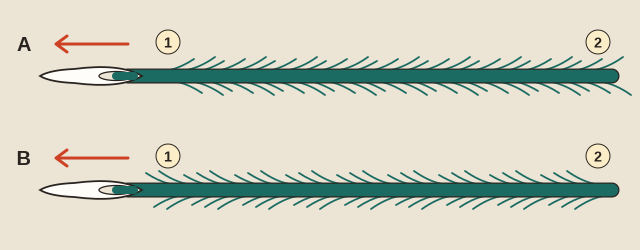
- Draw a strand along under your chin by one end, that end going first. Feel whether it is smooth or tickles.
- Draw it by the other end. One way is smoother. That is the direction the wool should go through the canvas.
- Thread the end that led when it was smooth. It goes in the eye of the needle. The wool then passes through the canvas as it passed under your chin, with its hairs lying back.
- Point every strand the same way. Put the leading ends of all the strands in the eye together. Two strands are two separate lengths: one folded in half runs against its grain on one side.
- Let the needle hang from the canvas every few stitches while you work, so that the wool untwists.
Is it colorfast? The wet cloth check
Do this with every color of a piece that will be blocked or cleaned. Reds, dark colors and hand-dyed wool are the most likely to run.
- Cut a short length of each color.
- Wet it with cool water until it is soaked.
- Lay it on a white cloth and fold the cloth over it.
- Press for a minute, then look. Leave it and look again after half an hour.
- Judge. White cloth still white: go on. Any color on it: keep that wool for a piece that stays dry.
Salt and vinegar are not a dependable cure. Rinsing in cool water until it runs clear helps a skein that only holds loose dye, and then it is checked again. Never go from cold water to hot: that felts wool.
Amounts
Work one square inch (6.5 square cm), measure what it took, multiply by the number of square inches of that color, and add about 30 percent. It is an estimate, and hands differ. The thread calculator does the sum from the mesh. Persian is sold by the yard of all three strands together. If you stitch with two, a yard (0.9 m) gives a yard and a half (1.4 m) of working thread. Buy all the wool for a background at one time from one dye lot. A dye lot is one batch of dyeing, with its number on the label, and the next batch may differ a little.
Substitutes
| The pattern says | You can use | Watch for |
|---|---|---|
| Tapestry wool on 10 mesh | Three strands of Persian | Part the strands |
| Tapestry wool on 12 to 14 mesh | Two strands of Persian, or three of crewel | A flatter surface |
| Two strands of Persian on 13 mesh | Three of crewel | Finer, smoother stitches |
| One strand of Persian on 18 mesh | One or two of crewel | Try it in the margin |
| Any of them | Smooth knitting yarn of the right thickness | It pills and stretches: see acrylic and knitting yarn |
Wools may be mixed in one piece if the finer one is built up to match. For fuzz, velvet and shine see specialty threads.
What goes wrong
| What you see | Why | What to do |
|---|---|---|
| Fuzzy stitches among clear ones | Threaded against the grain, or a length used too long | Check the grain; cut shorter |
| Wool breaks or thins in the needle | Old, moth-eaten or too loosely spun | Pull each length between your hands before you thread it, and discard what parts |
| Canvas shows | Too few strands, or strands still twisted together | Part them; add one |
| Hands ache, holes widen | Too many strands | Take one out |
| A line across the background | Two dye lots | Where they meet, use a length of the one and then a length of the other for some rows |
| Grit, webbing or short cut ends in the bag | Moths | Seal it away from the rest: see how to store needlepoint |
Moths. Do not count on wool being mothproofed: some once was, and much now is not. Keep it clean, look at it now and then, and store it where it can breathe but insects cannot get in. Old wool that pulls apart between your hands cannot be mended. Do not stitch with it.
Questions people ask
Wool or silk for a beginner? Wool, on 10 to 14 mesh. It is springy, fills the holes and forgives an uneven pull. Silk shows every twist.
Can you knit with needlepoint wool? Uncut tapestry wool is about as thick as worsted yarn and can be knitted or crocheted in small things. It is firmer than knitting yarn, and skeins are short. Cut lengths are no use for it.
What can leftovers do? Stripes and small motifs, a patchwork of trial squares, tassels and cord, embroidery on cloth, and crewel for punch needle.
Can wool needlepoint be washed? Most wool can stand cool water and mild soap. The canvas and the paint may not: see how to clean needlepoint.
Are the color numbers the same as for floss? No. Tapestry wool has numbers of its own. Match by eye, in daylight.