Needlepoint guide
Needlepoint thread and needle chart, by mesh
Find your mesh in the first column and read across for the needle and the strands that cover it in tent stitch. Every figure is where to begin. Ten stitches by ten in the margin settle it.
On this page 7 parts
The chart, for tent stitch
Tent stitch is the small slanted stitch over one crossing, worked as basketweave, continental or half cross. Mesh is the number of holes to the inch. Labels also call it count, points or gauge: 18 mesh, size 18 and 18/1 are one thing.
Three things to know before you read it:
- A range of strands (8 to 10): begin with the lower figure, and add a strand if the canvas shows. A firm pull draws the thread thin and may need the higher.
- A range of needles (16 or 18): a larger number is a finer needle. Begin with the finer one. If it drops through the hole, or the thread frays, take the thicker. The drop test is below.
- (W) means worked out from the figures around it.
| Mesh | Stitches in 1 in (2.5 cm) and in 10 cm | Needle | Tapestry wool | Persian wool, strands | Crewel wool, strands | Cotton floss, strands | Pearl cotton | Stranded silk, strands |
|---|---|---|---|---|---|---|---|---|
| 5 | 5 and 20 | 13 | Rug wool, or 2 | 8 | Too fine | No | No | No |
| 7 | 7 and 28 | 13 or 16 | 1 or 2 | 6 | Too fine | No | No | No |
| 10 | 10 and 39 | 16 or 18 | 1 | 3 | 4 or 5 (W) | 8 to 10 | Size 3, two | 8 to 10 (W) |
| 12 | 12 and 47 | 18 or 20 | 1 | 2 | 3 or 4 (W) | 8 | Size 3, two | 8 |
| 13 | 13 and 51 | 20 | 1 | 2 | 3 | 7 or 8 | Size 3, one | 6 or 7 |
| 14 | 14 and 55 | 20 | 1 | 2 | 2 or 3 | 6 or 7 | Size 3, one | 5 or 6 |
| 16 | 16 and 63 | 22 | Too thick | 1 or 2 | 2 | 6 | Size 5, one | 5 (W) |
| 18 | 18 and 71 | 22 | Too thick | 1 | 1 or 2 | 4 to 6 | Size 5, one | 4 |
| 22 | 22 and 87 | 24 or 26 | Too thick | Too thick | 1 | 3 | Size 8, one | 3 |
| 24 | 24 and 94 | 24 or 26 | Too thick | Too thick | 1 | 2 | Size 8, one | 2 |
| 28 | 28 and 110 | 26 | Too thick | Too thick | Too thick | 2 | Too thick | 2 |
| 40 | 40 and 157 | 28, or a crewel needle 10 | Too thick | Too thick | Too thick | 1 | Too thick | 1 |
The needles are tapestry needles, which are blunt. A crewel needle is an embroidery needle, which is sharp. 28 and 40 are silk gauze. Rug wool is a thick, rough wool for coarse canvas. On 5 mesh it is the first choice, and two lengths of tapestry wool the second. On 5 and 7 mesh, crewel, cotton and silk would take so many strands that thicker wool is the sensible answer.
How to read it
- Tapestry wool is one thick strand, used whole. 1 means one length in the needle.
- Persian wool comes as three strands lying together. Part them, then count strands. 6 is two whole lengths.
- Crewel wool is one fine strand. Several go in the needle side by side.
- Cotton floss is six fine strands, so 8 is one whole length and two strands of another.
- Pearl cotton is never divided. Size 3 is the thickest, then 5, 8 and 12. Size 12 is for outlines, and for couching, which is tying a thicker thread down.
- Stranded silk is counted as floss is, when its strands are about as fine. Some silks have finer strands and take more. Read the card.
- A single-strand silk, or wool and silk, is sold for a mesh: use one strand on the mesh on its label.
Never fold one strand double to make two. The fine hairs of wool all lie one way, which is its grain, and half of a folded strand would be pulled against them and come up fuzzy. The thread guide says why, and describes each thread. Wool yarn and floss, pearl cotton and silk go further.
For upright stitches: one more
Upright and level stitches, such as bargello, brick and satin, lie side by side along the canvas threads. A slanted stitch crosses an upright thread and a crosswise one and hides them both. An upright stitch lies beside the upright threads and crosses only the crosswise ones, so the canvas shows sooner. Add one strand.
| Mesh | Persian wool | Crewel wool | Cotton floss | Stranded silk | Pearl cotton |
|---|---|---|---|---|---|
| 5 (W) | 9 | Too fine | No | No | No |
| 7 (W) | 7 | Too fine | No | No | No |
| 10 | 4 | 5 or 6 | 9 to 11 | 9 to 11 | Size 3, two, with a strand or two of floss |
| 12 | 3 | 4 or 5 | 9 | 9 | Size 3, two, with a strand or two of floss |
| 13 | 3 | 4 | 8 or 9 | 7 or 8 | Size 3, with a strand or two of floss |
| 14 | 3 | 3 or 4 | 7 or 8 | 6 or 7 | Size 3, with a strand or two of floss |
| 16 | 2 or 3 | 3 | 7 | 6 | Size 5, with a strand or two of floss |
| 18 | 2 | 2 or 3 | 5 to 7 | 5 | Size 3 |
| 22 | Too thick | 2 | 4 | 4 | Size 8, with a strand of floss |
| 24 | Too thick | 2 | 3 | 3 | Size 8, with a strand of floss |
28 and 40 mesh have no row: tent stitch is the stitch for silk gauze. Tapestry wool has no strand to add. Where one length of it leaves canvas showing between upright stitches, change to Persian.
If the extra strand crowds the holes, go back to the tent stitch figure and work on canvas of about the thread's color, bought so or painted before you stitch. How to paint a canvas says which paint does not run.
The other way: stitches that cross or pile up, such as Smyrna cross and Rhodes, put two or more layers in one place. Try one strand fewer.
Check the cover in six stitches
Six stitches are enough to see whether a thread is hopeless. Ten rows of ten are enough to trust it.
- Choose a place in the bare margin of the same canvas, held taut.
- Thread the needle from your mesh's row, with strands that lie side by side.
- Knot the end and go down from the front, about an inch (2.5 cm) to the left of the place. The knot stays on top: this is only a trial.
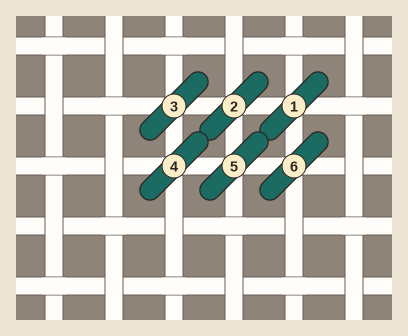
- Work three stitches of continental from right to left, with your ordinary pull: 1, 2 and 3 in the picture.
- Work three more in the row below, from left to right, each touching the one above: 4, 5 and 6. Come up at the upper right of each and go down at its lower left.
- Look straight down. Canvas between the stitches means too thin. Stitches that push each other up mean too thick.
- Hold it to a window. Points of daylight between the stitches will show as specks later.
- Change one thing. Add or take out one strand, and work six more beside them. Tapestry wool and pearl cotton cannot be parted: see What goes wrong for those.
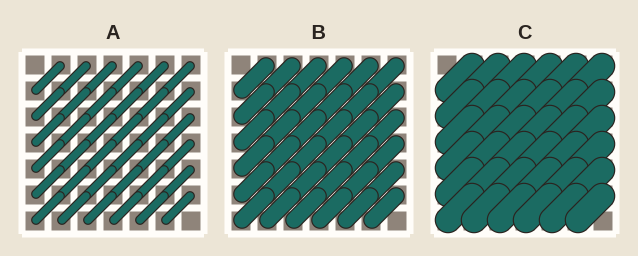
| Too thin | Too thick | |
|---|---|---|
| The front | Specks of canvas, gaps between rows | Fat stitches, uneven edges |
| The canvas | Lies flat | Ripples, or holes are forced wide |
| Your hand | Nothing to feel | A tug at every stitch, sore fingers |
| The thread | Lies loosely | Goes fuzzy before the length is used |
The needle: drop it
Take the size in the chart. Hold the needle point down over a hole and let go.
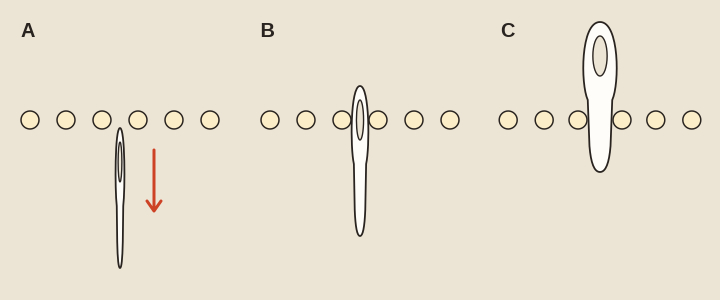
If the thread frays with the right needle, take the next thicker one, which has the smaller number. Needle sizes covers the rest.
What goes wrong
| Problem | Cure |
|---|---|
| Between two sizes of pearl cotton, one thin and one thick | Use the thinner with one strand of floss in the same color |
| Tapestry wool is too thin, or too thick | Thin: try a lighter pull. If that does not cure it, or it is too thick, change to Persian, where a strand can be added or taken out |
| Persian is thin with one strand and tight with two | One strand of Persian and one of crewel |
| The color of the painted canvas shows | Add a strand, or choose a thread near the paint's color |
| Strands twist into a rope | Part them, lay them side by side, smooth each stitch with a laying tool, a smooth stick held in the other hand |
| The second color covers less than the first | Dark dyes and pale ones differ a little: add a strand for that color |
Questions people ask
Which thread for 10 mesh? One strand of tapestry wool, or all three strands of Persian, with a size 16 or 18 needle.
Which thread for 16 mesh? One strand of size 5 pearl cotton or six of floss, with a size 22 needle. One or two strands of Persian also fit.
How many strands of floss for 18 mesh? Start with four. Use five or six for a dark thread on white canvas.
Does half cross need more thread in the needle? No. It uses less, because its back is short. It covers the front as the others do. On mono canvas it slips, so there it is not the stitch to use: see types of canvas.
How much thread should I buy? The chart does not say. The thread calculator gives an estimate for an area, and the thread and needle tool shows the same figures for one mesh at a time, from 10 to 18. Metallic, velvet and ribbon have a table of their own.