What people mean by Japanese needlepoint
There is no one craft called Japanese needlepoint. The words are used for silk embroidery, sashiko, kogin, temari balls and bunka pictures, and for needlepoint with a Japanese subject. To name a piece, look for stiff, open canvas under the stitches: with it, it is needlepoint. Without it, use the six steps below. To stitch one on canvas, go to the stitches that suit.
On this page
Which one do people mean?
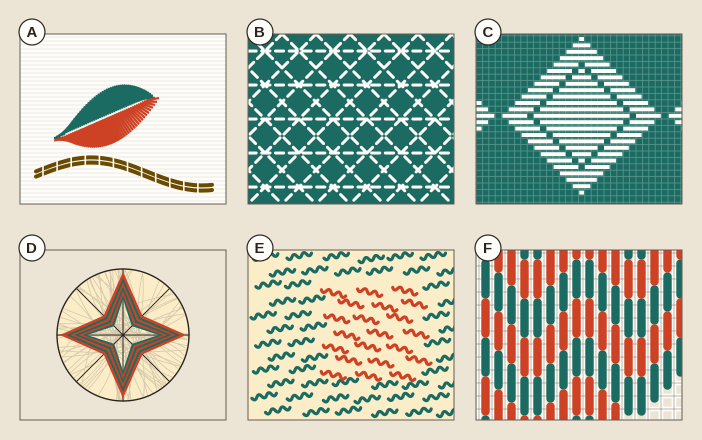
| What people call it | What it is | How it is worked | Is it needlepoint? | |
|---|---|---|---|---|
| A | Japanese embroidery, nihon shishu | Silk and gold thread on silk cloth stretched in a frame | The worker twists the silk for each part, or leaves it flat for shine. Shapes are filled with long smooth stitches. Gold thread is laid on the cloth and tied down with small stitches | No. The stitches follow a drawing on cloth, not a grid |
| B | Sashiko | White cotton running stitch, which is a row of dashes, on dark blue cotton | Lines of even stitches go through one layer or several. They strengthen and quilt the cloth, and make patterns | No |
| C | Kogin | White cotton darning on dark blue linen, hemp or cotton | The thread runs along one row of the weave, over and under counted threads. Row by row the stitches make diamonds | No, but it is counted, and can be copied on canvas |
| D | Temari | A ball wrapped in thread and stitched over | The ball is divided by guide threads, and bright threads are stitched round and round the marks | No |
| E | Bunka | A picture in crinkled rayon thread | A hollow needle pushes the thread in from the front, and short lines of it lie like brush strokes | No. It is a kind of punch needle |
| F | Japanese needlepoint, on canvas | Needlepoint with a Japanese subject or pattern | Any needlepoint stitch, on open canvas | Yes |
The letters are those of the picture.
What to do next: if you have a piece, go to Which one do I have? If you want to stitch one on canvas, go to On canvas.
Which one do I have?
- Is it a ball? Then it is temari, D. Stop here.
- Look for canvas. Stiff and open, with square holes, and covered or meant to be covered by the stitches: it is needlepoint, F. Stop here.
- Is the thread crinkled? Shiny and curly, like a fine chain pulled open, in short lines: bunka, E. A numbered kit sheet fits it. Stop here.
- Is the thread glossy and smooth, on silk or satin? Silk embroidery, A. Some large hangings are silk on cotton, with the whole cloth covered. Stop here.
- Is the thread dull white cotton on dark blue? Follow one line of stitches. Dashes of about one length, in lines that turn corners and cross: sashiko, B. Level dashes of many lengths, all in one direction, on cloth whose threads you can count: kogin, C.
- Not sure between B and C? Look at the back, if it is open. The back of kogin shows the pattern in reverse: where the front has a white stitch, the back has blue cloth.
Chinese silk embroidery looks much like Japanese, and style alone may not separate them. Old silk pictures says what to look at and how to keep it.
A little history, with dates
- Silk embroidery in Japan is thought to have begun with images of the Buddha, over 1,300 years ago. It went on to court dress, stage costume and kimono. Kyoto and Kanazawa each have a tradition with its own name, Kyo-nui and Kaga-nui, and both are worked now.
- A temple hanging of 1780 to 1840 in a London museum has flat silk laid and tied down, raised satin stitch, and couched gilt thread.
- Gift cloths, fukusa, laid over a present, were embroidered in silk. A museum in New York has covers dated from the 17th to the 19th century.
- For export. The ports opened to foreign trade in the mid-1850s, and Japanese silk hangings were the fashion in London, Paris and New York. Some cover every inch of a cotton cloth. Dated ones are of about 1870 to 1910.
- Sashiko and kogin grew out of need, in the Edo period (1603 to 1867). Running stitch joined and mended work clothes, and darning warmed a cold linen. Kogin is one regional kind of sashiko. It belongs to the Tsugaru country in the far north of the main island. It had almost gone by the early 20th century, and is taught again.
- Temari began with balls from China about the 7th century.
- Bunka spread about 1900 and reached the United States after the Second World War, with numbered kits.
These are living crafts. Their patterns have names and meanings, and some belong to a place or a house. What anyone may take from them is the technique. Draw your own diamond, wave or flower.
On canvas: stitches that suit
Canvas is stiff and open, so what was flat silk on silk becomes a stitch that fills holes. These stitches of the library come near the look.
| The look | On canvas | Thread |
|---|---|---|
| Smooth silk leaf or feather | Satin stitch, short, its direction turned for each part | Flat or stranded silk, laid |
| Gold outline | Couching: two metallic threads side by side on the surface, tied down with a fine one | Metallic braid or cord, and sewing thread |
| Kogin diamonds | Darning stitch in rows over odd numbers of threads, 1, 3, 5, 7 and 9, as the steps below show | Pearl cotton, white on a painted blue ground |
| Sashiko lines | Lines of running stitch over finished dark stitches: over two threads, under one, along one line of holes. Or single lines of tent stitch in white, set into the ground | White pearl cotton |
| Waves | Wave stitch, in two blues | Silk, cotton or wool |
| Bamboo | Bamboo stitch | Silk or pearl cotton |
| Seed heads, flower centers | French knots | Stranded silk |
| A plain ground with quiet movement | Nobuko, or basketweave | Matte cotton or wool, so that the silk shines against it |
To work a row of diamonds in darning stitch on canvas:
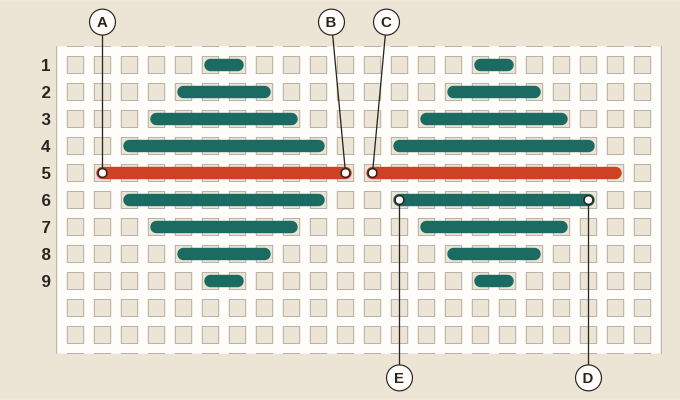
- Copy the table below. It says, for each of the nine rows of a diamond, how many canvas threads the needle goes over and how many it goes under. The two make ten, because the diamonds repeat every ten threads.
- Begin row 5, the middle. Come up at A, the left tip of the first diamond. Count nine threads to the right along the same row of holes, and go down at B.
- Go on along row 5. Pass under one thread and come up at C. Go over nine again, and so on to the end of the row. A miscount shows here at once.
- Turn for row 6. Go to the next row of holes below. Come up at D, one thread in from the right end of the last stitch. Work from right to left: over seven, down at E, then under three.
- Work rows 7, 8 and 9 in the same way, turning at each end. Every stitch is two threads shorter than the one above it, one at each end.
- Return to the middle. On the back, run the thread under a few stitches of the lower half and up to row 4. Work rows 4, 3, 2 and 1 upward.
- Pull gently in every row. The canvas must lie flat, with a little slack where the thread turns.
| Rows | Over, threads | Under, threads |
|---|---|---|
| 1 and 9, the points | 1 | 9 |
| 2 and 8 | 3 | 7 |
| 3 and 7 | 5 | 5 |
| 4 and 6 | 7 | 3 |
| 5, the middle | 9 | 1 |
Each diamond is nine threads wide and nine rows tall: half an inch (1.3 cm) each way on 18 mesh. A stitch over nine threads is long, so keep it for a picture or an ornament.
Flat silk on canvas
Flat silk has no twist: it is a bundle of loose, very fine fibers. It shines most of all, and it snags. Keep it for a small part, such as one bird, and learn on stranded silk first. Floss, pearl cotton and silk compares them.
- Bind the canvas edges, and sand or cover any rough spot on the frame.
- Smooth your hands. Dry skin catches the loose fibers.
- Use a frame on a stand, so that both hands are free.
- Cut it short: 15 to 18 inches (38 to 46 cm).
- Stab. Push the needle straight down and pull it out below, then straight up. Do not slip it in and out of the canvas in one move.
- Lay each stitch. A laying tool is a smooth, blunt stick like a thick needle. Hold it under the silk on top of the canvas, stroke the silk flat against it as the thread goes down, and slip the tool out last.
- Keep stitches short where anything could rub, over two to four threads.
- Change direction from petal to petal. The same color will look like two.
- Keep it dry. Silk and water do not agree, so fasten the canvas square on its frame from the start. Then it does not need to be dampened and pinned straight afterward.
| Problem | Cure |
|---|---|
| The silk spreads and frays | A shorter length, a larger needle, smoother hands |
| It looks dull | It is twisted. Let the needle hang, then lay the next stitch flat |
| Canvas shows between stitches | One more strand, or a painted canvas close to the silk's color |
| Couched gold lies in waves | Tie it down at closer, even steps, and bend it with the tool and not with the fingers |
Where each is taught
- Silk embroidery: in workshops and schools in Japan, and by teachers trained there. Kyoto counts about fifteen basic techniques, so it is a long study.
- Sashiko and kogin: in classes for beginners, and from kits of printed or evenly woven cloth. An institute in Hirosaki, in the north of Japan, keeps kogin.
- Canvas work of this kind: needlework guilds. Ask for silk, laid stitches and couched gold.
Questions people ask
What is the definition of Japanese needlepoint? There is none in use. Say Japanese embroidery for silk on silk, and needlepoint for stitching on canvas.
Is sashiko needlepoint? No. It is running stitch on cloth. Crafts like needlepoint has the rest of the family.
Are there stitches that are Japanese? Names such as Oriental or bamboo stitch describe a look on canvas, and are no evidence that a stitch came from Japan. Couching, satin stitch and darning are shared by many countries, Japan among them.
Is it older than needlepoint? Silk embroidery in Japan is far older than tent stitch on canvas: the history of needlepoint begins that story.
Which patterns suit? Japan, cherry blossom, koi and waves have charts for canvas.