Needlepoint guide
Crafts like needlepoint
Needlepoint is embroidery counted over the threads of a stiff, open canvas. Nearest to it are cross stitch and other embroidery, then latch hook on canvas, then loops punched or hooked through cloth, and last tapestry, which is woven. To pick one, go to "Which craft to choose".
On this page 14 parts
The ten side by side
Needlepoint itself is the first row, to measure the others against. The ground is what the work is done on: canvas or cloth. The warp is the set of threads held tight on a loom, and the weft is the yarn woven across them. Mesh is the number of holes to an inch (2.5 cm) of canvas.
| Craft | The ground | The thread | The stitch |
|---|---|---|---|
| Needlepoint | A stiff, open canvas | Wool generally; silk, cotton and others as well | Stitches counted over the canvas threads, most often the slanted tent stitch; the canvas is generally covered |
| Cross stitch | Fabric: evenly woven for counted work, or printed with the stitches | Stranded cotton floss most often | Two short slanted stitches that cross, counted on the fabric or worked over a printed design |
| Surface embroidery | Plain woven cloth | Many kinds | A wide variety of stitches, placed by the design and not by the weave |
| Crewel | A firm cloth | A fine wool of two threads, or plies, loosely twisted together | Surface stitches, freely worked |
| Bargello | Canvas: it is needlepoint | As for needlepoint | Upright stitches over four to six threads; in the classic pattern they step up and down into waves |
| Petit point | The finest canvas: it is needlepoint | Finer yarns | Tent stitch, made very small |
| Quick point | The coarsest canvas, rug canvas among it: it is needlepoint | Thick yarn | Needlepoint stitches, made very large |
| Latch hook | Rug canvas | Short cut lengths of yarn | Knots: each length is knotted to the canvas with a latched hook, and its ends stand up as a tuft |
| Punch needle | A woven cloth, held taut | Yarn or thread, fed through a hollow needle | Loops: the needle pushes each one through the cloth, and they form on the far side |
| Rug hooking | Burlap, linen or another stiff woven backing | Strips of wool fabric, or yarn | Loops: a hook pulls each one up through the backing |
| Tapestry weaving | None: warp threads held on a loom | Weft yarn, most often wool | Weaving: the weft passes over and under the warp and is packed down to cover it |
Three of the ten, bargello, petit point and quick point, are needlepoint under another name. Three more are other kinds of embroidery. In the last four the surface is made another way: one by knots, two by loops and one by weaving.
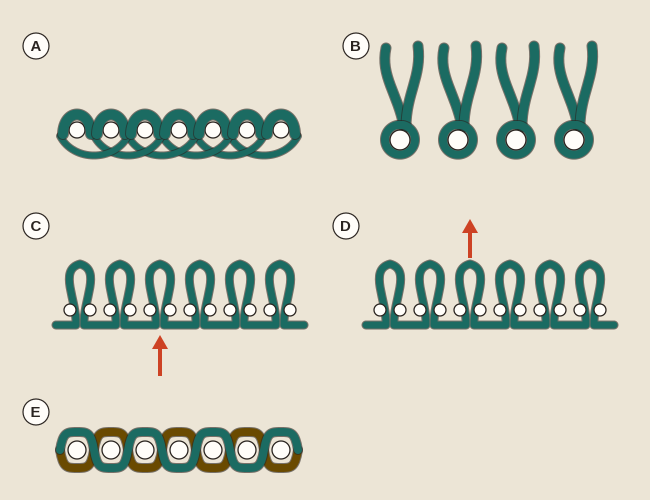
To name a piece in your hand, look at the front. Flat stitches that go down into holes are needlepoint or another embroidery. A pile of cut ends is latch hook if the yarn is knotted around the threads of a canvas. Cut loops make a pile too, but have no knots. Standing loops are punch needle or rug hooking: in a rug the two end alike, and the finished piece may not say which. A surface of ridges with no ground behind it is woven.
Which craft to choose
| You want | Take | Because |
|---|---|---|
| A picture with nothing to count | Needlepoint on a printed or painted canvas, or stamped cross stitch | The design is already on the ground |
| A picture counted from a chart, with no background to stitch | Counted cross stitch | The cloth may show around the design |
| To draw with thread, in many stitches | Surface embroidery | The stitches follow the design, not a grid |
| The same in wool | Crewel | It is surface embroidery in wool |
| A pattern of waves in a few shades | Bargello | One upright stitch covers four to six threads |
| Tiny detail | Petit point | The canvas is the finest and the stitches the smallest |
| A large piece in few stitches | Quick point | At 5 mesh there are 25 stitches in a square inch (6.5 square cm), against 324 at 18 mesh |
| A soft rug or wall hanging with no sewing | Latch hook | One knot, over and over, with yarn that can be bought cut and a canvas that can be bought printed |
| A looped rug, from a drawing | Punch needle, or rug hooking | Both are worked in any direction over a drawn design. The first pushes loops from the back, and the second pulls them up from the front |
| To make the cloth as well as the picture | Tapestry weaving | The picture is built as the cloth is woven. It needs a loom |
Easiest to learn: one move repeated, with nothing to count. That is tent stitch on a printed or painted canvas, stamped cross stitch, or latch hook on a printed canvas.
Fewest stitches for its size: quick point and latch hook, both on canvas of about 3 to 7 mesh.
Cheapest: the materials decide it more than the craft does. A canvas painted by hand costs the most, and a chart with plain canvas or cloth the least: see which costs more. A small piece keeps any of them cheap.
Cross stitch
The stitch is two short slanted stitches that cross to make an X. Cross stitch is worked in two ways. Counted cross stitch is worked from a chart in which each square is one stitch, and the stitcher counts the threads of the fabric. Stamped cross stitch is worked over a design printed on the fabric, with no chart.
The ground is the main difference. Counted cross stitch is worked on fabric woven with the same number of threads to the inch each way, so that every stitch comes out the same size. A fabric often used is Aida, woven so that its threads group into small squares, with a hole at each corner for the needle. The thread is most often stranded cotton floss: six loosely twisted strands that pull apart. Pearl cotton, which is a shiny twisted cotton used whole, silk and wool are used as well. Cross stitch need not cover its fabric: on household linens only a small part, such as a border, was traditionally stitched. Needlepoint generally covers its canvas.
Needlepoint comes both ways too. Its designs are usually printed or painted on the canvas, and some are charted, with each square of the chart standing for one crossing of the canvas threads. A cross stitcher who picks up charted needlepoint follows the chart in much the same way as a cross stitch chart. One who picks up a printed or painted canvas stitches over the colors already on it, as in stamped cross stitch. Either way the ground and the stitch change. The thread need not: needlepoint is generally worked in wool, but almost any thread can be used on canvas.
For a cross stitcher the new stitch is half of the old one: tent stitch is a single slanted stitch over one crossing of the canvas threads. Half cross is the name of one of the three ways of working it. The cross itself has long been a needlepoint stitch too, made on canvas. Needlepoint vs cross stitch compares the two in full.
Surface embroidery
Embroidery is the family name: needlepoint, cross stitch and crewel are all kinds of it. The kind compared here is surface embroidery, also called freestyle embroidery. In it the stitches follow the lines and shapes of a design, not the weave of the cloth under them. Stamped cross stitch is not counted either, but it is not meant here: its print sets every X in its row, so it stays with cross stitch.
Plain woven cloth, such as cotton muslin or linen, is a good ground for it, with the design drawn or transferred onto the cloth. The cloth can be held taut in a hoop or a frame. Needlepoint is worked in one stitch or a selection of stitches, each placed by the grid of the canvas. Surface embroidery is free of the grid: it draws on a huge variety of stitches, and nearly any design can be worked in it.
A needlepointer who takes it up gives up the grid: nothing is counted, and the stitches follow the design on the cloth. The stitches themselves can be used on canvas, among them satin stitch, chain stitch, stem stitch and the French knot, four of its basic stitches. Needlepoint vs embroidery sorts out the names.
Crewel
Crewel is surface embroidery in wool: a fine yarn of two threads loosely twisted together, freely stitched on a firm fabric. It is named for the yarn. Both crafts were used for furnishings such as bed hangings: canvas work from the 16th century on, and crewel in England in the late 17th and early 18th centuries. Needlepoint and crewel covers the difference, how to tell which one an old piece is, and crewel wool used on canvas.
Bargello
Bargello is not a different craft. It is needlepoint: counted stitches on canvas. What sets it apart is the stitch, which is upright where tent stitch is slanted. Each stitch lies parallel with the canvas threads and covers four to six of them, and in the classic pattern each steps up or down from the one beside it, so that the rows rise and fall in zigzags and waves. The colors repeat in sequence, in graded tones of one color or in contrasting colors. It is also called Florentine work and flame stitch.
It is usually stitched on single-thread (mono) canvas. What is bargello explains how a pattern is built, the bargello stitch page shows the stitch, and the bargello patterns are charts to start from.
Petit point
Petit point is needlepoint too: tent stitch made very small, on the finest canvas. It begins at 16 mesh, or at 22 mesh where the name is kept for the finest work alone. Most needlepoint from the 16th to the 18th century was petit point, at 20 to 45 holes to the inch. It takes finer yarn than ordinary needlepoint, and it is often used for the detailed parts of a piece.
Nothing about the stitch is new to a needlepointer. What changes is the scale, and with it the canvas and the thread. Petit point and gros point covers both, with the needle, the light and the other places the line between petit point and ordinary needlepoint is drawn. Canvas and mesh sizes describes silk gauze, a stiff, open canvas woven of fine silk, which is finer still.
Quick point
Quick point, also written quickpoint, is needlepoint at the other end of the scale: big stitches in thick yarn on large-scale canvas. It is worked on canvas of 3 to 7 mesh. Canvas this coarse includes rug canvas, which is woven of doubled threads and heavily starched, and 5 mesh rug canvas is the one most tied to the name.
It is needlepoint at a larger size, and nothing else about it is new. With five holes to the inch there are 25 tent stitches in a square inch, against 324 on 18 mesh canvas. What is quickpoint? has more.
Latch hook
Latch hook is made on rug canvas, and the design may be printed on the canvas as a colored grid. Nothing is stitched, though. Short lengths of yarn, cut in advance to one length, are knotted onto the canvas one at a time with a latch hook: a small hooked tool with a hinged latch that closes over the yarn as it is drawn through. The ends of each knot stand up, and together they make a tufted pile. It is used for rugs, wall hangings and mats.
Rug canvas is sold with 3.3 to 7 holes to the inch, and the sizes given for latch hook run from 3.3 to 5. The yarn can be bought already cut.
What carries over from needlepoint is the canvas and the way a design is followed: from a canvas printed with it, or from a chart similar to a needlepoint chart. Neither the needle nor the stitch carries over: the surface is a pile of knotted yarn.
Punch needle
Punch needle makes loops. The tool is a hollow needle in a handle, with the yarn or thread fed down through it. Each push of the needle leaves a loop on the far side of the cloth. A rug is usually worked from the back, so that the loops form on the other side. The loops are not knotted: friction holds them in the cloth. They are left as loops or cut to make a pile.
The ground is a woven cloth stretched taut in a frame or a hoop. Fine punch needle embroidery is worked on a firmly woven fabric. For rugs the backings are weaver's cloth and monk's cloth. Monk's cloth is a loose, coarse cloth woven with its threads in groups, two by two or four by four. The material runs from embroidery floss and thin yarn to strips of fabric.
For a needlepointer the grid does not carry over: there is no canvas, and nothing is placed by counting its threads. What is familiar from a printed or painted canvas is filling in a design that is already on the ground. Here it is printed, transferred or drawn on the cloth, and worked in any direction.
Rug hooking
Rug hooking also makes loops. They are pulled up, not pushed down: the worker faces the front of the piece and uses a hook, like a crochet hook set in a handle, to draw each loop up through a stiff woven backing such as burlap, linen or the cloth sold as rug warp, which is not the warp on a loom. The material is wool fabric cut into long strips, or yarn. The strips run from under 1/8 inch (3 mm) wide for fine work to 1/2 inch (13 mm). Narrow strips give fine detail and wide ones a bolder, plainer look. In a rug, the end result is the same as punch needle's: compare C and D in the picture near the top.
Like punch needle it is worked in any direction, and not every hole in the backing is filled: every second or third is a general rule. It is used for rugs, wall hangings and pillow covers.
Tapestry weaving
A woven tapestry is not stitched, and it has no ground cloth. It is made on a loom. Warp threads (the white dots of E in the picture near the top) are held on the loom, and colored weft threads are passed over and under them and packed down so tightly that the warp is normally completely covered. Each color of weft is woven only across its own part of the design, and rarely from edge to edge, and the picture is built up that way as the cloth itself is made. Wool has been the most widely used material for both warp and weft.
The name causes the confusion. Broadly, tapestry has been used for almost any heavy furnishing cloth, woven or embroidered. Since the 18th and 19th centuries its strict sense has been narrowed to the handwoven kind. Stitching on canvas was used to imitate woven tapestries, and the word is now used for both crafts. It lingers in the names of needlepoint's blunt needle, the tapestry needle, and of tapestry wool. The difference is in the making: needlepoint is stitched onto a canvas that is already woven, and in a tapestry the design is built up in the course of the weaving. What is needlepoint says how to tell a stitched piece from a woven one, and needlepoint and tapestry takes the names one by one.
Which is nearest
From the nearest to the farthest:
- The same craft at another size or with another stitch: bargello, petit point and quick point. All three are worked on canvas.
- On fabric, counted or worked over a printed design: cross stitch.
- Not counted, on cloth: surface embroidery and crewel.
- On canvas, with a hook in place of a needle: latch hook.
- Loops on cloth: punch needle and rug hooking.
- Weaving, not stitching: tapestry.
Knitting, crochet, quilting and needle felting
These four are often named in the same breath as needlepoint, but they stand about as far off as woven tapestry does. Needlepoint adds stitches to a canvas that is already woven. Knitting and crochet make the cloth itself, quilting sews layers of cloth together, and needle felting mats loose wool. None of the four is needlepoint, and needlepoint is not a kind of any of them.
| Tool | Worked on | What the tool does | |
|---|---|---|---|
| Needlepoint | A blunt needle with an eye | Canvas | Carries the thread through the holes, over and over, until the canvas is covered |
| Knitting | Two knitting needles, or one circular needle: rods with no eye | Nothing: the yarn becomes the cloth | Pulls each loop through a loop of the row before; a whole row of loops stays open on the needle |
| Crochet | One hook | Nothing: the yarn becomes the cloth | Pulls loops through loops, finishing each stitch before the next |
| Quilting | A sewing needle or a sewing machine | Three layers: a top, a soft filling called batting, and a backing | Sews through all three to hold them together |
| Needle felting | A thin, sharp needle with notches along its shaft and no thread | Loose wool | Stabs the wool again and again until the fibers tangle into felt |
Needlework is the word over all. In its narrow sense it is decorative work done with a needle, needlepoint and other embroidery among it. Used broadly it takes in knitting and crochet too, though crochet uses a hook.
What a needlepointer finds familiar. In knitting and crochet, the yarn and the blunt needle: ends are hidden with one, and a chart of squares is often followed. In quilting, the blocks: a traditional quilt top is usually geometric and built on a grid. In needle felting, only the wool.
Can they be combined? In some ways, yes:
- Knitting. A charted motif can be embroidered over finished knitting in duplicate stitch, which follows each knitted stitch with a blunt needle. One square is one knitted stitch, so the picture changes shape.
- Crochet. Rows of single crochet, and the close, squared cloth of Tunisian crochet, which keeps a row of loops on one long hook, can be embroidered in cross stitch from a chart.
- Yarn. Wool and acrylic knitting yarns go on plastic canvas and on some woven canvas: see acrylic and knitting yarn.
- Quilting. A quilt block makes a good needlepoint design: these are quilt block patterns for canvas. Strips of cloth, like the borders of a quilt, can frame a small stitched center in a pillow.
- Felt. Ready-made felt backs small pieces of needlepoint: see how to back needlepoint.
Which of these five to choose. For a picture or a pattern in firm, flat stitches, needlepoint. For something to wear that stretches, knitting. For a blanket or a shape in the round, crochet. For a padded bed cover, quilting. For a small figure in wool, needle felting.