Old needlework and needlepoint tools, frames and stands
The stand a Victorian lady stitched at was called a standing frame: two uprights on feet, with the frame held between them at a slant. Most old needlework tools are as easy to name once you know what they did. Find yours in the pictures and tables below.
On this page
Start here
- Find the working end. A hook, a blunt point, a sharp point, an eye, two prongs or a screw tells you most.
- Match it to the three pictures: frames, embroidery rings and small tools. The names are under each picture, and the tables of the rings and of the small tools have the same letters and numbers.
- Read every mark with a magnifier: a name, a town, a country, or the row of tiny stamps on silver. What they tell is under Marks on silver and German and French things.
- Look for what is missing. Empty shapes in a box, peg holes and screw holes say what the thing once had.
- Check it before you use it: see Can it be used now?
Most of these tools served sewing, embroidery, netting and lace as well as canvas. So this page says needlework, and says needlepoint only where a tool was for canvas.
The old frames
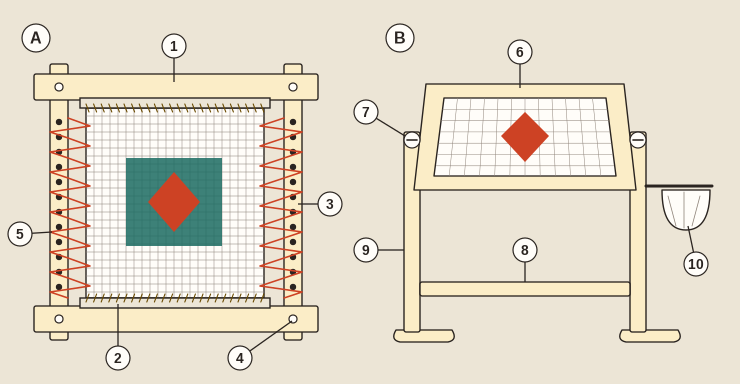
| Its old name | What it looks like | Its size, from books of the time | Date |
|---|---|---|---|
| Flat or four-piece frame | Two bars with webbing and two side laths, held by pegs through rows of holes | From 4 inches to 3 yards (10 to 274 cm) in the webbing. Small ones in the hand, large ones on trestles | An American one of 1725 to 1790; described in 1842 and 1882 |
| The same with screw sides | The side pieces are wooden screws with nuts | Middle sizes. Called the better kind in 1842 | 19th century |
| Knee frame, table frame, lap frame | A flat board with two short uprights and a frame between them, with thumbscrews | 8 to 27 inches (20 to 69 cm) in the webbing | Described in 1842 and 1877 |
| Standing frame, frame upon a stand | Picture B | 20 to 45 inches (51 to 114 cm) in the webbing | Described in 1842, 1877 and 1882 |
| The same with toothed wheels | Wheels that roll the canvas on | The same | Before 1842. They were said to get out of order |
| Tambour frame, Swiss frame | Two round rings, one inside the other. Older ones are covered in cloth or velvet. Some of bare wood screw to a table | For small pieces | Covered: in fashion in the later 18th century, seldom used by 1842. Bare wood on a foot: the usual one for white embroidery in the 1880s |
| Hand frame with screws | Two small rollers with webbing and two side screws | Held in the hand | Described in 1842 |
What did Victorian ladies call the stand? A standing frame. A frame for the lap was a knee frame, a table frame or a lap frame. "Floor frame" and "floor stand" are newer words for the first. Many were of mahogany, cedar or beech. The best were of fine wood, fit to stand in a sitting room, and the 18th century had them inlaid: a Paris stand of 1770 to 1780 was good enough to be turned into a writing stand.
Which were for needlepoint? All but the round ones. A book of 1842 says that a round frame cannot hold work as firmly as a square one, and that is true of canvas now: frames and stretcher bars says why a ring is a poor match for it. An old round frame was for muslin, a thin cotton cloth, and for tambour work, a chain stitch worked with a hook.
Fire screens. A panel of needlework in a pole screen or a tall framed screen is not a working frame, though it swings like one. If the back is closed and there is no webbing, it was for show.
Old embroidery rings
Two rings, one inside the other, hold cloth as taut as a drum. They were for embroidery on cloth, and they do not suit canvas. Look at what the rings are made of, and at the part that is red in the picture: what closes the outer ring, or what holds the pair to a table.
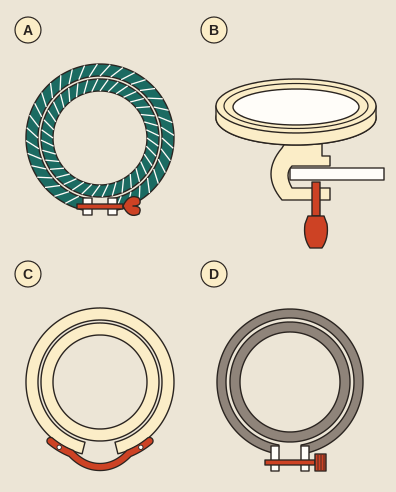
| The rings | Books and catalogs that have them |
|---|---|
| A. Wood or iron, covered in cloth, in velvet or in baize, a thick, soft woolen cloth. The outer one is closed with a thumbscrew, or only fits close | 1842 and 1882, both of them as a thing of the past: such rings were in fashion in the later 18th century |
| B. Wood, the inner one on a foot that screws to a table. The outer one is loose, or a leather strap with a buckle takes its place | The 1880s, as the kind most used for white embroidery |
| Wood, in plain pairs of 4 to 12 inches (10 to 30 cm). What keeps the outer one tight is not said | 1897 and 1907 |
| C. A spring in the outer one, so that it fits any thickness of cloth. Where a picture shows it, the spring is a strip of metal riveted over a cut in the wood. Round, or oval for stockings and long flowers | 1911, 1912, 1925 to 1926, 1929 |
| D. With a screw | 1907 and 1914. Of metal: 1914. Of metal, lined with cork: 1929 |
How old is yours? Each year in the table is one in which that kind was described or sold, and not its first or its last. Two bare rings of wood with a metal screw on the outer one are the hardest to date: rings with a screw were sold by 1907, and they are the usual kind today. So look for more than the screw:
- A patent date stamped in the wood or the metal is a limit: the ring is no older than that. A maker's name can be looked up.
- A screw with a cross in its head is of the 1930s or later.
- Plastic is modern.
What size will an old frame hold?
Old frames were sold by the length of the webbing, the strip of cloth marked 2 in the picture. The canvas is sewn to it, so that is the widest canvas they take. Lay a ruler on the webbing and not on the wood: the bar is always longer. Take off the bare margin at both sides to get the widest design.
| Webbing | Widest canvas | Widest design, with 2 inches (5 cm) bare at each side |
|---|---|---|
| 12 inches (30 cm) | 12 inches (30 cm) | 8 inches (20 cm) |
| 18 inches (46 cm) | 18 inches (46 cm) | 14 inches (36 cm) |
| 20 inches (51 cm) | 20 inches (51 cm) | 16 inches (41 cm) |
| 27 inches (69 cm) | 27 inches (69 cm) | 23 inches (58 cm) |
| 30 inches (76 cm) | 30 inches (76 cm) | 26 inches (66 cm) |
A frame said to be 20 by 30 inches (51 by 76 cm) may be measured in two ways. If one of those is the length of the webbing, read that row: a design up to 16 or 26 inches (41 or 66 cm) wide. If both are the outside of the wood, the frame holds less. Measure the webbing.
The design may be longer than the frame the other way, because the canvas that waits can be rolled on a bar. Round bars are best for that. A flat bar has edges that mark the work, so it is padded first, as the steps for setting up say.
The small tools
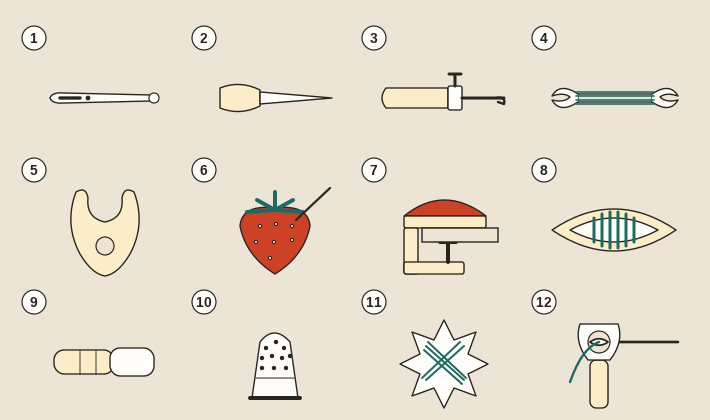
| Tool | What it was for | Dated pieces and books | |
|---|---|---|---|
| 1 | Bodkin: a large blunt needle with one or two eyes, often with a knob | Drawing ribbon, cord or tape through a hem | Silver, 1600 to 1650; with a knob and two eyes, described in 1882 |
| 2 | Stiletto or piercer: a round smooth spike | Making holes for eyelets. In embroidery with gold thread, guiding cord round an edge | Bone, late 19th century; described in 1882 |
| 3 | Tambour hook, with a fine, sharp, hooked tip. In steel it sits in a handle and is held by a small screw; the handle may be hollow, for spare hooks. In bone it may be one piece, with no screw | Chain stitch on cloth in a round frame | Bone, in one piece, 1800 to 1830. Steel with a screw, described in 1882 |
| 4 | Netting needle, forked at both ends to carry the thread. With it goes a mesh: a plain rod on which the loops are tied, so that all come out one size | Net for purses and curtains | Steel or wood, 19th century |
| 5 | Lucet or chain fork: two horns and a hole | Square cord for laces and drawstrings | Boxwood, 19th century. Hard to date |
| 6 | Emery: a small, hard cushion, often a strawberry | Running a needle in and out to take off damp and rust | Described in 1882. The strawberry on a tomato is thought to be Victorian |
| 7 | Clamp, plain or in the shape of a bird whose beak opens | Holding a hem to the table edge, so that it could be pulled taut | About 1850. Out of use as sewing machines came in |
| 8 | Shuttle for knotting | Winding the thread for a string of knots, sewn down on embroidery | Steel, 1770 to 1790 |
| 9 | Needle case, or bodkin case | Needles, kept dry | Silver, about 1720; carved ivory, 1750 to 1780; book form, 1838; covered card with a maker's name printed on the back, 1920s |
| 10 | Thimble, closed or open at the top | Pushing the needle | Uneven dimples, likely before the 1850s. Silver with a steel core, late 19th century |
| 11 | Winder or reel: a star, a snowflake, a spool | Silk sold in skeins was wound on it | Wood, 18th century; silver, about 1790 |
| 12 | Needle threader | Threading a needle when sight is weak. The needle is laid behind the plate, with its eye exactly over the small hole. The front of that hole is wide and slopes inward like a cup, so the end of the thread is led through plate and eye together | Ivory, with a metal plate, described in 1882 |
Marks on silver
On British silver look for a row of small stamps, each in its own little shield: a lion or another sign for the purity of the silver, a sign for the town, one letter for the year, and the maker's initials. Copy all of them, with the shape round the letter, because the same letter in another shape is another year. Then look the row up in a list of hallmarks. Old American silver has a maker's mark and no letter for the year. A tool with no stamp at all may be silver or plate, and needs someone to look at it.
Scissors, wax, boxes and tables
Scissors. A dictionary of 1882 lists gilded and blued ones, handles of silver and of mother-of-pearl, and buttonhole scissors with a gap in the blades. Handles in the shape of a stork are the ones people ask about most. They have been copied for so long that the shape gives no date. Look for a maker's name at the joint.
Wax. A lump of beeswax was for drawing linen thread through. It has no use on canvas wool.
Work boxes and tables. A fitted box has shaped places for each tool: one of rosewood with red silk is of 1800 to 1840. A work table is a small table with a drawer, and often a cloth bag hanging below. Dated American ones are of 1800 to 1810, 1810 to 1815, and 1865 to 1875. Match the tools to the shaped places. One that does not fit was added later.
Georgian and 18th century tools
Georgian means the British years from 1714 to about 1830, when four kings named George reigned. Work of this time was carried about. A lady's small tools could hang from her waist in an etui, a narrow case.
| In the 18th century | Dates and reasons |
|---|---|
| Etui with scissors, bodkin, knife and pen | One in agate and gold is dated about 1710, and may be of the middle of the century. One in enamel: about 1750 to 1760 |
| Silver needle case with room for a thimble, a bobbin and scent | About 1720 |
| Knotting shuttle, such as one of pierced steel | Knotting was thought elegant, and it could be done in company |
| Tambour hook and round frame | Tambour work came into Europe about the middle of the century |
| Silk winders | Silk came in skeins |
| Flat frame of mahogany or cherry, 55 by 41 1/2 inches (140 by 105 cm) | Large hangings and chair seats, in wool and silk on canvas |
| Work table with a drawer and a fitted compartment under flaps | About 1775, in Paris |
Thimbles, needles and shears were mostly of brass, steel and silver. A plastic part, or a chrome-bright plating, is not of this century.
German and French things in the box
- German canvas had every tenth thread dyed yellow to help the counting. It was sold so in 1882.
- Berlin patterns are squared paper charts, painted. One of about 1850 to 1860 is German.
- Berlin or German wool is the soft wool sold for them.
- German needles came from Aachen and the towns round it, and a book of 1882 put them next after the English.
- French needles have a part of their own, below.
- English needles came chiefly from Redditch, which made most of the world's supply in the 1870s.
"Made in Germany" in English is 1887 or later: materials and labels has such marks by year. A tool with a German town on it and no country in English may be older, or may have been sold at home.
Old French needles and needle packets
It is the packet that is French. A needle by itself is a piece of steel with an eye, made alike in several countries, and tells neither where nor when. So read the paper:
| On the packet | What it means |
|---|---|
| Aiguilles | Needles |
| à tapisserie | Blunt, thick, with a large eye: the kind for canvas |
| à chenille | The same with a sharp point |
| à coudre, à broder, à repriser | For sewing, for embroidery, for darning |
| à tricoter | Knitting needles |
| A number | The size: the higher, the finer. In 1882 tapestry needles already ran from 14 to 25, so it is no date |
| L'Aigle, Orne, Normandie | A needle district. One needle factory there was built in 1819, enlarged about 1836 and in 1861, and turned to plastics before it closed in 1952. Another factory, of a firm begun in 1833, has never stopped |
In one museum folded paper cases hold English needles of the 19th century, and a packet of bead needles of about 1900 has a cover printed in gold on red. Colors and gilt give no year. A firm's name may, if a town directory lists it. Leave the needles in the paper: needle sizes has the ones to stitch with.
Magnifying glasses and reading glasses
A lens on a foot, on a jointed arm, or on a cord round the neck was for reading and fine work of every kind. The lens cannot be dated by eye. A cord and plug, a plastic handle or a bulb under the glass belongs to the 20th century. If you use an old one, see what strength it has by Lights and magnifiers, and never leave it where the sun can fall on it.
Can it be used now?
| Check | What to look for | What to do |
|---|---|---|
| Is it square? | Measure the two diagonals of the frame. They should match | Loosen the pegs or screws, square it, and tighten them again |
| Is it flat? | Lay it on a table and press each corner | If one corner rocks, use it for show |
| Worm, the young of beetles that eat wood | Small round holes with pale powder in or under them | Wrap it in plastic, keep it away from other wood and from wool, and ask a conservator |
| Joints | Wobble at the uprights and at the feet | Tighten the screws. Do not glue an antique |
| Pegs and nuts | Missing or odd ones | A wood turner can make pegs. Four of one size hold better than a mixture |
| Webbing | Rotten, loose, or held with rusty nails | Let it be replaced with cotton webbing and new tacks, unless the frame is rare |
| Rust | On screws, tacks and hooks | It marks canvas for good. Keep it from touching |
| Surface | Sticky, flaking or greasy | Dust it with a dry cloth. No spray polish, no silicone. Do not strip it |
| Old needles | Any roughness or brown spots | Keep them in their packet. Stitch with new ones |
Why not rusty needles? Rust roughs the canvas and the wool, and leaves a brown mark that stays. Needle sizes says how to judge a needle. An old emery will clean a speck of tarnish, if it has not gone hard with damp.
To set up a flat frame that is sound:
- Hem the canvas on all four sides: turn half an inch (13 mm) to the back and sew it down. Then no raw edge has to hold the lacing.
- Sew the top edge to one webbing, middle to middle, with strong thread, then out to each end. Sew the bottom edge to the other webbing.
- Roll what is too long. Skip this if the canvas fits. Wrap one loose bar in soft paper folded six or eight times, so that its edges do not mark the work. Turn the bar over and over to wind the canvas on, with smooth tissue between the turns, until the rest fits between the bars.
- Lay the laths across the ends of the two bars, one at each side.
- Put in two pegs at the first bar. At each end, push a peg through the hole in the bar and on through a hole in the lath under it.
- Spread the second bar until the canvas is taut, and put in two more pegs. Count the holes: each lath must be pegged at the same one, or the frame is not square. A frame with screws has nuts to turn in place of pegs.
- Lace each side to its lath with string: over the lath, through the hem of the canvas, and over the lath again, close together.
- Tighten the lacing a little at one side, then at the other, until the canvas is flat. Tie both ends.
How to mount a canvas on a scroll frame is the same work on a new one, and stands sets the height.
What cannot be told
- Who used it. A name scratched inside a box is evidence. A story is worth writing down, and is not proof.
- The year, from the wood. The same frame was made for a hundred years.
- Bone from ivory, by a picture. Ask someone to look at it.
- Whether a set belongs together. Boxes lost tools and were filled again.
- What it would sell for. That is an appraiser's question.
What goes wrong
| Mistake | Instead |
|---|---|
| Calling every hook a crochet hook | Look at the tip and the handle. A sharp, fine steel hook held by a screw is a tambour hook. A sharp bone hook in one piece may have served for both |
| Taking a netting needle for a broken shuttle | It has a closed fork at both ends, so that it can pass through a loop |
| Polishing silver until the marks go | Read and photograph the marks first |
| Cutting off old webbing with its sewing | Photograph it. It shows how the work was held |
| Putting an old canvas back on an old frame | Leave them apart: old needlepoint says how to keep it |
Questions people ask
Is an old frame better than a new one? It can be heavier and steadier. It is not adjustable in as many ways. If it is square and firm, it does the same work.
What is the small round stand with a screw under it? A table clamp for a round frame, in the style of the 1880s.
What is a slate frame? The present name for the flat frame in picture A.
Why has my frame a basket? For the balls of wool. Baskets at the sides of standing frames were sold in 1842.
What can replace a lost part? New pegs, webbing and thumbscrews can be put to an old frame, and the old parts kept in a bag with it. For a lost small tool, tools and supplies lists what is needed now. The history of needlepoint says what was being stitched in each period.