Needlepoint guide
Types of needlepoint canvas: mono, interlock, Penelope and more
Three weaves cover nearly all needlepoint: mono, woven of single threads; interlock, whose threads are locked where they cross; and Penelope, woven of pairs. For a first piece on a frame take mono. Take interlock for anything that will be cut to a shape, and Penelope for large and small stitches in one piece.
On this page 9 parts
Which canvas to take
- A first piece, a pillow, a painted design: mono, 13 or 14 mesh, on a frame.
- An ornament, a key fob or any shape cut close to the stitching: interlock.
- A face or a flower in tiny stitches on a background of large ones: Penelope.
- A chair seat or a footstool: mono worked in basketweave, or Penelope worked in continental. Both stitches have a thick back, which wears.
- A rug: rug canvas.
- A box, or a child's first piece: plastic canvas.
- Very fine work: congress cloth, then silk gauze.
Mesh is the number of holes to the inch (2.5 cm) of any of them. A crossing is the place where an upright thread and a crosswise thread meet, or, on Penelope, two and two.
Tent stitch is the small slanted stitch over one crossing. It can be worked in three ways that look the same on the front and differ on the back: half cross, continental and basketweave. Which of the three you may use depends on the canvas.
Canvas and mesh sizes explains it, and gives widths and colors. 13 mesh or 18 mesh helps you choose.
The kinds side by side
| Canvas | Weave | Mesh it is made in | Works well | Works badly | Frays when cut? | Pulls out of shape? | Best for |
|---|---|---|---|---|---|---|---|
| Mono | Single threads, over one and under one | 10 to 24 | Basketweave, continental, nearly every decorative stitch, stitches pulled tight to open holes | Half cross | Yes: tape the edges | Yes, but blocks back | Painted designs, pillows, most needlepoint |
| Interlock | Pairs of fine threads twisted round single threads | 3.3 to 18 | Half cross, continental, long upright stitches | Stitches pulled tight to open holes; basketweave is harder to read | Hardly | Less, but hard to block | Kits, cut shapes |
| Penelope | Pairs both ways | 10/20 most; also 5/10 and others | Half cross, continental, small tent stitches (petit point), tent stitch over a laid thread (tramé) | Long upright stitches show canvas | Yes | Less than mono | Detail in a plain background, hard wear |
| Rug canvas | Pairs both ways, not for splitting | 3.3 to 7 | Cross stitch, tent stitch | Fine detail | Yes: tape the edges | Little: it is very stiff | Rugs, floor cushions |
| Congress cloth | Single threads, close and fine | 24 | As mono | Thick wool | Yes | Yes | Fine counted work |
| Silk gauze | Fine silk, locked | 18 and finer | Continental | Thick thread | A little | Yes, if held in the hand | Miniatures, jewelry |
| Plastic | A molded sheet, not woven | 5, 7, 10, 14 | Continental, Scotch, slanted Gobelin | Work that must bend | No | No, though a hard pull curls it | Boxes, children, shapes |
To tape an edge is to fold masking tape over it, half on the front and half on the back. It is also called binding. How to start has the steps.
Mono canvas
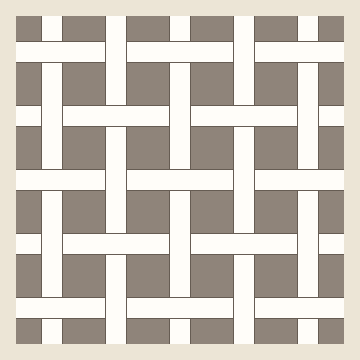
Mono is the plain weave, and the one most painted designs are on. Its threads are thick and smooth, its holes are the largest for their mesh, and the crossings can slide. That is its strength and its weakness. A piece that has been pulled crooked can be pulled straight again and blocked, and basketweave is easy to place, because the weave itself shows you which way to go. But a cut edge ravels, and half cross slips on it.
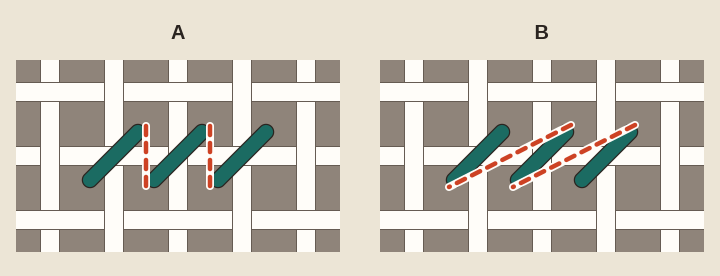
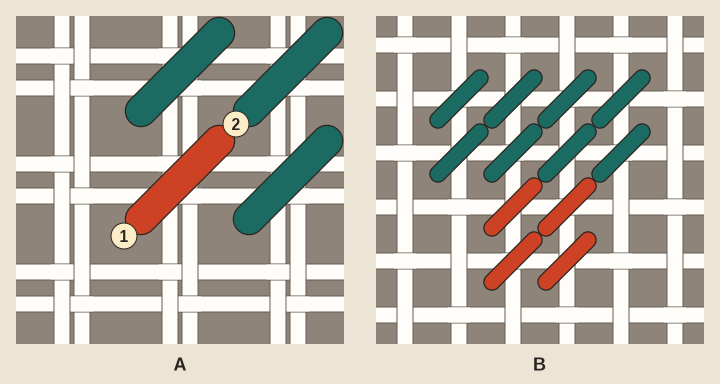
Why not half cross. On the back, a row of half cross (A) never goes under an upright thread. Nothing there ties the upright threads, they slide, and the stitch slips with them. Continental (B) goes under two of them at every stitch, and basketweave is woven behind. On interlock the crossings are locked, so half cross is safe there.
Mono is also sold dyed or sponged with paint, and with a metal thread woven in one direction. Those are meant to be left partly bare.
A better grade has smooth, even threads with no knots or thin places. An orange line woven along the selvage, the firm edge of the roll, is a maker's sign for its better mono. The line means nothing for the stitching and is not a counting line.
Interlock canvas
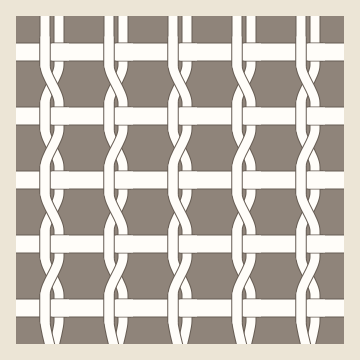
Two fine threads twist round each single one, so the crossings are locked. It can be trimmed close to the stitching, it is lighter, and half cross sits well on it. It is stitched exactly as mono is, over one crossing at a time, and its pairs are never split. It gives less, so it is harder to block straight if your stitches pull it crooked. Use a frame.
Penelope canvas
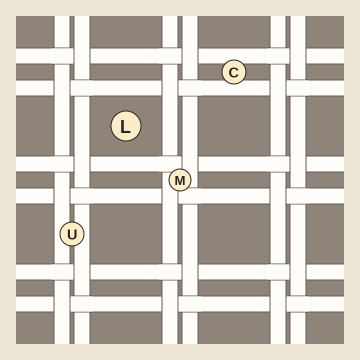
Penelope, also called duo or double canvas, has its threads in pairs. Stitched over the pairs it makes large stitches. With the pairs parted it makes small ones, half as wide and half as tall.
Reading the number. 10/20 means ten large stitches to the inch (2.5 cm), or twenty small ones. The first number is the large holes, and it is the one that sets the size of your chart. The second is always double: 5/10, 11/22.
Which way up. The pairs that lie close together run up and down. The two threads of a crosswise pair stand farther apart, and the gap between them (C in the picture) is easily taken for a large hole. Turn the canvas until the close pairs are upright, and mark the top.
Which holes. For large stitches use only the large holes, L, and go from one L to the next. Stay out of C: it is as wide as a large hole but not as tall. For small stitches use every hole, L, U, C and M, once the pairs are parted.
Which stitch. For the large stitches, half cross or continental. Half cross is safe here because each stitch lies over four threads and not two, so it does not slip between them. It is thin on the back: for a seat, use continental. For the small stitches use continental too. With its pairs parted the canvas is a fine mono, and half cross is not for mono. Upright stitches such as bargello cover Penelope less well than mono.
Which thread. On 10/20, in the large stitches use one strand of tapestry wool or three of Persian, with a size 18 needle. In the small ones use one strand of Persian, or crewel wool, stranded silk or size 5 pearl cotton, with a size 22. The thread and needle chart has every mesh.
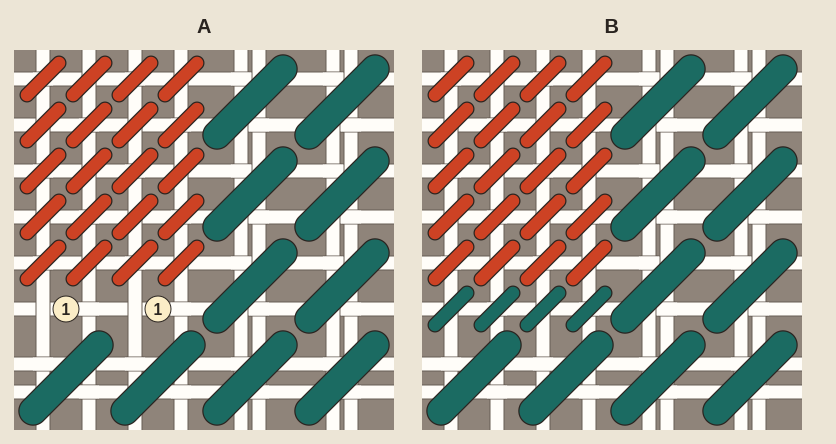
To stitch small and large on one piece
- Mount the canvas on stretcher bars, taut.
- Open the holes. With the finer needle, push down through every U, C and M over a patch about 1 inch (2.5 cm) each way, and a little past its edges. This parts the upright pairs and the crosswise pairs alike.
- Even them out. Nudge the threads with the needle until the holes match.
- Stitch the detail in small stitches, patch by patch.
- Find the part-used crossings. Go round the detail. A large stitch needs all four small places of a crossing. Look for crossings where the detail has taken one, two or three.
- Fill them. Put small stitches in the background color in the places that are left.
- Work the background in large stitches, over whole crossings.
Petit point and gros point says more of both sizes. Canvases sold with the middle already stitched are mostly Penelope: see preworked canvas.
The other canvases
- Rug canvas has the largest holes. Its pairs count as one thread. See how to make a rug.
- Congress cloth is a fine mono of 24 threads to the inch, between cloth and canvas, and comes stiff or soft.
- Silk gauze is a stiff silk grid for tiny work.
- Linen canvas. Good canvas is woven of cotton or of linen. The weave and the mesh decide how it stitches, so choose by those.
- Bargello canvas is a brown mono at 13 mesh. Its threads are coarse enough to keep upright stitches in line. It is seldom sold now.
- Garment canvas has locked threads and no stiffener, at 18 mesh, for things to wear.
- Plastic canvas needs no frame, tape or blocking.
- Waste canvas comes apart when wetted. It is for stitching on clothes, never for needlepoint itself.
Scrim is any light, open woven cloth. Some needlework books use the word for the canvas you stitch on. It is not a separate kind to buy.
How to tell which one you have
- Look at a crossing. Hold the canvas to the light and choose one place where threads cross.
- Count the threads that meet there. One and one is mono. One and a twisted pair is interlock. Two and two is Penelope or rug canvas.
- Pull a thread at a cut edge. On mono and Penelope it slides out whole. On interlock it will not come.
- Try the gap. Push a needle between the two threads of a pair. On Penelope it opens a clean small hole. On rug canvas the pair is stiff and stays together.
- Count the mesh over an inch (2.5 cm), each pair as one.
What goes wrong
| What you see | Why | What to do |
|---|---|---|
| Stitches vanish under the crossings | Half cross on mono | Work continental or basketweave |
| Penelope stitches of uneven size | Some went into the small gaps | Use only the large holes; take out the odd ones |
| The piece comes out half the size | Small holes used for a chart meant for large | Work over the pairs, from big hole to big hole. To check a size, divide the chart's width in stitches by the first number: 100 stitches on 10/20 is 10 inches (25 cm) |
| A cut edge falls apart | Mono, Penelope or rug canvas left untaped | Tape it as soon as it is cut |
| Interlock leans and will not block | Locked threads resist | Use a frame and an easy hand from the start |
| Canvas shows between small and large stitches | Part-used crossings left bare | Fill them with small stitches |
Questions people ask
Is mono or interlock better for a beginner? Mono on a frame: its holes are larger and the weave is easier to follow. If you will not use a frame, or the piece is an ornament to cut out, interlock is the safer choice.
Can I use one chart on any of them? Yes. One square is one tent stitch on every kind, and only the mesh changes the size: the canvas calculator works it out.
Can interlock be split like Penelope? No. Only one direction is paired, and the twist holds it.
Is brown canvas a kind? No, a color. Penelope is often brown, and brown hides well under dark wool. For pale threads choose white.