Needlepoint guide
13 mesh or 18 mesh: which canvas to choose
Choose 13 mesh for larger holes, thicker thread and fewer stitches, and 18 mesh for fine detail. A beginner is safe on 13. The same chart works on both; on 18 it comes out smaller.
On this page 10 parts
Choose in four questions
- Can you see the holes with ease? Hold a scrap of 18 mesh at your stitching distance, in your own lamp light. If you have to hunt for the holes, take 13 or 14. No scrap yet? Hold a ruler there instead. On 13 mesh the holes stand two millimeters apart, and on 18 about one and a half. If one millimeter mark runs into the next for you, take 13.
- How small is the detail? Lettering, faces, thin lines and tiny flowers want 18. Bold shapes, stripes and large blocks of color want 13.
- How big is the piece? For a whole pillow or a seat, 13 nearly halves the number of stitches. For a small ornament, 18 gives the design room.
- What will fill it? Wool yarn, or size 3 pearl cotton: 13. Floss, silk, or size 5 pearl cotton: 18.
If two answers pull against each other, trust the first.
For a painted canvas, the mesh is already settled, so choose by the paint. Look for one on which every crossing of threads is plainly one color, for then each stitch tells you its thread. Where a crossing is two colors you have to choose.
Mesh is the number of holes, and so of stitches, to the inch. Canvas and mesh sizes shows how to count it.
The words in the tables: tent stitch is the small slanted stitch over one crossing, and basketweave is tent stitch worked in diagonal rows. Persian wool is three strands that you part, tapestry wool one thick strand, and crewel one fine one (wool yarn). Cotton floss and stranded silk are fine strands put together, and pearl cotton is one shiny twisted cord, thicker in size 3 than in size 5 (floss, pearl cotton and silk).
Side by side
| 13 mesh | 18 mesh | |
|---|---|---|
| Stitches in 1 inch (2.5 cm) | 13 | 18 |
| Stitches in 10 cm | 51 | 71 |
| Stitches in a square inch (6.5 square cm) | 169 | 324 |
| Tent stitches in a 4 inch (10 cm) square | 2,704 | 5,184 |
| From hole to hole | 2.0 mm | 1.4 mm |
| Tapestry needle | Size 20 | Size 22 |
| Persian wool | 2 strands | 1 strand |
| Tapestry wool | 1 strand | Too thick |
| Crewel wool | 3 strands | 1 or 2 strands |
| Cotton floss | 7 or 8 strands | 4 to 6 strands |
| Stranded silk | 6 or 7 strands | 4 strands |
| Pearl cotton | Size 3, one strand | Size 5, one strand |
| Thread for a 4 inch (10 cm) square in basketweave, an estimate | 26 yards (24 m) | 36 yards (33 m) |
| Capitals 5 stitches high | 3/8 in (1 cm) | 1/4 in (0.7 cm) |
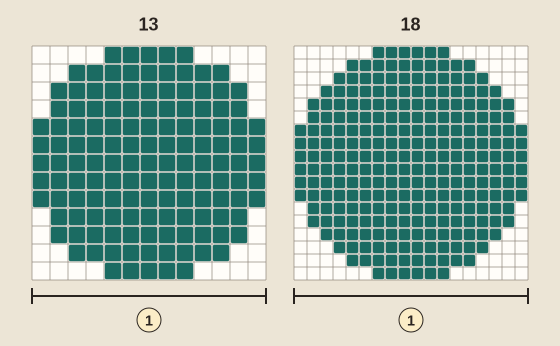
| A circle 9 stitches across, the smallest that looks plainly round | 0.7 in (1.8 cm) | 0.5 in (1.3 cm) |
| Easy to see | Yes | In good light |
| Best for | First pieces, pillows, stockings, seats, bold designs | Ornaments, belts, lettering, pictures, shading |
Thread is measured as it goes in the needle. If you use four strands of floss together, you need four yards of single strand for every yard of the estimate. The thread calculator does it for any size.
14 and 16 mesh, between them
| Mesh | In 10 cm | In a square inch (6.5 square cm) | In a 4 inch (10 cm) square | Needle | Take it when |
|---|---|---|---|---|---|
| 13 | 51 | 169 | 2,704 | 20 | You want the usual coarser canvas |
| 14 | 55 | 196 | 3,136 | 20 | A chart is a little too large on 13; wool still fits |
| 16 | 63 | 256 | 4,096 | 22 | 18 is hard to see, but you want its threads |
| 18 | 71 | 324 | 5,184 | 22 | You want the usual finer canvas |
14 takes the threads of 13, with floss and silk one strand fewer. 16 takes the threads of 18, with floss six strands and silk five. Painted designs on 16 are few, so it is mostly for work from a chart. The thread and needle chart has a row for each.
The same design on each
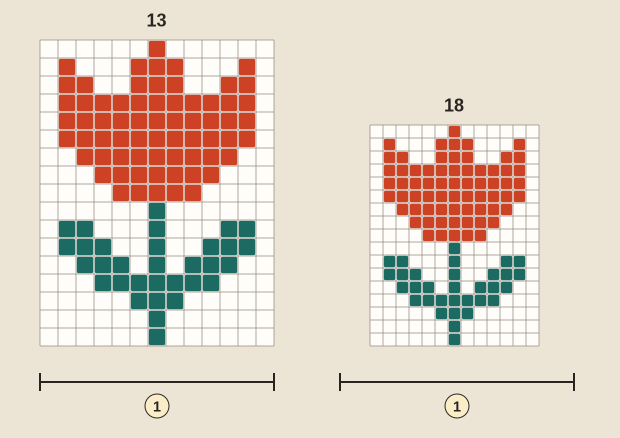
Keep the stitches and the size changes. Keep the size and the number of stitches changes, and with it the detail:
Moving a chart from one to the other
- Find the stitch count. It is on the chart. If you have only a size in inches, multiply it by the mesh it was charted for.
- Divide by your mesh. The answer is inches. Multiply by 2.54 for centimeters.
- Add the margin. Two inches (5 cm) on every side, and cut the canvas to that.
- Change the needle and the thread to the new mesh's column in the first table above. For 14 and 16, take its row in the thread and needle chart.
- Stitch a patch of ten tent stitches by ten in the margin before you begin.
- Judge it. Neighbors should just touch. Canvas showing between them: add a strand. Stitches that push each other up, or canvas that ripples: take one out.
| A chart this wide | On 13 mesh | On 14 mesh | On 16 mesh | On 18 mesh |
|---|---|---|---|---|
| 54 stitches | 4.2 in (10.6 cm) | 3.9 in (9.8 cm) | 3.4 in (8.6 cm) | 3 in (7.6 cm) |
| 72 stitches | 5.5 in (14.1 cm) | 5.1 in (13.1 cm) | 4.5 in (11.4 cm) | 4 in (10.2 cm) |
| 90 stitches | 6.9 in (17.6 cm) | 6.4 in (16.3 cm) | 5.6 in (14.3 cm) | 5 in (12.7 cm) |
| 182 stitches | 14 in (35.6 cm) | 13 in (33 cm) | 11.4 in (28.9 cm) | 10.1 in (25.7 cm) |
A quick rule: from 18 to 13 a design grows by almost four tenths, and from 13 to 18 it shrinks to a little under three quarters. A painted canvas cannot be moved. Its mesh is fixed.
The canvas calculator works out any chart, and how to read a chart the rest.
Blank canvas for common pieces
The canvas to cut is the same on either mesh; what changes is the number of stitches you have to design with.
| Piece | Stitches on 13 | Stitches on 18 | Canvas to cut |
|---|---|---|---|
| Ornament, 3 in (7.6 cm) | 39 by 39 | 54 by 54 | 7 by 7 in (18 by 18 cm) |
| Ornament, 4 in (10 cm) | 52 by 52 | 72 by 72 | 8 by 8 in (20 by 20 cm) |
| Belt, 1 1/4 in (3.2 cm) high | 16 high | 22 high | 5 to 5 1/4 in (13 cm) high, and 4 in (10 cm) longer than the stitching |
| Pillow, 14 in (36 cm) | 182 by 182 | 252 by 252 | 18 by 18 in (46 by 46 cm) |
Decorative stitches on each
A stitch is counted in canvas threads, so it shrinks with the mesh. One over four threads is about 5/16 inch (8 mm) long on 13 and a little under 1/4 inch (6 mm) on 18.
- In a small area 18 fits more repeats, so a pattern such as mosaic or Hungarian has room to show.
- On 13 choose small stitches for small shapes, since even a Scotch square over three threads is nearly 1/4 inch (6 mm).
- Long stitches snag less when they are shorter. A stitch over six threads is safer on 18.
- Upright stitches on either mesh, such as bargello, want a fuller thread than tent stitch: one strand more. Pearl cotton has no strand to add, so on 18 use the thicker size 3 instead, and on 13 put a strand or two of floss in the needle with it.
Seeing 18 mesh
Put a lamp on the side away from your stitching hand, close to the work. Lay something dark in your lap under white canvas, or something white under dark canvas, so that the holes stand out. Use a frame, so they keep still. Add a magnifier if you like one. Lights and magnifiers has more.
What goes wrong
| What you see | Why | What to do |
|---|---|---|
| The design is far too large | An 18 mesh chart worked on 13 | Divide the stitches by 13 before you cut |
| The letters are a blur | Too few stitches for the detail | Simplify the letters, or use 18 |
| Wool will not go through | Tapestry wool on 18 | One strand of Persian, or pearl cotton size 5 |
| White specks show | Thread for 18 used on 13 | Add strands |
| The canvas ripples | Thread for 13 used on 18 | Take strands out |
Questions people ask
Is 13 or 18 mesh more common? Painted canvases come mostly in these two, and some designs are painted in each. More threads are made for 18.
Is 18 mesh petit point? By one common rule, yes: petit point is 16 to the inch and finer. Others keep the name for 22 and finer. See petit point and gros point.
Does 13 mesh look rough? It looks bolder, with plainer steps on a curve. Choose bold shapes and the steps become part of the design.
Can I use 18 mesh thread on 13? Yes, with more of it: two strands of a thread sold for 18 are often right on 13. Try it in the margin.