Needlepoint vs cross stitch
Needlepoint is stitched on stiff, open canvas, mostly in small single slants, and the stitches cover all of it. Cross stitch is worked on cloth, each stitch is an X, and the cloth can show around the design. Both build a picture on a grid.
On this page
- The quick comparison
- The stitch
- Painted or counted
- Which is easier?
- Which costs more?
- A stocking, a pillow, an ornament: which to choose
- Can a cross stitch chart be used for needlepoint?
- Converting a chart, both ways and to other crafts
- Bead, crochet and weaving charts
- Canvas and Aida of the same number
- And embroidery?
The quick comparison
The ground is the cloth or canvas you stitch on. An intersection is the place where two threads of the canvas cross.
| Needlepoint | Cross stitch | |
|---|---|---|
| Ground | Stiff, open-weave canvas | Woven fabric: Aida, a cotton woven in small blocks with a clear hole at each corner, or evenweave, a plain cloth whose single threads are counted |
| Main stitch | Tent stitch: one slanted stitch over one intersection | Cross stitch: two slanted stitches that cross |
| Is the ground covered? | Yes: most designs cover the canvas completely | Not necessarily: it can decorate almost any fabric, clothing included |
| Thread | Wool, silk, stranded cotton floss, or pearl cotton, a shiny twisted cotton used whole | Stranded cotton floss |
| Design usually comes as | A painted or printed canvas, or a chart | A chart; the design is not usually printed on the fabric |
| Needle | Blunt tapestry needle | Blunt tapestry needle |
| How fine it is | Mesh: the holes, and so the stitches, to an inch of canvas. 13 and 18 are usual | Count: the blocks or threads to an inch of cloth. 14 count Aida makes 14 stitches to the inch |
| What it costs | From a chart on blank canvas, the least. A hand-painted canvas, the most | A chart, cloth and floss |
| Typical uses | Pillows, upholstery, belts, stockings, ornaments | Samplers, initials on household linen, decorating clothing |
Take needlepoint if you want no counting (choose a printed or painted canvas), or something hard-wearing such as a pillow or a belt. Take cross stitch if you want a design on cloth or clothing, or do not want to stitch a background. From a chart, the two are nearly the same work.
The stitch
A needlepoint tent stitch is one diagonal over one intersection of the canvas. It leans right: its lower end is at the left and its top end at the right, like a forward slash. One way of working it is even called half cross. Thread and canvas are matched so that the single diagonal covers: too fine a thread will not. Worked in wool, the result is a very durable fabric. A cross stitch is two diagonals, one over the other, with the top one always lying the same way.
Painted or counted
Cross stitch is a counted technique. You work from a chart, counting squares or threads. Needlepoint designs are usually painted or printed on the canvas, so there is no chart to follow: you stitch the color you see. A hand-painted canvas costs more than a printed one, and a chart costs least of all.
Needlepoint can be counted too. Charted designs are worked onto blank canvas, one square of the chart to one stitch, and bargello, which is upright stitches in zigzags and waves, is always counted. Some stitchers paint their own canvases. See how to read a needlepoint chart and how to paint your own canvas.
Which is easier?
Needlepoint on a printed or painted canvas is the easier start: one stitch to learn and nothing to count. From a chart there is little between them. Cross stitch then has the help of Aida fabric, whose clear holes were made for counting, and 14 count is the one to begin on. Needlepoint from a chart is easiest on 13 mesh.
Which costs more?
Needlepoint, if the canvas is painted: each one is painted by hand, and that is what you pay for. A printed canvas costs less. Needlepoint from a chart costs least, and is nearest to cross stitch, since each is then a chart, a plain canvas or cloth, and thread. It still takes more thread than cross stitch does for the same chart, because each stitch is thicker and the background is stitched too. A small piece keeps either one cheap.
A stocking, a pillow, an ornament: which to choose
Choose by what the thing has to do. A needlepoint canvas becomes a thick, firm cloth covered with thread. Cross stitch stays a light cloth with a picture on it.
| What you are making | Needlepoint | Cross stitch | Choose |
|---|---|---|---|
| Christmas stocking | Firm, so it keeps its shape on the mantel. The whole shape is stitched, background too. Painted canvases come in stocking shape | Light and soft, so it needs backing cloth and a lining to hang well. The background can stay bare, and a name is easy to count | Needlepoint for one that is solid color; cross stitch for one with a lot of plain ground |
| Pillow | Hard-wearing in wool | Works on a pillow for show. A bare cloth ground shows dirt and rubs | Needlepoint if people lean on it |
| Chair seat, stool, rug, belt | The usual choice: the canvas is made to be covered and worn | Not for hard use | Needlepoint |
| Ornament | Stiff and small, easy to shape. Every square is stitched | Small, flat and quick to count. It is stretched over card | Either |
| Framed picture with a lot of sky or plain ground | All of it is stitched | Plain ground is left as cloth | Cross stitch |
| Sampler, verse, fine backstitch lines | Lettering of one stitch can break up on the slant | Thin lines and letters are its strength | Cross stitch |
| Towel, shirt, napkin | It needs canvas, so it would be a patch | Stitched on the thing itself. If its threads cannot be counted, over waste canvas, a canvas that is laid on, stitched through and then pulled out | Cross stitch |
A stocking by the numbers. Take one that fits in a space 11 by 17 inches (28 by 43 cm). On 13 mesh that space is 143 by 221 stitches, on 18 mesh 198 by 306, on 14 count cloth 154 by 238. If the stocking fills six tenths of the space, it has about 18,960 stitches on 13 mesh and 36,350 on 18. In cross stitch on 14 count it has about 21,990 crosses if the ground is filled, but only about 8,800 if four tenths of it is picture. That is why a stocking with a bare ground suits cross stitch, and one full of color suits needlepoint. How to make a needlepoint stocking has the rest.
The look. Neither looks better; they look different. Needlepoint is one thick surface, every stitch at the same slant, with a soft sheen in silk and a matte one in wool. Cross stitch is a grid of small raised Xs with a little cloth between them and clean cloth round the design, so it looks lighter, and thin outlines look sharper. If you like a thing to look woven or upholstered, you will like needlepoint. If you like it to look drawn on linen, you will like cross stitch.
Like needlepoint, but with thread? Needlepoint can be all thread: stranded cotton, pearl cotton or silk on 18 mesh. Off canvas, the nearest are cross stitch and tent stitch on even cloth, and they are set side by side in crafts like needlepoint.
Can a cross stitch chart be used for needlepoint?
Yes. One square of the chart becomes one tent stitch. Two things change. The piece will be a different size if your canvas mesh (stitches to the inch) differs from the fabric count (stitches to the inch of the cloth): divide the number of squares across the chart by your mesh to get inches. And you will need to choose a background color and stitch it, since needlepoint usually covers the whole canvas. If the chart has backstitched outlines, which are thin lines of small straight stitches drawn over the squares, decide whether to leave them out or add them over the finished tent stitch.
Converting a chart, both ways and to other crafts
A chart changes craft square for square: one cross becomes one tent stitch, one tent stitch one cross. What changes is the size, the background and everything on the chart that is not a whole square.
"28 over two" is a cloth with 28 threads to the inch, each cross worked over two of them, so it makes 14 stitches to the inch.
| Stitches to the inch | Canvas | Cross stitch fabric | 72 squares | 100 squares |
|---|---|---|---|---|
| 10 | 10 mesh | 10 count | 7.2 in (18.3 cm) | 10 in (25.4 cm) |
| 13 | 13 mesh | Not usual | 5.5 in (14.1 cm) | 7.7 in (19.5 cm) |
| 14 | 14 mesh | 14 count, or 28 over two | 5.1 in (13.1 cm) | 7.1 in (18.1 cm) |
| 16 | 16 mesh, less often sold | 16 count, or 32 over two | 4.5 in (11.4 cm) | 6.3 in (15.9 cm) |
| 18 | 18 mesh | 18 count, or 36 over two | 4 in (10.2 cm) | 5.6 in (14.1 cm) |
From cross stitch to needlepoint:
- Choose the shape and the background. The cloth did the background before; now you stitch it. Give every bare square inside the shape a color. Add two or three rows all round, to be lost in the seam when the piece is made up, which needlepointers call finishing.
- Work out the size. Count the squares each way, with the rows you added, and divide by the mesh, or use the canvas size calculator. Cut the canvas 2 inches (5 cm) bigger than that on every side.
- Deal with the lines. You have three choices. Leave the backstitch out. Or work it in backstitch on top, when all the tent stitch is done. Or make the outline in tent stitch: along each line, stitch the squares that touch it on the inside of the shape in the darker color.
- Fill part squares. Some charts split a square, with a half or a quarter stitch in it. Give such a square one color, the one that keeps the edge smooth.
- Choose a thread that covers, from the table under these steps. A single tent stitch needs more than a cross does, which takes only two or three strands of floss on 14 count.
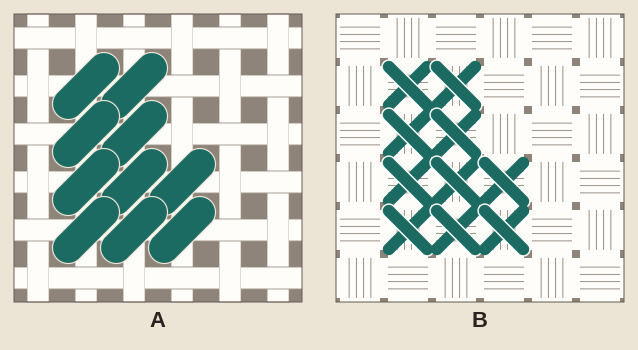
- Look for thin slanted lines, one stitch wide. One that leans right, as the stitch does, comes out solid: A in the picture. One that leans left, with its top end at the left, comes out as separate dashes: B.
- Mend the lines that lean left. Work them in reverse tent, which is tent stitch leaning left (C), or in small crosses over one intersection with a strand or two fewer (D).

| Mesh | Strands of floss in tent stitch | Or one strand of |
|---|---|---|
| 10 | 8 to 10, a great many: wool is the easier choice | Tapestry wool |
| 13 | 7 or 8 | Tapestry wool, or pearl cotton size 3 |
| 14 | 6 or 7 | Tapestry wool, or pearl cotton size 3 |
| 16 | 6 | Pearl cotton size 5 |
| 18 | 4 to 6 | Pearl cotton size 5 |
Size 3 pearl cotton is thicker than size 5. Thread coverage has more threads.
From needlepoint to cross stitch:
- Check the chart. It must be tent stitch, with one square to a stitch. A bargello chart does not carry over, since its squares are canvas threads. Nor does a part in decorative stitches, which are any stitches but tent.
- Choose the background. Leave it out if the cloth can be that color.
- Keep the colors. The color numbers on the charts here are stranded floss, so they stay.
- Work out the size. Divide the squares each way by the stitches to the inch, the first column of the size table. On 28 count over two that is 14, not 28.
- Cut the cloth 3 inches (7.5 cm) bigger than that on every side if it is to be framed. One inch (2.5 cm) is enough for a card or a small gift.
To other crafts:
| Craft | One square becomes | 72 squares wide | What changes |
|---|---|---|---|
| Latch hook, short yarns knotted into rug canvas | One knot | 14.4 in (36.6 cm) at 5 holes to the inch; 21.8 in (55.4 cm) at 3.3 | Much bigger. Only whole squares |
| Fuse beads, melted together on a pegboard | One bead of 5 mm | 14.2 in (36 cm) | Only whole squares |
| Beads on canvas | One bead, on 13, 14 or 18 mesh | As tent stitch | Bead size must fit the mesh |
| Knitting | One stitch, wider than tall | 13.7 in (34.8 cm) at 21 stitches to 4 in | 72 rows are only 10.7 in (27.1 cm) at 27 rows to 4 in: a circle becomes an oval |
For knitting, knit a sample and redraw the chart with more rows (at 21 stitches and 27 rows to 4 inches, or 10 cm, that is nine rows for every seven), or embroider the motif on afterward in duplicate stitch, which follows each knitted stitch with a needle.
Bead, crochet and weaving charts
A needlepoint chart is a grid of true squares. It carries over to any craft whose units sit in straight rows and columns, as long as you allow for units that are not square. It does not carry over to a craft whose rows are staggered. Looking for charts that serve both? See one pattern book for needlepoint and crochet.
| Craft | One square becomes | Straight or staggered | What to do |
|---|---|---|---|
| Beads on a loom, or in square stitch | One bead | Straight | Use the chart as it is. Measure your beads: if they are taller than wide, the picture grows tall |
| Brick stitch beads | None fits | Staggered, like bricks in a wall | Redraw it on brick graph paper, whose rows are staggered too |
| Peyote beads | None fits | Staggered: brick stitch turned on its side | Redraw it, or see "From a peyote chart," below |
| Tapestry crochet, single crochet color work | One stitch | Straight | Make a sample first: the stitches are not square |
| Corner-to-corner crochet | One tile of three double crochet and a chain of three | Straight, worked on the slant | Read the chart from a bottom corner. The tiles are big: at 1 inch (2.5 cm) a tile, 60 squares are 5 feet (1.5 m) |
| Filet crochet | One mesh, open or solid | Straight | Two colors only: dark is solid, light is open |
| Tapestry weaving | None: the chart is a picture | Free | Enlarge it to full size and put it behind the warp, the lengthwise threads. Weaving from the back turns it round, so reverse it |
To crochet or knit a needlepoint chart:
- Choose a tent stitch chart of few colors. A bargello chart or a decorative stitch has no single squares to use.
- Work a sample 4 inches (10 cm) square in your yarn and stitch.
- Count it. Say it has 14 stitches across and 16 rows up.
- Find the width. Squares across, divided by 14, times 4: a chart of 72 is 20.6 inches (52 cm) wide.
- Find the height. Squares up, divided by 16, times 4: the same chart is 18 inches (46 cm) tall, so a circle would come out too short.
- Mend it. Rows over stitches is 16 over 14, or 8 rows for every 7 squares. Work every seventh row of the chart twice. Of 72 rows that makes 82, and 82 rows are 20.5 inches (52 cm): square again.
- Read it in turn. Going to and fro, read right side rows from one side and wrong side rows from the other. In the round, read every row from the same side.
From a peyote chart to canvas. Each bead becomes a block of two upright stitches. Everything stays where the beads put it.
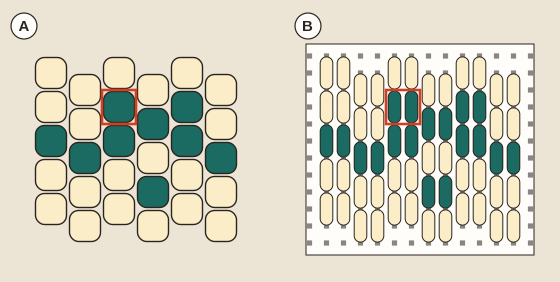
- Turn the chart so that its straight columns of beads stand upright, as in A.
- Find the size. Columns times two, and beads in a column times two, are canvas threads. A chart of 20 columns of 30 beads is 40 threads by 60, and one more for the step: 2.2 by 3.4 inches (5.6 by 8.6 cm) on 18 mesh, or 3.1 by 4.7 inches (7.8 by 11.9 cm) on 13.
- Stitch the first bead, the top one of the column at the left. Come up in a hole, count two threads straight up, go down. Make the same stitch in the next column of holes to the right.
- Go down the column of beads. Each new pair stands right under the last, its top ends in the holes where the pair above came up.
- Start the next column of beads one thread lower or higher, as the chart has it. That is the half bead.
- Fill the gaps with upright stitches over one thread: at the top of the columns that stand lower, and at the bottom of the others.
- Use a thread thick enough to cover as an upright stitch: more strands than for tent. Check in the margin.
With one stitch a bead it is the ordinary brick stitch of canvas, and the picture comes out half as wide.
Beads themselves can be sewn to canvas one to a stitch from a needlepoint chart: see adding beads.
Canvas and Aida of the same number
14 mesh canvas and 14 count Aida both make 14 stitches to the inch, and 18 mesh and 18 count Aida both make 18. So a chart comes out the same size on either. Nearly everything else differs. To choose between the numbers, see 13 mesh or 18 mesh, which has 14 and 16 mesh between them.
| 14 mesh canvas | 14 count Aida | 18 mesh canvas | 18 count Aida | |
|---|---|---|---|---|
| Stitches to 4 in (10 cm) | 56 (55) | 56 (55) | 72 (71) | 72 (71) |
| 100 squares | 7.1 in (18.1 cm) | 7.1 in (18.1 cm) | 5.6 in (14.1 cm) | 5.6 in (14.1 cm) |
| The grid | Single threads, open holes | Blocks of threads, small holes | Single threads, open holes | Blocks of threads, small holes |
| Usual stitch | Tent | Cross | Tent | Cross |
| Strands of floss | 6 or 7 | 2 or 3 | 4 to 6 | 1 or 2 |
| Another thread | Tapestry wool, one strand, or pearl cotton size 3 | Floss is usual | Pearl cotton size 5 | Floss is usual |
| Tapestry needle | 20 | 24 | 22 | 26 or 28 |
| Background | Stitched | Usually left bare | Stitched | Usually left bare |
Why canvas takes more strands. On the front a square of 14 mesh holds one slant of six or seven strands. A square of 14 count Aida, worked with two strands, holds two slants of two, or four strands in all. Canvas also has bigger holes to hide.
Can Aida be used for needlepoint? Tent stitch can be worked on it, one to a square, but it is then embroidery on cloth. A thread thick enough to hide the cloth crowds the small holes. For a true needlepoint of the same size, buy canvas with the same number. More in stitching on burlap and other fabric.
Can canvas be used for cross stitch? Yes: cross stitch is an old needlepoint stitch. The bare canvas is meant to be covered, so work the background too. Two slants cover better than one, so begin with one strand fewer than for tent stitch (5 or 6 of floss on 14 mesh, 3 to 5 on 18), and try them in the margin.
Does canvas stretch more than Aida? Neither is stretchy. Canvas is stiff, but slanted stitches in rows pull it into a leaning shape, and blocking brings it back. A frame and basketweave keep the lean small.
Which is faster? Count the slants. A tent stitch is one and a cross is two, so square for square needlepoint is quicker. But needlepoint fills the background too. A chart 72 squares each way has 5,184 squares. If 2,000 of them are the motif, cross stitch makes 4,000 slants and needlepoint 5,184. If the motif has 3,000, cross stitch makes 6,000 and needlepoint still 5,184. So cross stitch is quicker when less than half the piece is stitched, and needlepoint when more is. A painted canvas also saves finding your place on a chart. "Which is easier?", above, says which is easier to learn.
How can you tell a finished piece? Look at one stitch through a magnifier. Single slants that cover the whole ground are most likely needlepoint. An X, with cloth showing around the design, is cross stitch. If crosses cover the whole ground it may be either. The ground settles it: at the edge or on the back, look for open canvas or for close cloth.
The same for 16 and for 22: strands of floss on 22 count Aida
On 22 count Aida use one strand of floss for a cross and one or two for a tent stitch, with a size 26 needle. A size 28 is for one strand only. It is mostly sold as Hardanger cloth, the cloth of a Norwegian embroidery, woven with its threads in pairs. A pair counts as one: each stitch goes over one pair each way, from one clear hole to the next. There is cloth with 16 squares to the inch as well, made for cross stitch; for needlepoint of that size take 16 mesh canvas.
| 16 mesh canvas | 16 count Aida | 22 mesh canvas | 22 count Aida | |
|---|---|---|---|---|
| Stitches to 4 in (10 cm) | 64 (63) | 64 (63) | 88 (87) | 88 (87) |
| 100 squares | 6.3 in (15.9 cm) | 6.3 in (15.9 cm) | 4.5 in (11.5 cm) | 4.5 in (11.5 cm) |
| Strands of floss for tent stitch | 6 | 2 | 3 | 1 or 2 |
| Strands of floss for cross stitch | 5 | 2 | 2 | 1 |
| Tapestry needle | 22 | 26 | 24 or 26 | 26 or 28 |
So cloth takes fewer strands than canvas of the same number: for tent stitch on 16, a third as many. It is closed and soft and shows between the stitches, and that makes a tent stitch on it embroidery on cloth. Needlepoint is stitched on canvas, whose open threads the stitches hide. The thread and needle chart has every mesh.
And embroidery?
Embroidery is the whole family: the art of decorating fabric with needle and thread. Needlepoint and cross stitch are both kinds of embroidery, worked on the grid of the weave. Other kinds, such as crewel work in wool, are free-style: the stitches do not have to follow the weave of the cloth. More in needlepoint vs embroidery. Crafts like needlepoint sets ten crafts beside needlepoint, latch hook, punch needle and rug hooking among them.
For cross stitch patterns, see the cross stitch section of this site.
Which is more popular: cross stitch, embroidery or needlepoint?
No public count takes cross stitch, embroidery and needlepoint one by one, so no ranking of the three can be trusted. The surveys put them in larger groups. In the United States 11.7 percent of adults did weaving, crocheting, quilting, needlepoint, knitting or sewing in the year to July 2022; the question does not name cross stitch or embroidery. England's survey for 2023/24 asks about crafts as one thing, textiles beside woodwork and ceramics.
| What a ranking counts | What it tells you |
|---|---|
| Searches for a word | How many people look for a pattern, a shop or a meaning. One stitcher can search many times or never |
| Sales of kits, canvas or thread | What was bought in one place. Floss is sold for all three |
| Posts and followers | What is shown, not what is made |
Choose by the piece you want to make. Is needlepoint popular? has the figures year by year.