Crochet guide
How to crochet a potholder
A potholder is crocheted twice as thick as a dishcloth, in cotton or wool, about 7 to 8 in (18 to 20 cm) square. The plainest is one strip folded in half and sewn. The other ways below are a pouch that folds into a square, a stitch that is double by itself, and two circles joined.
On this page 8 parts
| Way | How it is worked | Seams | To know |
|---|---|---|---|
| 1. Folded strip | Rows, twice as long as wide, folded | Three sides | Rows |
| 2. Folded pouch | Rounds on a chain, flattened into a square | One diagonal | Rounds |
| 3. Thermal stitch | Rows that are double by themselves | None | Two loops at once |
| 4. Round hot pad | Two circles, joined | The edge | Increases |
The yarn. Cotton or wool all through, the sewing and the loop too. Acrylic, polyester and nylon can melt. Wool is harder to wash. Use a fiber that does not melt, and judge the thickness for yourself before trusting it with anything hot. Use it dry: a wet one lets the heat through. Yarn for dishcloths and potholders compares the fibers.
The stitch. Single crochet (double crochet in United Kingdom patterns) leaves hardly a hole. For a still closer fabric use a smaller hook.
You also need a yarn needle, scissors, a tape measure and a stitch marker.
| To work | Know first |
|---|---|
| Ways 1 to 3 | Chain, single crochet, slip stitch, fastening off |
| Way 4 | The same, with double crochet (UK treble) and the magic ring |
In the lines sc is single crochet, dc is double crochet, ch is chain, st is stitch, sl st is slip stitch, rnd is round and RS is the right side, the side that faces you in row or round 1. What stands in square brackets is worked as many times as the number after them says.
Way 1: the folded strip
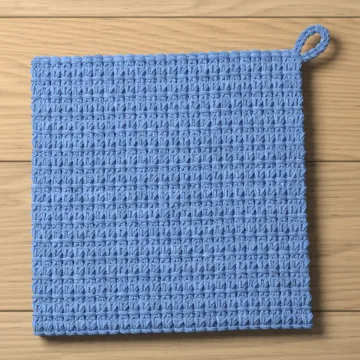
This is our simple solid potholder, about 8 in (20 cm) square: medium cotton, about 120 yd (110 m), an estimate, a 5.5 mm (I-9) hook, 13 stitches and 15 rows to 4 in (10 cm).
1. Chain 27 and work 60 rows
It is a dishcloth twice as long: 26 stitches in every row. Put the marker in the edge of row 30. At the end fasten off: cut the yarn 30 in (76 cm) from the hook and pull it through the loop. This tail sews the last seam.
Foundation: Ch 27.
Row 1 (RS): Sc in 2nd ch from hook and in each ch across (26 sc).
Rows 2 to 60: Ch 1, turn; sc in each st across (26 sc).
2. Weave in, then fold
Weave in every end but the long one now, on the wrong side, which will be inside. Fold between rows 30 and 31, wrong sides together, so that row 60 lies on the starting chain.

3. Sew the two sides
Cut two lengths of 30 in (76 cm), one for each side. Begin at the fold, and sew two or three times into the same place to fasten the yarn. Then whip stitch: put the needle through both layers, bring it round over the edges to the side it started from, and put it through the next pair, always the same way. Sew the end of each row to the end of the row that lies on it: 30 stitches a side. Fasten the end as the beginning.
4. Sew the last edge
The long tail hangs at one end of row 60: begin there. Put the needle under both loops of a stitch of row 60 and under the chain that lies against it, 26 times. The chain you passed over in row 1 is left out.

Or crochet the three sides shut, in place of steps 3 and 4: single crochet through both layers, one in each pair of row ends and of stitches, three in each corner.
5. Make the loop
Put a slip knot on the hook. Put the hook through both layers at the corner where the last seam ends, yarn over, and pull through the layers and the loop: the yarn is joined. Chain 12, slip stitch in the same place, and fasten off. Hide the ends between the layers. Hanging loops shows a thicker one.
Way 2: the pouch that folds into a square
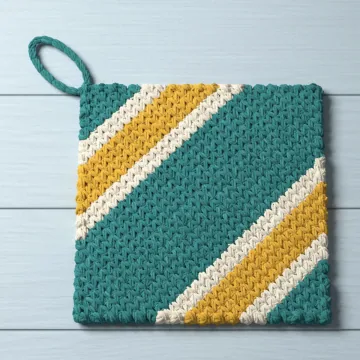
Often called the magic potholder. One flat pouch is worked round a chain, then flattened the other way: double-thick diagonal potholder, about 6¾ in (17 cm) square. Medium cotton, about 95 yd (87 m), an estimate, a 5 mm (H-8) hook, 14 stitches and 16 rounds to 4 in (10 cm). Ours has stripes. Here it is in one color.
1. Work round the chain
Chain 35. Single crochet in the second chain from the hook and in each to the end. Do not turn over: work one more in the last chain, on its other side, and go on along the under side of the chain. Both sides have 34.

2. Go round and round
Do not join and do not turn: round 2 begins in the first stitch of round 1. Put the marker in the first stitch of each round and work one stitch in each stitch. There are no more increases, so the sides turn up at once into a flat pouch. Count 68.
| What to work | Stitches | |
|---|---|---|
| Round 1 | One in the 2nd chain from the hook and in each chain, then one in each chain on the other side | 34 + 34 = 68 |
| Rounds 2 to 19 | One in each stitch | 68 |
3. Stop when the height is half the width
That is about round 19. Flatten the pouch, measure across and up: 9¾ in (25 cm) and 4¾ in (12 cm).
4. Fold it the other way
Take the hook out and put the marker through the loop. C and C in the picture are the ends of the chain. T and T are the ends of the mouth, straight above them. Open the mouth and bring T and T together over the middle. The pouch flattens into a square of two layers. The open edges meet in a line from corner to corner. If they gap, unfold it, put the hook back in the loop and work one round more. If they overlap, pull a round out. When it fits, slip stitch in the next stitch and fasten off.

5. Sew the diagonal
Weave the ends in on the inside. With a length of about 38 in (97 cm) whip stitch the edges, stitch to stitch, from corner to corner: about 34 stitches. At one end of the seam join the yarn and make a loop of 14 chains, as in way 1.
Another size
The chain, when it is laid straight, is the diagonal of the square: 1.41 times a side.
| Square | Length of the chain | Chains at 14 stitches to 4 in (10 cm) | Rounds, about |
|---|---|---|---|
| 5¾ in (14.5 cm) | 8 in (20 cm) | 29 | 16 |
| 6¾ in (17 cm) | 9¾ in (25 cm) | 35 | 19 |
| 8 in (20 cm) | 11½ in (29 cm) | 41 | 23 |
Way 3: thermal stitch
The top of a stitch is two loops. The back loop is the one farther from you. Each stitch here goes under two strands: that back loop, and the loop the row below left free, which lies just behind it. The fabric is twice as thick as single crochet. Use medium cotton, about 120 yd (110 m), an estimate, and a 5 mm (H-8) hook.

- Chain 29, for a square of about 8 in (20 cm) at 14 stitches to 4 in (10 cm). Row 1: single crochet in the second chain from the hook and in each chain, under one loop of the chain only, the back one: 28. The other loop stays free.
- Row 2: chain 1, turn, and work each stitch under the back loop and the free loop of the chain behind it.
- Every row after: chain 1, turn, and work under the back loop and the free loop of the row below, 28. The rows are short, so many are needed. Stop when the square is folded corner to corner and the edges meet: step 7 of the dishcloth shows the test.
- Last row: chain 1, turn, and work under both loops of the stitch and the free loop, three strands. Fasten off.
Thermal stitch has every move in pictures.
Way 4: a round hot pad
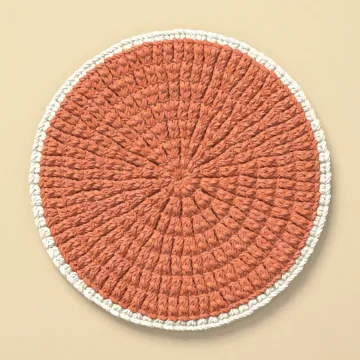
Two circles of 7 rounds, joined: round hot pad, about 8½ in (22 cm) across. Medium cotton, about 105 yd (96 m), an estimate, and a 5.5 mm (I-9) hook.
1. Work two circles
Each grows by 12 stitches a round. The chain 3 at the start of a round stands for its first stitch, and "same st" is the stitch it stands on. Do not turn. Fasten off each with a tail of 6 in (15 cm), and weave in the ends on the wrong side.
Foundation: Make a magic ring.
Rnd 1 (RS): Ch 3 (counts as dc), 11 dc in ring, sl st in top of ch-3 to join (12 dc).
Rnd 2: Ch 3 (counts as dc), dc in same st, 2 dc in each of next 11 sts, sl st in top of ch-3 to join (24 dc).
Rnd 3: Ch 3 (counts as dc), 2 dc in next st, [dc in next st, 2 dc in next st] 11 times, sl st in top of ch-3 to join (36 dc).
Rnd 4: Ch 3 (counts as dc), dc in same st, dc in next 2 sts, [2 dc in next st, dc in next 2 sts] 11 times, sl st in top of ch-3 to join (48 dc).
Rnd 5: Ch 3 (counts as dc), dc in next st, 2 dc in next st, dc in next st, [dc in next 2 sts, 2 dc in next st, dc in next st] 11 times, sl st in top of ch-3 to join (60 dc).
Rnd 6: Ch 3 (counts as dc), dc in same st, dc in next 4 sts, [2 dc in next st, dc in next 4 sts] 11 times, sl st in top of ch-3 to join (72 dc).
Rnd 7: Ch 3 (counts as dc), dc in next 2 sts, 2 dc in next st, dc in next 2 sts, [dc in next 3 sts, 2 dc in next st, dc in next 2 sts] 11 times, sl st in top of ch-3 to join (84 dc).
2. Join them
Hold them wrong sides together. Join the yarn with a slip stitch through a stitch of both, chain 1, and work one single crochet through both in each pair of stitches, the first in the same place: 84. Slip stitch in the first, and fasten off. For a loop chain 12 before you fasten off, and slip stitch in the same place.
In single crochet begin with 6 and grow by 6 a round: the round striped potholder has 16 rounds, to 96.
Finish the edge
- One round of single crochet through both layers, with three in each corner, closes and frames any square.
- A cord: reverse single crochet over it, chain 1, left to right.
- Thicker: hold two strands of cotton with a larger hook, or sew a third layer, a thin cotton cloth, inside before the last seam.
If it goes wrong
| What you see | Why | What to do |
|---|---|---|
| A hole at the end of the fold | The sewing began a row away from it | Take one stitch more, right at the fold |
| The folded strip is not square | Your rows are shorter or taller | Work until half of it is as tall as it is wide |
| The pouch gapes along the diagonal | Too few rounds | Unfold and work one more |
| The pouch overlaps | A round too many | Pull it out |
| The pouch leans | A spiral leans | Pull it square before you sew |
| The edge flutes | Too many stitches round it | One in each row end at most; pass over one in five |
| You can see light through it | Loose stitches | A hook one size smaller |
Questions people ask
How big should it be? 7 to 8 in (18 to 20 cm) square. A hot pad for a wide pot is larger: 8 to 9 in (20 to 23 cm).
Can it be acrylic? No. Acrylic can melt. Look at the label: a blend with acrylic, polyester or nylon is no good either.
Can I join two dishcloths? Yes, if they are cotton and match. Hold them wrong sides together and work one round of single crochet through both.
Which is the thickest? Ways 1 to 3 are about as thick as each other: two layers of single crochet, or a stitch twice as thick. Way 4 is two layers of a taller stitch, with gaps between the posts.
How do I wash it? As the label of the yarn says. Dry it all through before you use it again. Washing and care has the symbols.
I am left-handed. Work the same lines. Pictures 3 and 5 are then mirror images.
Where to go next
Print the simple solid potholder or the diagonal one, or choose among the potholders.