How to crochet shorts or underwear
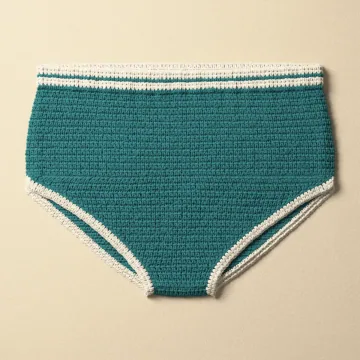
Yes, you can crochet underwear. Briefs are one flat piece that runs from the front of the waist, between the legs and up the back, with a seam at each side and elastic at the waist. Shorts and pants are worked from the waist down in rounds, or in flat pieces with a gusset. The briefs are written out below, then the others.
On this page
- Which pair, and how it is built
- Measure first
- Sizes of the briefs
- Before you start the briefs
- 1. Work the front straight
- 2. Shape the front of the legs
- 3. Work the crotch
- 4. Widen the back
- 5. Work the back straight
- 6. Line it while it is flat
- 7. Sew the side seams
- 8. Edge the legs
- 9. Work the casing
- 10. Put in the elastic
- Shorts in rounds
- A gusset
- Other kinds
- If it goes wrong
- Questions people ask
- Where to go next
Which pair, and how it is built
| You want | How it is built | Our pattern |
|---|---|---|
| Briefs, a full panty, a bikini bottom | One flat piece, two side seams, elastic at the waist | High waisted bottom, seven sizes |
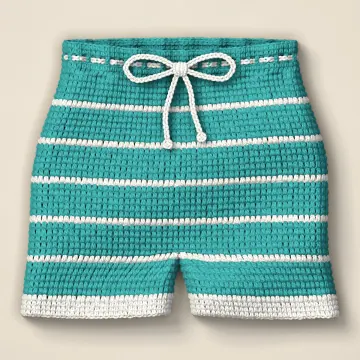
| Shorts with no seams | From the waist down in rounds, a chain across the crotch, then each leg | High waisted shorts, children's shorts |
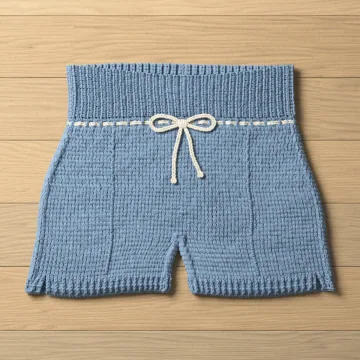
| Shorts or pajama pants with seams | Flat leg pieces, a square gusset, a drawstring or elastic | Men's shorts, men's lounge pants |
| Leggings | As shorts in rounds, with the back raised, a gusset and legs that narrow | Children's leggings |
| A bodysuit | A top that goes on down into briefs, with snaps at the crotch | Rompers close this way |
Measure first
| Measure | Where | What it sets |
|---|---|---|
| Waist | Where the top edge will sit | The elastic or the drawstring |
| Hips | Around the fullest part | The size |
| Rise | From the waist in front, under the crotch, to the waist at the back | How long the piece is. The back is the longer half |
| Thigh | Around the fullest part | The leg opening |
Close briefs finish 2 to 3 in (5 to 7.5 cm) smaller than the hips and stretch to them. Shorts and pants finish wider than the hips, by 1½ in (4 cm) up to 6½ in (16.5 cm) in our patterns.
Sizes of the briefs
| To fit: waist; hips | Chain, then stitches | Finished, around the hips | Front; back, waist to crotch | Each leg opening; elastic to cut for the waist |
|---|---|---|---|---|
| XS: 23½ in (59.5 cm); 33½ in (85 cm) | 64, then 63 | 31½ in (80 cm) | 12¾ in (32.5 cm); 15 in (38 cm) | 20½ in (52 cm); 22 in (56 cm) |
| S: 25¾ in (65.5 cm); 35½ in (90 cm) | 68, then 67 | 33½ in (85 cm) | 13 in (33 cm); 15¼ in (38.5 cm) | 21¼ in (54 cm); 25 in (63.5 cm) |
| M: 29 in (73.5 cm); 39 in (99 cm) | 74, then 73 | 36½ in (92.5 cm) | 13½ in (34.5 cm); 15½ in (39.5 cm) | 22¼ in (56.5 cm); 28 in (71 cm) |
| L: 33 in (84 cm); 43 in (109 cm) | 82, then 81 | 40½ in (103 cm) | 13½ in (34.5 cm); 15¾ in (40 cm) | 23½ in (59.5 cm); 32 in (81.5 cm) |
| 1X: 37 in (94 cm); 47 in (119.5 cm) | 90, then 89 | 44½ in (113 cm) | 14 in (35.5 cm); 16¼ in (41.5 cm) | 24¾ in (63 cm); 36 in (91.5 cm) |
| 2X: 41 in (104 cm); 52½ in (133.5 cm) | 100, then 99 | 49½ in (125.5 cm) | 14½ in (37 cm); 16¾ in (42.5 cm) | 27 in (68.5 cm); 40 in (101.5 cm) |
| 3X: 44½ in (113 cm); 54½ in (138.5 cm) | 104, then 103 | 51½ in (131 cm) | 14¾ in (37.5 cm); 16¾ in (42.5 cm) | 27¾ in (70.5 cm); 44 in (112 cm) |
Choose by the hips. The elastic, joined, is about 2 in (5 cm) shorter than the waist.
Before you start the briefs
Have: for size M about 400 yd (366 m) of light yarn (weight 3) in color A and 100 yd (91 m) in color B, by estimate; a 4.5 mm (US 7) hook; a yarn needle, scissors, pins; elastic ¾ in (2 cm) wide; a safety pin, sewing thread and needle; stretch fabric for a lining.
The yarn must be soft and must spring back. Cotton has little stretch of its own, so a cotton with a little elastic in it keeps its shape better. Yarn for clothes compares the fibers.
Gauge: 16 single crochet (double crochet in United Kingdom terms, UK from here on) and 18½ rows to 4 in (10 cm).
Know first: the chain, the single crochet, the slip stitch, and how to join a new yarn and fasten off.
The rows are those of our high waisted bottom, size M, word for word. In them sc is single crochet, ch chain, st stitch, Rnd round, sl st slip stitch, RS the right side, and sc2tog two single crochet worked together. The chain 1 at the start of a row or round is never a stitch. Every other size is written out in the pattern.

F is the waist in front, B the waist at the back, C the crotch, L a leg opening. The edges S will be the side seams. The numbers are rows. A dashed line crosses the piece after rows 25, 50, 64 and 100, where the shaping changes.
1. Work the front straight
With color A chain 74. Rows 1 to 25 go from the waist to the top of the leg.
- Row 1 (RS): Sc in 2nd ch from hook and in each ch across (73 sc).
- Rows 2 to 25: Ch 1, turn; sc in each st across (73 sc).
2. Shape the front of the legs
Rows 26 to 30 take off two stitches at each end, rows 31 to 50 one at each end.
- Rows 26 to 30: Ch 1, turn; sc2tog twice, sc in each st across to last 4 sts, sc2tog twice (53 sc).
- Rows 31 to 50: Ch 1, turn; sc2tog, sc in each st across to last 2 sts, sc2tog (13 sc).

Rows 24 to 33. All the numbers stand at this end, though even rows begin at the other.
The decrease, sc2tog: hook in the next stitch, pull up a loop; hook in the stitch after it, pull up a loop. Three loops are on the hook. Yarn over and pull through all three.

Count at row 30, 53 stitches, and at row 50, 13.
3. Work the crotch
Fourteen rows straight, about 3 in (7.5 cm). With its two edgings the crotch is 4 in (10 cm) across.
- Rows 51 to 64: Ch 1, turn; sc in each st across (13 sc).
4. Widen the back
An increase is two stitches in one stitch, here at each end of a row. The back widens over 36 rows, where the front narrowed over 25, so it is longer and covers more.
- Rows 65 to 89: Ch 1, turn; 2 sc in first st, sc in each st across to last st, 2 sc in last st (63 sc).
- Row 90: Ch 1, turn; sc in each st across (63 sc).
- Rows 91 to 100: Repeat Rows 89 and 90, 5 more times (65, 67, 69, 71, 73 sc at the ends of the repeats) (73 sc).
5. Work the back straight
- Rows 101 to 124: Ch 1, turn; sc in each st across (73 sc).
Row 124 is the waist at the back. Fasten off.
6. Line it while it is flat
Without a lining the fabric shows what is under it. Lay the piece, wrong side up, on stretch fabric, its greater stretch from side to side. Cut it ½ in (1.5 cm) larger all around. Turn under ¾ in (2 cm), snip the turned part where an edge curves inward, pin it one stitch in from every edge, and sew down the fold with small slanting stitches. Stretch the piece a little as you sew. Underwear may be lined at the crotch alone, in cotton jersey. See lining clothes.
7. Sew the side seams
Fold the piece at the crotch with the right side outward, so that row 124 lies behind the first chain. At each side, with a new length of yarn A of about 16 in (40 cm), sew rows 1 to 25 to rows 124 to 100 with mattress stitch: row 1 to row 124, row 2 to row 123, and so on, 25 row ends to 25.
8. Edge the legs
Right side facing, join color B in the end of row 26, the first row past the side seam, and chain 1. Work single crochet along the row ends, the hook under two threads at the side of the edge stitch, to row 99:
| Along rows | How many in a row end | Stitches |
|---|---|---|
| 26 to 30 | 2 in each | 10 |
| 31 to 50 | 1 in each of three, 2 in the fourth, five times | 25 |
| 51 to 64, the crotch | 3 rows, skip 1, 6 rows, skip 1, 3 rows | 12 |
| 65 to 99 | 1 in each of four, 2 in the fifth, seven times | 42 |
Join with a slip stitch: 89. That is round 1.
- Rnd 2: Ch 1; sc in each st around; join with sl st in first sc (89 sc).

J is where you join. This is the right leg, as worn. At the left leg join in the end of row 99 and go the other way, down the same numbers: 42, 12, 25, 10. Skipping two row ends at the crotch keeps it from waving.
9. Work the casing
A casing is a tunnel for elastic. Right side facing, join color B at the left side seam, as worn, in the first chain of the front, and chain 1. Work round 1 along the waist: one single crochet in each of the 73 chains, then one in each of the 73 stitches of row 124, 146 in all. Join with a slip stitch.
- Rnds 2 to 5: Ch 1; sc in each st around; join with sl st in first sc (146 sc).
- Rnd 6: Ch 1; sc in back loop only of each st around; join with sl st in first sc (146 sc).
- Rnds 7 to 10: Ch 1; sc in each st around; join with sl st in first sc (146 sc).
All ten rounds can be in color B. For the stripe of our pattern work round 3 in color A: change the yarn in the slip stitch that joins round 2, and change back in the one that joins round 3.
Fasten off with an end of about 94 in (240 cm) for sewing. Round 6, in the back loop, makes the line to fold on. Turn rounds 6 to 10 to the inside. Sew round 10 to the back of round 1, stitch to stitch, but leave 2 in (5 cm) open at the middle of the back.

The elastic lies between rounds 2 to 5 and rounds 7 to 10.
10. Put in the elastic
Cut 28 in (71 cm). Draw it through with a safety pin, lap the ends 1 in (2.5 cm) and pin them. Try it on. Then sew the ends firmly and close the casing.
Elastic in the legs goes on in one of two ways. Work the last round over a ring of thin elastic, or sew a soft flat elastic to the inside of the edge, stretched as you sew. One sewing teacher cuts it 2 in (5 cm) shorter than the edge and puts its join at the side seam. A sewing book lays it almost flat along the front of the leg and stretches it along the back.
Shorts in rounds
You chain the waist, join it in a ring and go straight down to the crotch; a chain across it divides the legs. No seam is sewn. The numbers are our children's shorts, size 6, for a waist of 22½ in (57 cm) and hips of 25 in (63.5 cm).
Have: light yarn (weight 3), about 350 yd (320 m) of color A and 105 yd (96 m) of B, by estimate, or 455 yd (416 m) of one color; a 4.5 mm (US 7) hook; a yarn needle. Gauge: 16 stitches and 13½ rounds of half double crochet (hdc; UK half treble) to 4 in (10 cm). One round is in double crochet (dc; UK treble). A ch-1 sp is the gap under one chain. A part in brackets is worked as often as the number after it says.
| Step | The sum | Size 6 |
|---|---|---|
| Around the hip | Hips plus 3 in, times 4 stitches | (25 + 3) × 4 = 112 |
| Chain at the waist, loose enough to go over the hips | 8 stitches fewer, added again in round 5 | 112 − 8 = 104 |
| Half of the hip round for each leg | Round divided by 2 | 56 |
| Crotch chain | 8 to 12 for children, 10 to 20 for women | 10 |
| Each leg | Half plus the chain | 56 + 10 = 66, 16½ in (42 cm) |
| Waist to crotch | Measured, with room to sit | 9½ in (24 cm) |
The body. With color A chain 104, loosely. Lay it flat, see that it is not twisted, and join it with a slip stitch in the first chain. The join is the middle of the back. Round 3 makes 52 holes for a cord and round 5 adds the 8 stitches.
- Rnd 1: Ch 1; sc in each ch around; join with sl st in first sc (104 sc).
- Rnd 2: Ch 1; sc in each st around; join with sl st in first sc (104 sc).
- Rnd 3: Ch 2; [dc in next st, ch 1, skip next st] 52 times; join with sl st in first dc (52 dc, 52 ch-1 sps).
- Rnd 4: Ch 1; [sc in next st, sc in next ch-1 sp] 52 times; join with sl st in first sc (104 sc).
- Rnd 5: Ch 1; [hdc in next 12 sts, 2 hdc in next st] 8 times; join with sl st in first hdc (112 hdc).
- Rnds 6 to 32: Ch 1; hdc in each st around; join with sl st in first hdc (112 hdc).
Fasten off. The pattern works rounds 10, 16, 22 and 28 in color B; one color does as well.
The legs.
- Find the middles. Lay the body flat. The join is the middle of the back. Count 57 stitches from it, the way you worked: stitch 57 is at the middle of the front.
- Make the crotch chain. Right side facing, join color A in stitch 57, chain 10, and slip stitch in the first stitch of the round, at the middle of the back. Do not twist the chain.
- Work round 1 of the first leg. Chain 1. Half double crochet in that same stitch and on to stitch 56, then in each of the 10 chains. Join with a slip stitch in the first: 66.
- Go on to the hem. Rounds 2 to 11 stand under this list. Then fasten off.
- Work the second leg. Join color A in stitch 57 again, chain 1, and work that stitch and the rest of the round, 56 in all, then the free side of the 10 chains. Join: 66. Then the same rounds 2 to 11. Close a small gap at the end of the crotch chain with a yarn end.
- Rnds 2 to 8: Ch 1; hdc in each st around; join with sl st in first hdc (66 hdc).
- Rnds 9 to 11: Ch 1; sc in each st around; join with sl st in first sc (66 sc).

F is the middle of the front, K the middle of the back. 1 and 2 are the legs.
The cord. With color B chain 196. Slip stitch in the second chain from the hook and in each chain back: about 42½ in (108 cm). Go in at hole 27 of the 52, counted from the join, from the outside, out at the next, and around until it comes out at hole 26. Knot each end and tie a bow.
Women's high waisted shorts have the same plan: 136 stitches below the waistband in size M, 164 at the hip, a chain of 12, and 94 stitches for each leg. The 28 are added in seven rounds, every second one: at each side, halfway between the middle of the back and the middle of the front, work two stitches in each of two stitches side by side. That makes four more in a round.
A gusset
A gusset is a small piece set in where seams meet, for room to move. In our men's shorts, size M, each leg is one flat rectangle of 93 stitches. Sew the inseams, then the front and the back seam, and leave 20 row ends of every edge open. That leaves a hole with four sides. The gusset is a square, 17 stitches by 20 rows, 4¼ in (11 cm). Pin its corners to the four seams first. Then whip stitch each of its sides to one edge of the hole. Two sides are row ends: sew row to row, 20 to 20. The other two, between them, are the starting chain and the last row, with 17 stitches: take about 7 row ends of the leg to every 6 stitches.

G is the gusset, F the front seam, K the back seam, I the inseams.
The back must be higher than the front: 1½ in (4 cm) in these shorts. Short rows, which turn before the end, add it across the back, just under the waistband. When the round at the waist is done (164 stitches here), work seven rows of single crochet on the back alone. Row 1 is 40 stitches, 20 on each side of the middle of the back. Each row after it begins with chain 1 and a turn, goes back over the row before and on into the next 7 stitches of the waist round: 82 in row 7. Then the waistband goes around over those 82 and the 82 that were left.
Other kinds
- Men's underwear. Go by the hips, as above. For more depth in front, work 4 or 5 plain rows more for each 1 in (2.5 cm), spread among rows 31 to 50. The side seams still match. Each leg edge gets one stitch more for every row you add, in the part that has 25. It needs no opening in front: bought pairs come with one and without. For a swim brief line the front. For a looser pair take the men's shorts.
- Pajama pants. Straight legs, wide at the hip: our lounge pants are 3½ to 4½ in (9 to 11.5 cm) wider than the hips, with elastic or a cord at the waist.
- Leggings. Close at the hip and narrower to the ankle. Our children's pair, for hips of 25 in (63.5 cm), goes from 15¼ in (38.5 cm) at the top of the leg to 8½ in (21.5 cm) at the ankle.
- Lace pants or shorts. Use the plan of shorts in rounds with a mesh or lace stitch: the inches stay, and your own lace gauge gives the stitches. Line the top, or wear them over plain shorts or a swimsuit.
- A bodysuit. Work a close top down to the waist. Go on with the briefs from the front edge and from the back edge, and let the two ends overlap at the crotch. Sew snaps on after it has been tried on.
- A corset. A crocheted one is for looks. Cloth corsets are firm because the cloth does not stretch and bones stand in channels. For a sturdy crocheted one use a tight single crochet in cotton, in panels a little smaller than the body, and lace it, as on our corset belt.
If it goes wrong
| What you see | Why | What to do |
|---|---|---|
| It rides up at the leg | The back is too narrow, or the leg edge too loose | More increase rows at the back; a smaller hook for the edge |
| The leg edge bites | Too few stitches along the row ends, or tight elastic | 1 more in every fifth row; longer elastic |
| The leg edge waves | Too many stitches | Skip a row end here and there |
| The back is too low when you sit | Too few rows at the back | 4 or 5 plain rows more for each 1 in (2.5 cm), spread among rows 65 to 100 |
| Shorts pull at the crotch | The crotch chain or the rise is short | A longer chain, 2 more rounds before it, or a gusset |
| It slides down | The elastic is too long | Take it in at the gap you left |
| It sags in the water | Cotton takes up water and grows longer | Yarn with elastic in it, a lining; dry it flat |
Questions people ask
Can you crochet panties without elastic? Yes, with a cord through a round of holes in place of the casing, or with ties at the sides, as on our string tie bottom.
How do I make the rise longer? Add the same number of rows to the front and the back, above the leg, so that the side seams still match.
Where to go next
Print the high waisted bottom in your size, or see all the shorts, pants, leggings and bikini bottoms. A bra cup makes the top of the set. Changing a pattern's size goes with your own sums.