Overlay crochet
Overlay crochet makes a plain disk of single crochet (UK double crochet) and, in the same rounds, long stitches that lie on top of it as raised lines. The plain stitches go in the back loops; the long ones reach down to a front loop or a post of an earlier round. A four-color coaster below shows every step.
On this page
- How overlay crochet works
- The long stitches of the coaster
- What to get for the coaster
- Overlay coaster, round by round
- What you should see after each round
- Where each long stitch goes and what is left
- How a larger mandala grows from it
- What goes wrong
- Overlay, mosaic, spike and surface crochet
- Questions people ask
| Question | Short answer |
|---|---|
| What does it look like? | Raised lines, V shapes and petals lying over rings of other colors |
| What do I need to know? | Single crochet, double and treble crochet (UK treble and double treble), front and back loops, front post stitches |
| What do I need to have? | Smooth yarn in colors that contrast, a hook, scissors, a yarn needle |
| Do I turn the work? | No. The right side faces you in every round |
| Are the lines put on afterward? | No. They are made in the same rounds as the plain ground under them |
How overlay crochet works
- The ground goes in the back loops. Every plain single crochet is worked in the back loop only, so the front loops stay empty on the front.
- The lines reach down. A long stitch, most often a double or treble crochet, goes into one of those empty front loops, or round the post (the upright part) of a long stitch made earlier. It lies in front of the rounds between.
- The stitch behind is skipped. The long stitch takes the place of a stitch in your round. The one hidden behind it is not worked.
The color usually changes in every round, and each round uses one color alone. Long stitches of later rounds cross the rings below, so the piece looks as if the color changed every few stitches.
"Two rounds down" counts from the round in hand. Plain stitches go one round down. So in Round 5, two rounds down is Round 3. This page names the round by its number.
The long stitches of the coaster
| Short | Name | Where the hook goes | Then |
|---|---|---|---|
| FLdc | front loop double crochet (UK front loop treble) | Yarn over once; hook under the front loop of the stitch named | Finish as a double crochet |
| FPdc | front post double crochet (UK front post treble) | Yarn over once; round the post of the stitch named, from the front, behind it and out to the front | Finish as a double crochet |
| FPtr | front post treble crochet (UK front post double treble) | Yarn over twice; round the post in the same way | Finish as a treble crochet |
- Draw the first loop up long. Pull it level with the top of the round you are in before you finish the stitch. Then it lies flat and does not gather the rounds.
- Up or down through the front loop? Teachers differ: some put the hook in from below, pointing up, and others from above, pointing down. Choose one and keep to it.
- Post of a long stitch. It lies on the front. Take the hook behind its upper part, between it and the ground. The hook never goes through the ground.
What to get for the coaster
- Yarn: small amounts of medium (weight 4) smooth yarn in four colors that contrast, such as A navy, B cream, C gold, D teal. Cotton suits a coaster.
- Hook: 5.5 mm (I-9), or the one that gives you a close disk that lies flat.
- Size: about 4½ in (11.5 cm) across, worked out from 13 single crochet and 15 rounds to 4 in (10 cm).
How to change color. Start each new color with a standing single crochet in the back loop of the stitch named. It is the first single crochet of the round and counts as one. At the end, cut the yarn and close the round with an invisible join: with a yarn needle, skip the first stitch of the round, go under both loops of the next, and go back down into the back loop of the last. Leave this sewn loop as large as the stitch tops beside it.
How to work into the sewn loop. It covers the first stitch and takes its place, so the two count as one stitch. It has a front and a back strand like any other top.
- Where the next round has an sc there, put the hook under the back strand of the sewn loop. Leave the loops of the covered stitch alone.
- Where the next round skips that stitch, skip both as one.
- No long stitch of this coaster goes into a covered stitch. In a piece of your own, start each round at a stitch whose front loop and post you will not need.
Overlay coaster, round by round
United States terms: sc is single crochet, ch is chain, st is stitch, sk is skip, rnd is round. Every sc from Rnd 2 on goes in the back loop only, also in the top of a long stitch. Do not turn. "Join" is the invisible join. Work what stands in brackets six times: its first sc goes in the stitch where the round starts. Round 1 begins in a magic ring.
Rnd 1 (A): In a magic ring, 6 sc; slip stitch in first sc (6).
Rnd 2 (A): Ch 1 (not a st); beginning in the same st, 2 sc in each
st around; cut, invisible join (12).
Rnd 3 (B): Start in the 2nd st of any pair of Rnd 2.
[Sc in next st, 2 sc in next st] 6 times; join (18).
Rnd 4 (C): Start in the first of any 2 sc that share one st.
[Sc in next st, 2 sc in next st, FLdc in the Rnd 2 st that the
next st stands on, sk that next st] 6 times; join
(18 sc, 6 FLdc = 24).
Rnd 5 (D): Start in the top of any FLdc.
[Sc in FLdc, sc in next st, FLdc in each of the next 2 open front
loops of Rnd 3, sk 1 st, sc in next st] 6 times; join
(18 sc, 12 FLdc = 30).
Rnd 6 (C): Start in the first of any 2 FLdc side by side.
[Sc in first FLdc, 2 sc in second FLdc, FPtr round the next Rnd 4
FLdc, sk 1 st, sc in next st, FPtr round the same Rnd 4 FLdc,
sk 1 st] 6 times; join (24 sc, 12 FPtr = 36).
Rnd 7 (D): Start in the first FPtr of any two that share one post.
[Sc in next 4 sts, FPdc round each of the next 2 FLdc of Rnd 5,
sk 1 st, sc in next st] 6 times; join
(30 sc, 12 FPdc = 42).
Rnd 8 (A): Between two pairs of FPdc are 5 sc. Start in the 4th.
[Sc in next 3 sts, 2 sc in next st, sc in next 2 sts, FLdc in the
Rnd 6 sc between the two FPtr of the V below, sk 1 st] 6 times; join
(42 sc, 6 FLdc = 48).
Weave in the ends on the back, and block the coaster flat.
What you should see after each round
| Round | Color | In one sixth, in order | Count | On the front |
|---|---|---|---|---|
| 1 | A | 1 sc | 6 | A small disk |
| 2 | A | 2 sc | 12 | A ring of open front loops in Rnd 1 |
| 3 | B | 1 + 2 sc | 18 | A ring of B, about 1½ in (4 cm) across |
| 4 | C | 3 sc, 1 FLdc | 24 | Six spokes of C cross the ring of B |
| 5 | D | 2 sc, 2 FLdc, 1 sc | 30 | Two bars of D between each two spokes cross the ring of C |
| 6 | C | 3 sc, FPtr, sc, FPtr | 36 | A V of C grows from each spoke, across the ring of D |
| 7 | D | 4 sc, 2 FPdc, 1 sc | 42 | The bars of D run on over the ring of C |
| 8 | A | 7 sc, 1 FLdc | 48 | One bar of A stands in each V, in a frame of A |
The long stitches go only through loops and posts that lie on the front. So the back shows rings of color and no lines.
Where each long stitch goes and what is left
- Round 4. Each sixth of Round 3 is two sc that share a stitch and one that stands alone. The lone one is skipped: the FLdc goes in the front loop of the Round 2 stitch under it.
- Round 5. Between two spokes, two front loops of Round 3 are in plain sight. Put one FLdc in each; the loop behind a spoke is not used. The two cover one stitch of Round 4, so skip one.
- Round 6. Between two pairs of D bars are three plain sc. Work the middle one, which stands on the spoke. Skip the one on each side: an FPtr lies over it. Both FPtr go round that spoke.
- Round 7. The two FPdc go round the two bars of Round 5 and again cover one stitch.
- Round 8. The sc between the arms of a V in Round 6 has an open front loop. Skip the stitch that stands on it.
In Rounds 5 and 7, two long stitches with one skip are the increase. So the number skipped is not always the number of long stitches.
How a larger mandala grows from it
Each round goes on adding six stitches, one in every sixth. A plain round may stand between. Round 9, if plain, is [sc in next 7 sts, 2 sc in next st] 6 times (54).
| Rounds | Stitches in the last | Across, about, in this yarn |
|---|---|---|
| 8 | 48 | 4½ in (11.5 cm) |
| 12 | 72 | 6¾ in (17 cm) |
| 16 | 96 | 9 in (23 cm) |
The widths are estimates from the gauge above. To lay lines of your own, make a long stitch and leave one plain stitch of the last round unworked. Base here is an FLdc made two rounds ago; base top is the sc of the last round that stands on it.
| Line | What to work | What to skip |
|---|---|---|
| Straight outward, to begin | FLdc in the front loop two rounds down, straight below the stitch you have come to | The stitch you have come to |
| A spot | A cluster in that same front loop, in place of the FLdc | The stitch you have come to |
| Straight outward, to go on | FPdc round the post of the base | The base top |
| Slanting, upper end before the base top | FPtr round the post of the base, then go on from the base top | The one stitch before the base top |
| Slanting, upper end after the base top | Sc in the base top, then FPtr round the post of the base | The one stitch after the base top |
| A V | Both slanting lines, with one sc in the base top between them, as in Round 6 | One stitch on each side |
A slanting line runs farther than a straight one, so it needs the taller FPtr.
Where the lines gave no extra stitch, put 2 sc in one stitch of each sixth. The circle chart has the counts.
Overlay is worked in rows too: see rows without turning. Overlay makes pillow covers and bags as well as mandalas. To hang a round one, see mandalas in a hoop.
What goes wrong
| What you see | Why | What to do |
|---|---|---|
| No front loop where you need one | A single crochet went through both loops | Take the work out to that stitch and use the back loop |
| The edge turns up like a bowl | Long stitches pulled short, or an increase missed | Draw the long loops up level with the round; count each sixth |
| The edge ruffles | Too many stitches: a stitch behind a long one was worked | Find the sixth that has one too many, take the round out to there, and skip that stitch |
| Hard to see where to go | Many open loops | Put a marker in each loop you will need two rounds later |
| Many tails | A new color in each round | Work two rounds in one color, or weave in as you go |
Overlay, mosaic, spike and surface crochet
Overlay mosaic has the same ground and the same front loops, with long stitches placed by a chart and one color a row. A spike stitch goes through the fabric, and its long loop wraps the rows it passes. Surface crochet is worked on a fabric that is already finished.
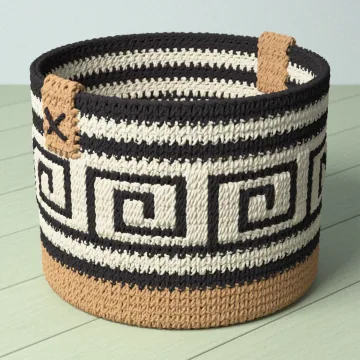
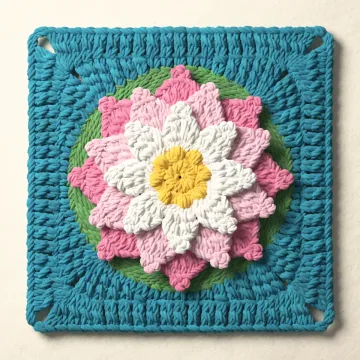
Patterns here that use parts of it: the Greek key mosaic basket has back loop rounds with double crochet dropped into the free loops two rounds down, and the water lily square has petals worked into front loops.
Questions people ask
Is overlay crochet hard? The stitches are ordinary ones. The care goes into reading: which round, which loop, how many to skip. Try a flat circle and a front post treble first.